The Time Traveller's Dossier : Victor Red Seal - The Commodification of Genius
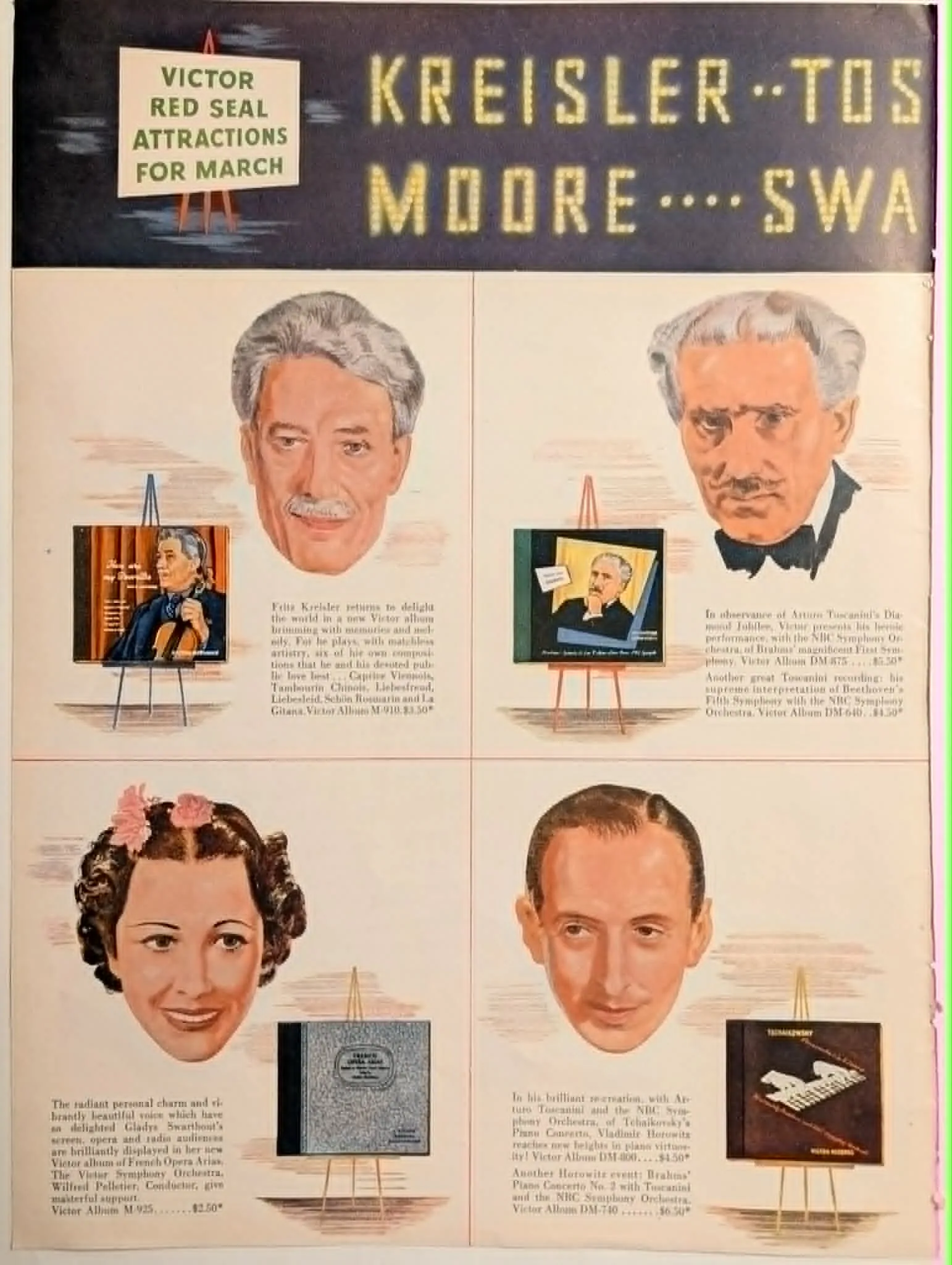
Before the groove. Before the shellac. Genius was a ghost. It lived only in the moment of its execution. You had to be there. In the gilded hall. In the right city. With the right wealth. Then came the capture. The pressing. The Victor Red Seal. This dossier examines a specific moment in 1942. March. A catalogue of captured time. Four titans of the stage. Frozen. Packaged. Priced. It was not merely commerce. It was the industrialization of the sublime. The shift is absolute and irrevocable. The concert hall collapsed into the domestic living room. Art was no longer an ephemeral event. It was physical inventory. This artifact from RCA Victor is a window into the exact moment when the world’s greatest talents were transformed into household commodities. The ephemeral became the permanent.
Category: Entertainment
The History
The Geography of Sound and The Void We must first understand the void that existed before the mass distribution of audio recordings. For centuries, human music was inextricably linked to physical space. To hear Arturo Toscanini conduct a symphony, you required geographic proximity. You required a physical ticket. You needed a tailored suit. You needed a specific social standing to access the auditorium. The music existed only as long as the acoustic vibrations held in the air of the hall. Then, it returned to silence. It was an elite, localized phenomenon. The invention of the phonograph began to fracture this reality, but early acoustic recordings were faint. They were thin shadows of the real performance. By the time this advertisement was printed—1942, celebrating the Diamond Jubilee of Toscanini—the world had shifted fundamentally. Electrical recording, introduced in the mid-1920s, had matured into a sophisticated science. The microphone had replaced the acoustic horn. Dynamic range expanded exponentially. The subtle, resinous bite of Fritz Kreisler’s bow against catgut could finally be captured. The thunderous, percussive weight of Vladimir Horowitz’s Steinway grand piano could be pressed into a groove. The Victor Red Seal label was born to signify the absolute apex of this technology. It was not merely a record label. It was a cultural institution. It was a badge of sophisticated intellect for the upwardly mobile middle class. The crimson center label signaled that you were not just listening to a song; you were bearing witness to a historical masterclass. The Architecture of the Album Observe the pricing structure embedded within the copy. $2.50. $4.50. $6.50. In 1942, during the severe economic throes of the Second World War, these were not casual or impulsive purchases. Adjusted for inflation, Victor Album DM-740—featuring Horowitz playing Brahms—at $6.50 would cost well over a hundred modern dollars. This was a substantial capital investment. Furthermore, the term "album" itself originates from this specific era and format. Because a heavy, 78 RPM shellac record could only hold approximately four to five minutes of audio per side, a complete classical symphony required multiple discs. These fragile discs were bound together in heavy, leather-like spines. They were blank books filled with heavy paper sleeves, visually identical to family photo albums. Hence, the "record album." Victor did not just sell the discs; they sold the physical weight of high culture. The wooden easels depicted in this advertisement are not accidental design choices. The miniature albums are displayed as if they are classical oil paintings. Victor was instructing the consumer: You are not buying plastic and shellac. You are curating a private, domestic gallery of ultimate human achievement. The physical object demanded profound respect. It required careful handling. The dropping of the steel needle into the groove was a sacred domestic ritual. The Typology of the Virtuoso The advertisement meticulously selects four specific human archetypes to blanket the cultural market. First, Fritz Kreisler. He is the warm, nostalgic romantic. His album, M-910, features his own compositions. Caprice Viennois. Liebesfreud. These were the sonic signatures of old Europe. A refined Europe that, in the spring of 1942, was currently burning and fracturing under global conflict. Kreisler offered a psychological escape to a world of Viennese cafes that no longer existed. Then, we see Arturo Toscanini. The strict disciplinarian. The maestro. His face in this rendering is cast in intense, dramatic shadow. He glares directly at the viewer. He represents absolute authority. Unyielding perfection. His Diamond Jubilee—his 75th year—is weaponized by the copywriters as an event of supreme historical weight. To own his interpretation of Beethoven’s Fifth Symphony was to own the definitive text of human struggle and triumph. Gladys Swarthout provides the accessible, radiant glamour. She bridges the widening gap between the rigid, traditional concert hall and the modern cinematic screen. Her "French Opera Arias" offer vocal warmth and humanity. She represents the biological instrument at its peak. Finally, Vladimir Horowitz. The technician. The raw, terrifying force of nature. His rendering of Tchaikovsky’s Piano Concerto with Toscanini was already legendary. Victor effectively captures all four quadrants of the listener's psyche: Nostalgia, Authority, Beauty, and Power. The Standardization of Interpretation This artifact documents a fundamental cognitive shift in human history. Before the mass distribution of the Red Seal records, every single performance of a symphony was localized, unique, and subject to organic variation. A listener in New York heard a vastly different Brahms First Symphony than a listener in London or Berlin. The mass-produced recording changed this dynamic forever. It standardized the interpretation. Toscanini’s specific tempo choices, his aggressive attacks, his precise balancing of the NBC Symphony Orchestra, became permanently etched into the master lacquer. For millions of listeners across the globe, this specific recording did not just represent a performance of Beethoven’s Fifth. It became the definitive baseline. It became the singular truth against which all future performances would be inevitably judged. This highlights the immense, unseen power of the RCA Victor corporate enterprise. They did not merely record musical history; they dictated its future parameters. They centralized the definition of musical perfection. The ghost of the live performance was no longer transient. It was trapped in a spiral groove, spinning at exactly 78 revolutions per minute, sounding identical in a thousand different living rooms simultaneously. The Mechanical Prefixes and the Automation of Art A critical technical detail lies in the album prefixes: 'M' and 'DM'. Kreisler and Swarthout's albums are listed as M-910 and M-925. Toscanini and Horowitz bear the DM prefix (DM-875, DM-640). This represents a distinct evolution in consumer technology. 'M' stood for Manual sequence. Sides 1 and 2 were on the first disc, 3 and 4 on the second. The listener had to manually flip each heavy disc every four minutes. 'DM' stood for Drop-Automatic. The sequence was pressed specifically for automatic record changers (Sides 1 and 8 on the first disc, 2 and 7 on the second). You stacked the entire symphony on a towering spindle, and the machine dropped them in sequence. The 'DM' format allowed for an uninterrupted twenty minutes of classical immersion. It was the dawn of passive listening. The machine took over the labor, allowing the listener to recline. This technical nuance embedded in the advertisement marks the transition from active musical engagement to automated, continuous consumption. The Economics of the Shellac War We must also view this artifact through the harsh lens of macroeconomics and global supply chains. 1942 is a critical pivot in modern history. The United States had recently entered World War II. Shellac, the primary raw material utilized to press these 78 RPM records, was a resin secreted by the lac bug, sourced primarily from Southeast Asia. With critical maritime supply lines disrupted by the Pacific theater of war, shellac became a highly restricted, heavily rationed material. Record companies were eventually forced to halt production or ask civilians to donate old records to be melted down into new ones. Therefore, these heavy, multi-disc RCA albums were profound luxury goods produced in an era of extreme, impending scarcity. Yet, the advertisement deliberately does not mention the war. It ignores the rationing. It presents a stoic facade of uninterrupted cultural supremacy. It sells a sense of permanence in an era defined by mass destruction. The Red Seal became a psychological anchor for the consumer. When the external geopolitical world is chaotic and unpredictable, the internal world—the domestic living room illuminated by the warm glow of a vacuum tube amplifier—must remain ordered, beautiful, and eternal. This single page of printed matter carries the invisible weight of all these intersecting forces. It is a precise map of human desire, technological capability, and corporate strategy.
The Paper
This artifact speaks profoundly through its physical decay. It is printed on standard mid-century magazine stock, likely an 80 to 90 GSM coated paper. The clay coating was an engineering necessity, required to hold the dense ink of the halftone printing process without bleeding. Observe the CMYK dot patterns under close magnification. In an era long before digital color correction and automated prepress, the separation of cyan, magenta, yellow, and black required immense manual precision by skilled lithographers. The flesh tones of Toscanini and Horowitz are built from meticulous, microscopic grids of magenta and yellow. Over eight decades, the paper has predictably oxidized. The edges turn a brittle yellow. The lignin embedded in the wood pulp reacts slowly with ambient ultraviolet light and atmospheric oxygen. Yet, the ink remains resolute and highly saturated. The tactile nature of this page—brittle to the touch, slightly textured, carrying the faint olfactory signature of dry dust and old binding glue—reinforces its status as a survivor of the 20th century. It is a highly delicate membrane that has successfully carried a complex commercial and cultural message across eighty-four years of turbulent history. The physical medium ages and degrades, but the structural data it holds remains frozen.
The Rarity
Classification: Class A - The Cultural Time Capsule. While vintage magazine advertisements from the early 1940s are not inherently rare in raw numerical volume, this specific alignment of subjects significantly elevates its archival status. Finding a single, pristine document that simultaneously promotes Kreisler, Toscanini, Swarthout, and Horowitz at the absolute zenith of the shellac era is uncommon. Its core value is not monetary; it is deeply contextual. It serves as a primary source document for the serious study of 20th-century musicology, audio engineering marketing, and the economic structure of the RCA Victor empire. It is a crystalline record of the recording industry’s golden age, just before the invention of the microgroove vinyl LP altered the landscape forever.
Cite this article
- MLA
- Naodhinsuk, Ronin. “The Time Traveller's Dossier : Victor Red Seal - The Commodification of Genius.” The Record Institute, 5 July 2026, https://therecord.institute/journal/the-time-travellers-dossier-victor-red-seal-the-commodification-of-genius.
- APA
- Naodhinsuk, R. (2026, July 5). The Time Traveller's Dossier : Victor Red Seal - The Commodification of Genius. The Record Institute. https://therecord.institute/journal/the-time-travellers-dossier-victor-red-seal-the-commodification-of-genius
- CHICAGO
- Naodhinsuk, Ronin. 2026. “The Time Traveller's Dossier : Victor Red Seal - The Commodification of Genius.” The Record Institute, July 5, 2026. https://therecord.institute/journal/the-time-travellers-dossier-victor-red-seal-the-commodification-of-genius.