The Time Traveller's Dossier : VW Scirocco - The Democratization of Velocity
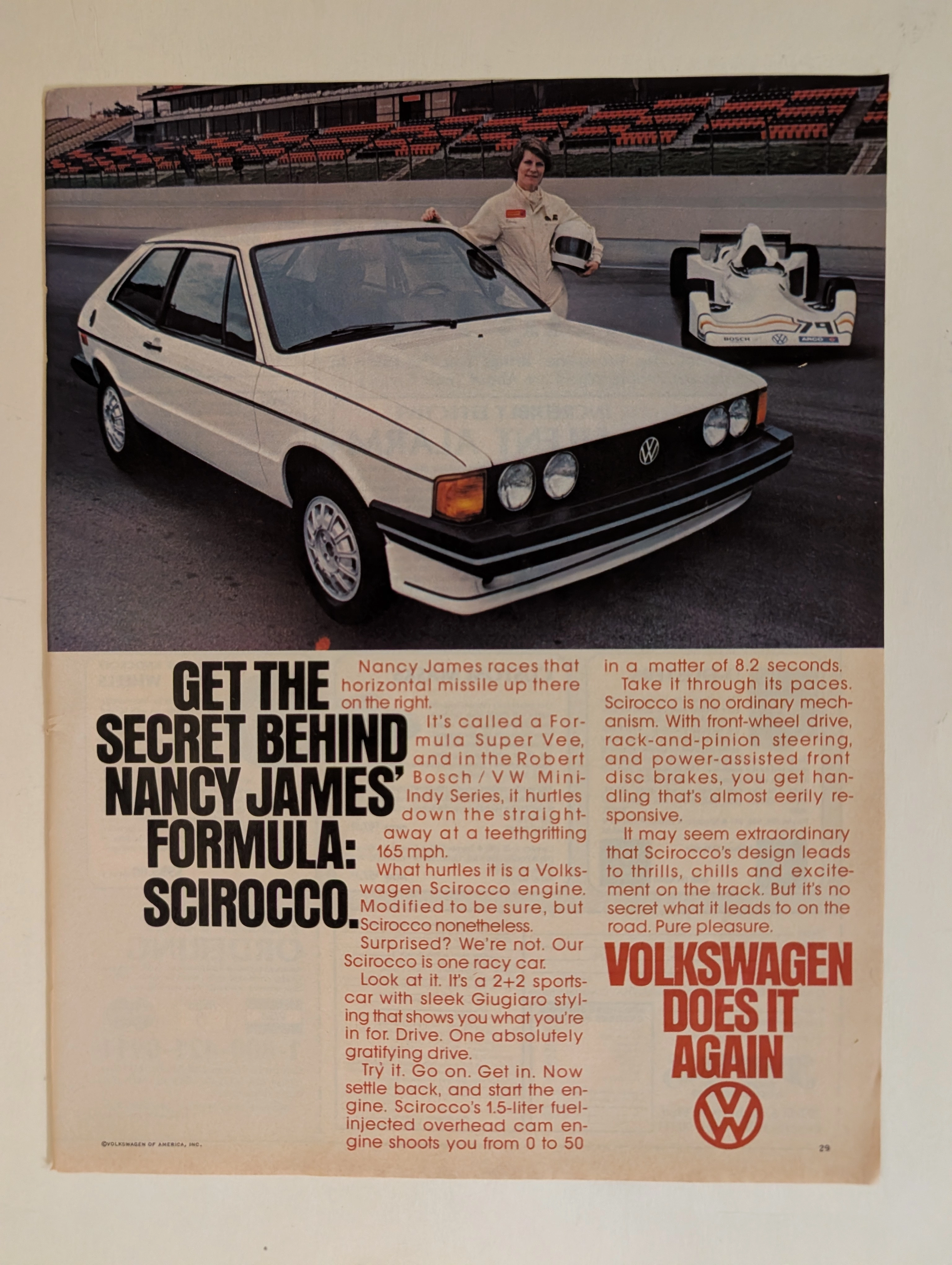
We measure automotive history by the architectures that define it. For decades, the global standard for accessible mobility was curved, air-cooled, and rear-engined. The Volkswagen Beetle was an institution of utilitarian survival. But by the mid-1970s, survival was no longer sufficient. The world demanded forward momentum. The global fuel crisis of 1973 had altered the economic atmosphere. The American muscle car was dying under the weight of its own inefficiency. The Japanese imports were rewriting the rules of reliability. Volkswagen faced an existential precipice. Their solution was a violent pivot in engineering philosophy. This artifact documents that exact, definitive rupture in their timeline. It is not merely a car advertisement. It is a public declaration that the era of the air-cooled curved line was dead. The problem was an aging product line trapped in an obsolete paradigm. The solution was a water-cooled, front-wheel-drive wedge, validated on the racetrack and sold to the public.
The History
The Crisis of the Curved Line The year is the late 1970s. The theater is the American automotive market. Volkswagen of America was in a precarious transitional phase. The Beetle, the vehicle that had built their empire, had become a mechanical anachronism. Its rear-mounted, air-cooled engine could no longer meet tightening emissions standards. Its handling dynamics were antiquated. Its cabin space was compromised by its iconic, yet restrictive, geometry. To survive, Volkswagen had to completely invert their own engineering DNA. They moved the engine from the rear to the front. They shifted from air-cooling to water-cooling. They transitioned from rear-wheel drive to front-wheel drive. This was the EA337 project, which would eventually birth the Golf, known in America as the Rabbit. However, a revolution requires a vanguard. Volkswagen needed a vehicle to prove that this new front-wheel-drive architecture was not just practical, but capable of high performance. They needed a halo car to shift the public perception before the mass-market hatchback arrived. That vanguard was the Scirocco. Named after a fierce Mediterranean wind, it was designed to blow the old perceptions away. The Architecture of the Wedge To signal a complete break from the past, Volkswagen outsourced the aesthetic language. They turned to the Italian design house Italdesign, helmed by Giorgetto Giugiaro. Giugiaro was the master of the "folded paper" era of automotive design. He rejected the organic, bulbous curves of the 1950s and 1960s. He embraced sharp angles, flat planes, and aggressive geometric proportions. The Scirocco was a masterpiece of this philosophy. It was a 2+2 sports coupe with a sleek, aerodynamic wedge profile. This artifact explicitly highlights this origin, stating: "Look at it. It’s a 2+2 sports car with sleek Giugiaro styling." This was a critical marketing tactic. Volkswagen was explicitly associating its German engineering with elite Italian design. It was a promise to the consumer: you are not buying an economy car; you are buying a piece of accessible European exoticism. The wedge shape was not merely aesthetic; it was functional. It cut through the air with far greater efficiency than the upright stance of its predecessors. It represented a shift toward aerodynamic optimization, a necessary evolution in an era defined by fuel scarcity. The Super Vee Crucible The core narrative of this artifact revolves around the transfer of technology from the racetrack to the driveway. The copy introduces the "Robert Bosch / VW Mini-Indy Series." This was a critical component of Volkswagen's marketing strategy. Formula Vee had existed for years, utilizing old Beetle components to create an affordable entry-level racing series. But Formula Super Vee was the evolution. It utilized the new, water-cooled, inline four-cylinder engines that powered the Scirocco and the Rabbit. The logic was brutal and effective. If a modified 1.5-liter Scirocco engine could hurl a Formula Super Vee down a straightaway at 165 mph, then the factory version was over-engineered for the American highway. The race track served as the ultimate crucible for the new mechanical architecture. It proved the durability of the water-cooled block. It proved the efficiency of the overhead cam design. Most importantly, it proved the precision of the Bosch fuel injection system. Before this era, fuel injection was largely reserved for high-end sports cars or aircraft. The Scirocco democratized the Bosch K-Jetronic continuous fuel injection system. It replaced the imprecise carburetor with a mechanism that measured air and metered fuel with clinical exactitude. The artifact leverages the extremity of the 165 mph race car to validate the 8.2-second 0-to-50 mph acceleration of the street car. It is the translation of race-day violence into everyday reliability. The Authority of Nancy James The most profound cultural shift documented in this artifact is the central figure. The expert validating this machinery is Nancy James. In the automotive advertising landscape of the 1970s, female representation was rigidly stereotyped. Women were typically positioned as passengers. They were often utilized as aesthetic accessories, draped over hoods to sell the car to a male demographic. If they were depicted driving, it was usually to highlight the vehicle's ease of parking or its capacity for groceries. This artifact violently shatters that convention. Nancy James is not an accessory. She is a pilot. She stands between the consumer vehicle and the horizontal missile of the Formula Super Vee. She wears a Nomex racing suit. She holds a crash helmet. She is presented as an authority on velocity, mechanical grip, and performance. The copy reads: "Nancy James races that horizontal missile up there on the right." The advertisement does not qualify her presence. It does not lean on the novelty of her gender. It presents her as a professional driver evaluating a machine. This represents a monumental shift in marketing demographics. It acknowledges the female consumer not merely as a practical purchaser, but as an enthusiast capable of desiring "thrills, chills and excitement on the track." It is a quiet but firm dismantling of the patriarchal monopoly on automotive performance. The Mechanical Translation The text meticulously details the mechanical specifications that defined this new era. It lists "front-wheel drive, rack-and-pinion steering, and power-assisted front disc brakes." Today, these are standard components on the cheapest economy cars. In the late 1970s, pulling them together into an affordable sports coupe was revolutionary. Front-wheel drive allowed for better packaging. By placing the engine and transmission over the driven wheels, interior space was maximized, and traction in adverse weather was vastly improved. Rack-and-pinion steering replaced the vague, wandering steering boxes of the past with direct, tactile feedback from the road surface. Power-assisted front disc brakes replaced fade-prone drum brakes, providing the stopping power necessary to match the newly injected acceleration. The artifact describes the handling as "almost eerily responsive." This was the shift. The car was no longer just a vessel for transportation. It was an extension of the driver's intent. The Scirocco engineered a shift in expectation. The middle-class consumer could now demand the mechanical sophistication previously reserved for the wealthy. The slogan "VOLKSWAGEN DOES IT AGAIN" is a bold claim. It implies that the transition from the air-cooled Beetle to the water-cooled Scirocco was just as significant as the creation of the original people's car.
The Paper
Material Context: This artifact is printed on standard web offset magazine paper, characteristic of mass-circulation American periodicals from the late 1970s to early 1980s. The paper is relatively thin, estimated at 50 to 60 GSM. Unlike the heavy, clay-coated luxury stock of the 1950s, this paper was engineered for high-speed rotary presses and immense print runs. Printing Pathology: The image is rendered using a standard four-color (CMYK) halftone process. Upon macro inspection, the rosette patterns of the ink dots are clearly visible, particularly in the subtle gradients of the sky and the white paint of the vehicles. The registration is functional but exhibits the slight tolerances typical of mass-market printing. The stark red ink used for the typography and the Volkswagen logo at the bottom shows signs of minor saturation bleed into the porous paper fiber. Chronological Markers: The physical degradation of the page serves as a timeline. The edges of the artifact display mild oxidation, a yellowing process caused by the breakdown of lignin within the wood pulp when exposed to ultraviolet light and oxygen. The texture has become slightly brittle, losing the suppleness it possessed when it first rolled off the press. The physical fragility of the paper contrasts sharply with the durable, mechanical message printed upon it.
The Rarity
Classification: Class A (High Cultural Documentation) Vintage automotive advertisements from this era are generally common due to the massive circulation of magazines like Car and Driver, Motor Trend, and Road & Track. However, this specific artifact elevates itself from standard commercial ephemera due to its specific intersection of historical elements. It is an artifact documenting Volkswagen's critical transition to water-cooled, front-wheel-drive architecture. It is an artifact featuring the specific Robert Bosch / VW Mini-Indy Series. Most importantly, it is a rare artifact of late 1970s advertising that positions a female racing driver as the authoritative voice on high-performance mechanical engineering. Its value is not found in the scarcity of its material, but in the density of its sociological and industrial context. It is a primary source document capturing a pivotal moment in automotive evolution and cultural marketing.
Cite this article
- MLA
- Naodhinsuk, Ronin. “The Time Traveller's Dossier : VW Scirocco - The Democratization of Velocity.” The Record Institute, 11 April 2026, https://therecord.institute/journal/the-time-travellers-dossier-vw-scirocco-the-democratization-of-velocity.
- APA
- Naodhinsuk, R. (2026, April 11). The Time Traveller's Dossier : VW Scirocco - The Democratization of Velocity. The Record Institute. https://therecord.institute/journal/the-time-travellers-dossier-vw-scirocco-the-democratization-of-velocity
- CHICAGO
- Naodhinsuk, Ronin. 2026. “The Time Traveller's Dossier : VW Scirocco - The Democratization of Velocity.” The Record Institute, April 11, 2026. https://therecord.institute/journal/the-time-travellers-dossier-vw-scirocco-the-democratization-of-velocity.