The Time Traveller's Dossier : VW Type 3 Automatic - The Compromise of Engineering
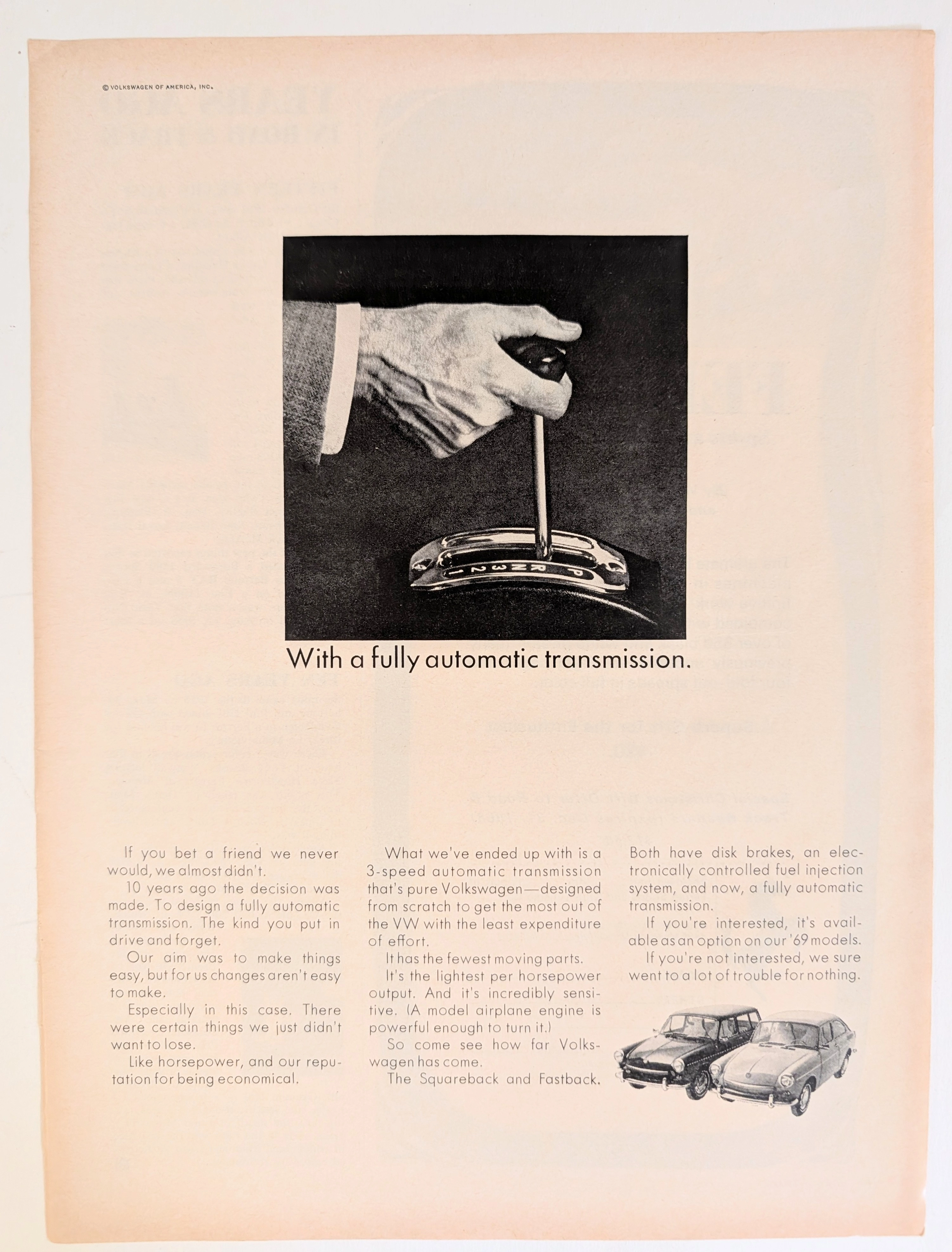
We often remember early Volkswagen history through the lens of simplicity, air-cooled engines, and rugged manual transmissions. But as the American market matured, the demand for comfort began to clash with the brand's original philosophy. This document is historical evidence capturing that moment of compromise. It is not just a car advertisement; it is an engineering confession and a declaration. After a decade of hesitation, Volkswagen of America introduced a fully automatic transmission for the 1969 models. It is a turning point showing that even the most stubborn brand had to adapt to the American consumerism trend that sought ultimate convenience.
The History
The American Automatics Arms Race To understand the weight of this advertisement, one must understand the environment of 1968-1969. The American auto industry was in the golden age of the Muscle Car and the personal luxury coupe. Detroit was pushing massive, lazy V8 engines mated to torque-converter "slushbox" automatics. The American driver expected to put a car in "Drive" and let the machinery do the thinking. Volkswagen, conversely, had built its empire on the Beetle—a car that demanded mechanical sympathy. But VW was trying to push its Type 3 line (the Squareback and Fastback) into a higher, more lucrative demographic. These buyers had disposable income, and they wanted convenience. VW faced an existential threat: adapt to the American desire for an automatic transmission, or lose the middle-class market entirely. A Decade of Ideological Hesitation The advertising copy confronts this ideological clash with brutal, refreshing honesty. It begins by stating, "If you bet a friend we never would, we almost didn't". The decision to develop a fully automatic transmission—"the kind you put in drive and forget"—took a staggering 10 years to finalize. Why the delay? Volkswagen’s philosophy was to make things easy for the driver, but internal changes were notoriously difficult for the company to justify. The primary engineering fear was parasitic power loss. Traditional automatics of the era sapped a massive amount of kinetic energy just to operate the hydraulic pumps within the transmission. For a Detroit V8 making 300 horsepower, a 20-horsepower loss was negligible. But for a Volkswagen flat-four engine struggling to make 60 horsepower, that same parasitic loss would render the vehicle dangerously slow and ruin its famous reputation for fuel economy. There were certain things, the copy notes, that they "just didn't want to lose". The 3-Speed Micro-Masterpiece To solve this, Volkswagen could not simply buy an off-the-shelf transmission from an American supplier. They had to engineer a bespoke solution. The result was a heavily optimized 3-speed automatic transmission designed from scratch to extract maximum performance from the low-output VW engine with the "least expenditure of effort". The ad boasts that this unit has the "fewest moving parts" and claims it is the "lightest per horsepower output". To emphasize its mechanical efficiency and lack of internal friction, the copywriter employs brilliant hyperbole: "A model airplane engine is powerful enough to turn it". This was a direct reassurance to the VW faithful that an automatic wouldn't kill the spirited, economical nature of the car. The D-Jetronic Revolution (Hidden in Plain Sight) While the headline focuses on the transmission, the most historically significant engineering triumph is buried in the final column of text. The ad casually mentions that both models feature an "electronically controlled fuel injection system". This is a monumental understatement. The system referenced is the Bosch D-Jetronic, introduced on the VW Type 3 in 1968. It was the world's first mass-produced electronic fuel injection system. In an era where even the most expensive Ferraris and Cadillacs were still relying on imprecise, mechanical carburetors, VW put a computer-controlled analog injection system in an affordable family car. Why? Because to make the new automatic transmission viable, the engine needed perfectly optimized fuel delivery to maximize its limited torque, while simultaneously meeting the newly enacted, stringent US emissions regulations. The automatic transmission forced VW into a technological leap that changed the automotive industry forever.
The Paper
Material Context: This artifact is printed on standard web offset magazine paper, typical of mass-circulation American periodicals from the late 1960s. It lacks the heavy clay coating of luxury publications, leaving it highly susceptible to environmental degradation. The edges exhibit noticeable oxidation and foxing (a yellowing and browning process), acting as a physical timeline of the lignin breaking down within the wood pulp. The copyright mark, "© VOLKSWAGEN OF AMERICA, INC.", firmly grounds the artifact in the corporate push of the late 60s. Printing Pathology: The manufacturing process relies on standard black-and-white halftone lithography. A macro inspection of the lower-right illustrations of the Squareback and Fastback reveals the distinct, coarse dot screen patterns required to simulate shading on cheap paper. Conversely, the primary photograph of the hand on the shifter utilizes a much finer screen, creating a stark, high-contrast image that commands the center of the page.
The Rarity
Classification: Class B+ (High Cultural and Engineering Documentation) Vintage 1960s Volkswagen print ads are generally common due to the massive circulation of magazines like LIFE, Time, and Esquire. However, the content of this specific artifact elevates its archival value. It is not selling a Beetle. It is selling the brand's awkward transition into modernity. It is a primary source document capturing the exact intersection of three major automotive milestones: the reluctant adoption of the automatic transmission, the marketing of the upscale Type 3 chassis, and the quiet, world-changing introduction of Bosch electronic fuel injection. It is a textbook example of how to market a compromise without losing brand integrity.
Cite this article
- MLA
- Naodhinsuk, Ronin. “The Time Traveller's Dossier : VW Type 3 Automatic - The Compromise of Engineering.” The Record Institute, 12 April 2026, https://therecord.institute/journal/the-time-travellers-dossier-vw-type-3-automatic-the-compromise-of-engineering.
- APA
- Naodhinsuk, R. (2026, April 12). The Time Traveller's Dossier : VW Type 3 Automatic - The Compromise of Engineering. The Record Institute. https://therecord.institute/journal/the-time-travellers-dossier-vw-type-3-automatic-the-compromise-of-engineering
- CHICAGO
- Naodhinsuk, Ronin. 2026. “The Time Traveller's Dossier : VW Type 3 Automatic - The Compromise of Engineering.” The Record Institute, April 12, 2026. https://therecord.institute/journal/the-time-travellers-dossier-vw-type-3-automatic-the-compromise-of-engineering.