The Time Traveller's Dossier : VW Water-Cooled Wonder - The Engine That Saved an Empire
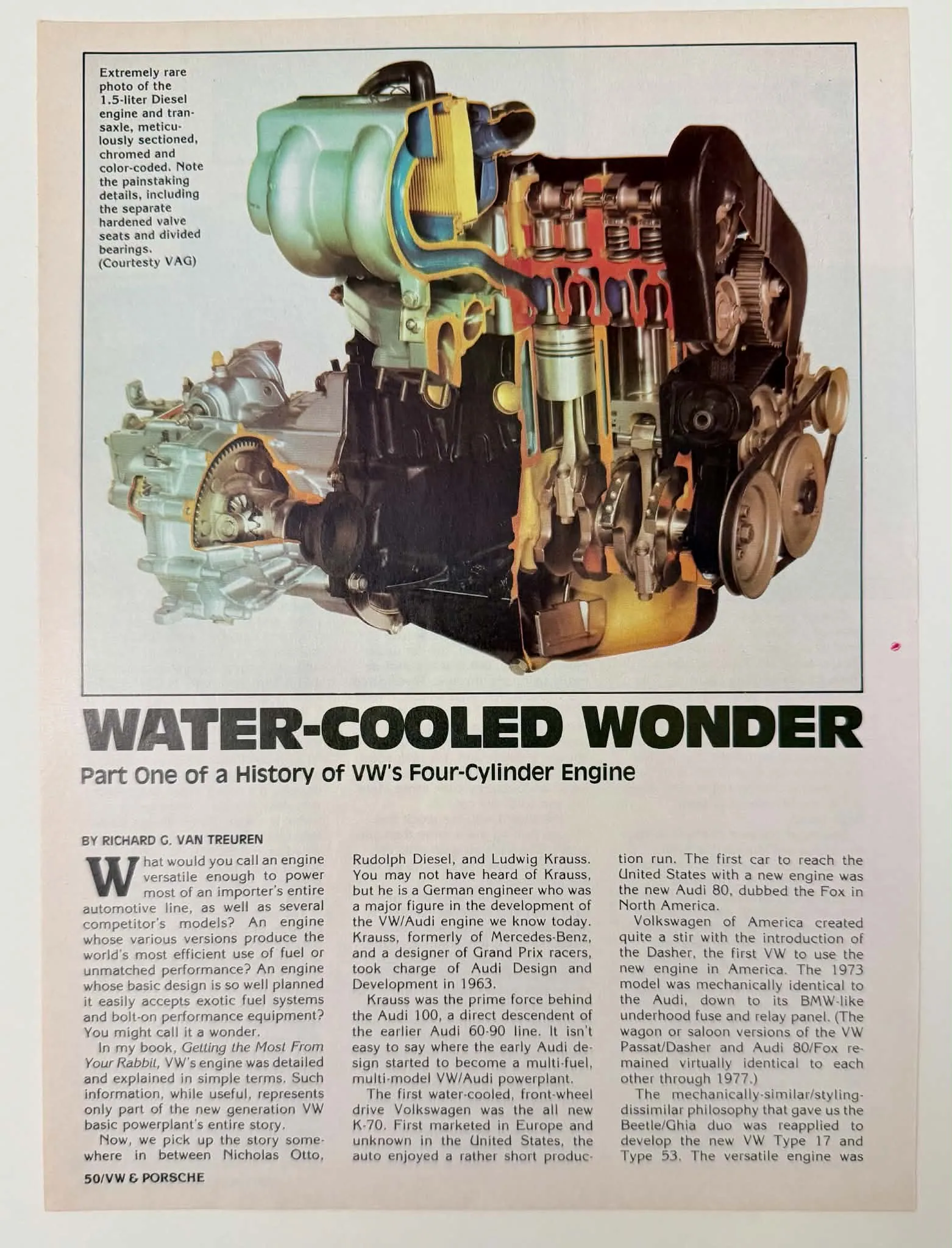
An empire built on air was suffocating. For decades, the automotive landscape was dominated by a singular, unmistakable sound: the clatter of the air-cooled, rear-mounted engine. It was reliable. It was universal. It was entirely obsolete. This artifact—a seemingly simple magazine page—documents the precise moment of a monumental paradigm shift. It records the death of an old philosophy and the violent, necessary birth of a new one. Before this engine, Volkswagen was trapped by its own success, clinging to pre-war technology as the world modernized. After this engine, the blueprint for the modern passenger car was permanently established. We are observing a primary archival document. It is a technical autopsy. By slicing a machine in half, chroming its organs, and painting its veins, engineers translated a complex mechanical revolution into a universal language. It is the visual documentation of how liquid replaced air, how front-wheel drive conquered the rear, and how an entire industry pivoted to survive.
Category: Technology
Brand: Volkswagen
The History
The Air-Cooled Prison History is rarely shaped by smooth transitions. It is forged in the fires of necessity and desperation. To understand the profound weight of the artifact presented, we must first examine the precarious landscape of the automotive industry in the late 1960s and early 1970s. Volkswagen had built a global empire on a singular, brilliant, but fatally aging concept: the Type 1 Beetle. Its air-cooled, rear-mounted flat-four engine was a marvel of post-war utilitarianism. It was simple. It was rugged. It mobilized millions. But an engineering philosophy cannot remain static while the world accelerates. By the dawn of the 1970s, the air-cooled paradigm had hit a thermodynamic and spatial wall. Engines cooled by ambient air rely on generous clearances, noisy fans, and compromise. As global emission standards tightened, the erratic temperature fluctuations of the air-cooled engine made precise combustion control impossible. Furthermore, placing the engine behind the rear axle compromised interior packaging, luggage space, and high-speed stability. Volkswagen was dying. The company was financially hemorrhaging, trapped inside the shell of its own iconic Beetle. The rear-engine, rear-wheel-drive layout was an evolutionary dead end. A radical, painful shift was required to save the empire from collapse. The Secret Architect Salvation did not come from within Volkswagen’s conservative headquarters in Wolfsburg. It came from a subsidiary, orchestrated by an engineer acting almost in defiance of his corporate overlords. The artifact points us directly to the source of this revolution: Ludwig Krauss. As the text explicitly notes, Ludwig Krauss was a former Mercedes-Benz engineer who took charge of Audi Design and Development in 1963. Audi, recently acquired by VW, was intended to be nothing more than a production facility for more Beetles. Krauss disagreed. Working in secret, hiding blueprints from VW executives, Krauss developed a modern, water-cooled, front-wheel-drive platform. He was the prime force behind the Audi 100, which was a direct descendant of the earlier Audi 60-90 line. This defiance saved the company. The mechanical philosophy developed by Krauss was so vastly superior that it fundamentally eradicated Volkswagen’s air-cooled dogma. The artifact documents this transition beautifully, noting that the mechanically similar but stylistically dissimilar philosophy was reapplied to develop the new VW Type 17 (the Golf/Rabbit) and Type 53 (the Scirocco). The Thermodynamic Shift The title of the article, "WATER-COOLED WONDER," is not mere journalistic hyperbole; it is a statement of thermodynamic triumph. Water cooling—or more accurately, liquid cooling—offered absolute thermal stability. By circulating a water-glycol mixture through passages cast directly into the engine block and cylinder head, engineers could tightly control the operating temperature of the internal components. This thermal equilibrium allowed for tighter tolerances between the pistons and cylinder walls. It allowed for higher compression ratios. It allowed for cleaner, more complete combustion. The engine could run leaner, hotter, and vastly more efficiently. The water-jacket also acted as a sound deadener, silencing the clattering cacophony that defined the air-cooled era. The transition to a water-cooled, front-mounted engine also solved the packaging crisis. By placing the engine transversely (or longitudinally in earlier models like the Dasher) between the front wheels, the entire cabin of the vehicle was freed up for human occupants. The modern compact car was born. The artifact mentions the introduction of the Dasher, which created quite a stir as the first VW to use the new engine in America in 1973. This vehicle was mechanically identical to the Audi, down to its BMW-like underhood fuse and relay panel. The Anatomy of a Miracle We must now direct our analytical focus to the central visual element of this artifact. We are presented with an extremely rare photo of the 1.5-liter Diesel engine and transaxle. This is not a standard promotional photograph. It is a meticulous, invasive dissection. The engine has been sectioned, chromed, and color-coded. To physically cut away the cast iron block, the aluminum cylinder head, and the complex transaxle casing requires hundreds of hours of painstaking labor. The engineers who created this display model were acting as modern anatomists, laying bare the internal organs of a mechanical beast to educate a skeptical public. Notice the visual hierarchy. The intake and exhaust tracts are highlighted in contrasting colors. The internal water jackets are exposed, visually proving the presence of the new cooling medium. The artifact demands that the viewer note the painstaking details, explicitly pointing out the separate hardened valve seats and divided bearings. Why harden the valve seats? Why feature divided bearings? Because this specific engine is a diesel. The Diesel Revolution The text references the lineage stretching between Nicholas Otto (inventor of the gasoline internal combustion engine) and Rudolph Diesel. Before this era, diesel engines were heavy, lethargic, and largely confined to agricultural tractors, commercial trucks, and a handful of specialized Mercedes-Benz taxicabs. Diesel combustion relies on extreme compression to ignite the fuel without a spark plug. This violent compression creates immense internal stress. Volkswagen achieved something deeply profound here. They took the basic architecture of their new, lightweight water-cooled gasoline engine and engineered it to withstand the brutal pressures of diesel combustion. The hardened valve seats mentioned in the caption were an absolute metallurgical necessity to prevent the engine from destroying itself under high heat and pressure. By successfully miniaturizing the diesel engine for a mass-market compact car, Volkswagen altered global economics. They delivered unprecedented fuel efficiency precisely when the world was gripped by the oil crises of the 1970s. The author, Richard G. Van Treuren, poses a rhetorical question: "What would you call an engine versatile enough to power most of an importer's entire automotive line... an engine whose various versions produce the world's most efficient use of fuel or unmatched performance?". He concludes, rightfully, that you might call it a wonder. The Architecture of the Future This specific powerplant architecture (internally known as the EA827) became the foundational bedrock of the Volkswagen Group for the next four decades. It was modular. It was scalable. As the text states, its basic design was so well planned it easily accepted exotic fuel systems and bolt-on performance equipment. This is the engine that powered the legendary Golf GTI, birthing the hot hatch segment. This is the engine that made diesel a viable option for the everyday commuter. This is the mechanical heart that allowed Volkswagen to pivot from the brink of financial ruin to global domination. The artifact we are studying is not merely a page from a magazine. It is the obituary of the air-cooled era and the birth certificate of modern automotive engineering. It represents the triumph of forward-thinking engineering over stubborn tradition. It reminds us that in technology, as in nature, adapt or die is the only law.
The Paper
The physical artifact presents as a page from a specialized automotive enthusiast publication, explicitly noted at the footer as "50/VW & PORSCHE". Tactile analysis suggests it is printed on medium-weight, machine-finished magazine stock, likely ranging between 70 to 90 GSM. The printing utilizes traditional web offset lithography. A microscopic examination of the macro images reveals the distinct CMYK halftone dot patterns inherent to this process, particularly visible in the color gradients of the engine's cutaway sections. The paper exhibits the early stages of chemical degradation. The edges show a slight yellowing, a result of the oxidation of lignin within the wood pulp fibers. This subtle decay serves as a chronological timestamp. It grounds the artifact in physical reality. The paper is slowly degrading, yet the mechanical philosophy it documents remains immortalized. The matte finish of the paper aggressively absorbs the ink, creating a flat, non-reflective surface that forces the eye to engage directly with the density of the text and the mechanical complexity of the image.
The Rarity
Classification: Class B The physical publication may be common among collectors, but the artifact explicitly notes that the image itself is an "Extremely rare photo" provided courtesy of VAG (Volkswagen AG). Its true rarity lies in its function as a pedagogical bridge. It captures the exact moment when complex, proprietary factory engineering was translated and explained to the consumer public. It is a highly specific snapshot of a paradigm shift. Its archival value is high because it serves as irrefutable primary evidence of how an industry explained its own evolution in real-time.
Cite this article
- MLA
- Naodhinsuk, Ronin. “The Time Traveller's Dossier : VW Water-Cooled Wonder - The Engine That Saved an Empire.” The Record Institute, 14 September 2026, https://therecord.institute/journal/the-time-travellers-dossier-vw-water-cooled-wonder-the-engine-that-saved-an-empire.
- APA
- Naodhinsuk, R. (2026, September 14). The Time Traveller's Dossier : VW Water-Cooled Wonder - The Engine That Saved an Empire. The Record Institute. https://therecord.institute/journal/the-time-travellers-dossier-vw-water-cooled-wonder-the-engine-that-saved-an-empire
- CHICAGO
- Naodhinsuk, Ronin. 2026. “The Time Traveller's Dossier : VW Water-Cooled Wonder - The Engine That Saved an Empire.” The Record Institute, September 14, 2026. https://therecord.institute/journal/the-time-travellers-dossier-vw-water-cooled-wonder-the-engine-that-saved-an-empire.