The Time Traveller's Dossier : Wellington Sears - The Unseen Architecture of Automotive Silence
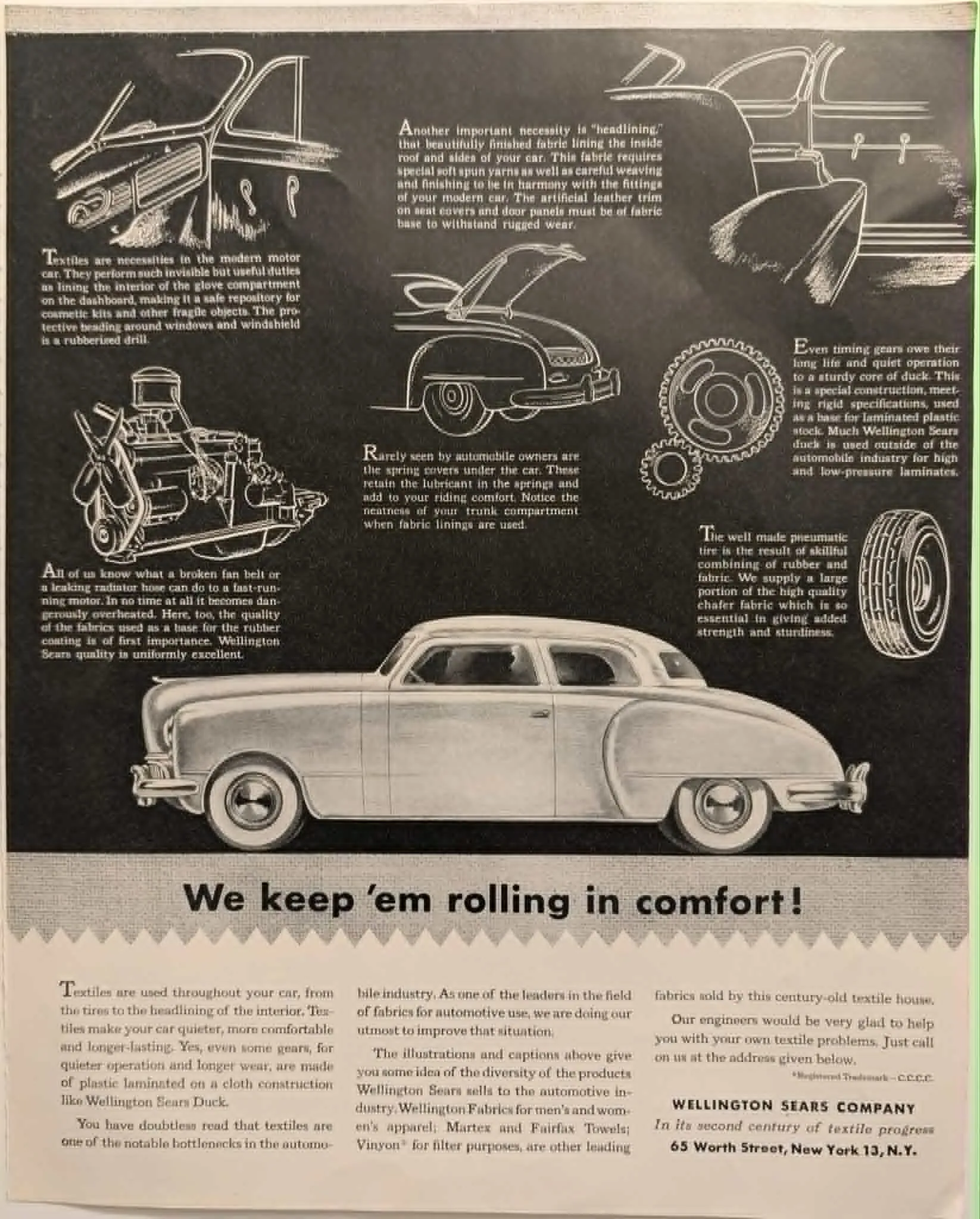
The problem was never motion. The problem was endurance. Early automobiles were violent machines. They were cages of vibrating steel. They rattled. They roared. They exhausted the human body long before the fuel tank ran dry. The solution was not better metal. The solution was the thread. We look at a car and see exterior geometry. We see aerodynamics. We see chrome. But the reality of vehicular comfort is entirely subterranean. It is woven. It is stitched. It is laminated. This artifact is a cross-section of that realization. It documents the precise moment in industrial history when the automobile transitioned from a mechanical carriage into a psychological sanctuary.
Category: Automotive
The History
The year is etched into the margins of progress. Wellington Sears Company announces its "second century of textile progress." Founded in 1845, this places the artifact precisely in the post-WWII era. The late 1940s into the early 1950s. This was a pivot point in human mobility. The war had ended. Production lines that once stamped out bomber fuselages and tank treads were re-tooled for civilian conquest. America was building the interstate highway system. The objective shifted. A vehicle no longer needed to merely survive a twenty-mile journey across rutted dirt roads. It needed to cross continents. It needed to sustain speeds of sixty miles per hour for hours on end. The human nervous system is not designed to sit inside a resonant metal box at high velocity. The vibration causes fatigue. The acoustic drone causes sensory exhaustion. The automotive industry faced a critical bottleneck. Metal alone was too harsh. Rubber alone lacked structural integrity. They needed a mediator. They needed industrial textiles. The Acoustic Chamber and The Psychology of Space Observe the upper right quadrant of the artifact. The "headlining." Before textiles, the roof of a car was an acoustic drum. Every piece of gravel, every drop of rain, every mechanical rotation of the driveshaft echoed off the bare steel. It was deafening. Wellington Sears introduces "special soft spun yarns." This is not merely cosmetic. It is an acoustic baffle. By lining the interior roof with meticulously woven fabric, the sound waves are trapped. They are absorbed rather than reflected. This singular engineering choice altered the psychology of driving. The cabin became a private room. Conversations could be held at normal volumes. The radio could be enjoyed. The vehicle became an extension of the domestic living room. The artifact highlights this shift explicitly. It demands harmony with modern fittings. The fabric must withstand rugged wear, yet provide the illusion of domestic softness. The hard, unforgiving reality of the machine is masked by the weave. The Structural Integrity of Powertrain Textiles Move to the mechanical. The artifact strips away the sheet metal to reveal the engine block. We assume an engine is a monolith of cast iron and forged steel. We are incorrect. Metal against metal creates catastrophic friction. It requires constant lubrication. It screams. The artifact highlights the "timing gears." These govern the precise synchronized opening and closing of the engine's valves. If they fail, the engine destroys itself. Wellington Sears provided a "sturdy core of duck." Duck canvas. An exceptionally heavy, plain woven cotton fabric. Why put fabric inside a combustion engine? Because when duck canvas is saturated with phenolic resins and cured under immense pressure, it becomes a laminated plastic gear. This composite material possesses the strength to turn heavy camshafts, but critically, it lacks the resonant frequency of steel. It is silent. It does not clatter. It does not whine. The textile core absorbs the micro-impacts of gear meshing. This is a profound technological intervention. The fabric acts as a kinetic shock absorber within the very heart of the propulsion system. Tension and the Architecture of Rubber Look to the fan belt. Look to the pneumatic tire. Vulcanized rubber is a miraculous substance. It grips. It flexes. It seals. But rubber stretches. Under centrifugal force and heat, pure rubber will expand until it tears. The artifact points to the "chafer fabric." A highly specialized textile required to give rubber its skeleton. A tire is essentially a pressurized balloon. Without a woven fabric carcass inside the rubber, the tire would warp out of shape immediately upon acceleration. Wellington Sears provided the high-quality chafer fabric that anchored the tire to the steel rim. They provided the base for the rubberized coating of the fan belts. They provided the ligaments to the automobile's muscles. Without these textiles, the engine overheats in minutes as the fan belt snaps. Without these textiles, the pneumatic tire suffers blowout at highway speeds. The Competitive Landscape and The Shift In this era, Wellington Sears was not just competing against other textile mills. They were competing against the rapid rise of synthetic chemistry. Companies like DuPont were pushing nylon and rayon. Wellington Sears, a "century-old textile house," had to prove that their natural fibers—specifically highly engineered cotton duck and specialized weaves—could handle the extreme thermodynamic and kinetic stresses of modern machinery. The artifact is a defensive manifesto. It proves their relevance. They list their consumer brands—Martex and Fairfax Towels—almost as an afterthought. Their true power lay in industrial domination. They were the invisible backbone of the automotive boom. The historical shift is undeniable. Cars shifted from being feats of raw mechanical engineering to feats of composite material science. The artifact documents the moment we realized that comfort is not a luxury. Comfort is an engineered requirement for sustained human travel. The silence you experience in a modern vehicle was born here, in the looms of the mid-20th century.
The Paper
The artifact exhibits the classic hallmarks of mid-century industrial publishing. It is printed on medium-weight magazine stock, likely hovering around 70 to 80 GSM (Grams per Square Meter). The surface retains a slight calendared sheen, though the passing of decades has introduced micro-abrasions across the planar surface. The printing method is a high-density offset lithography. Notice the intense saturation of the black background. This is not a standard halftone screen. The black ink coverage is heavy, requiring a high-tack ink formulation to prevent offsetting onto adjacent pages during the high-speed web press runs of the era. The white lines of the technical illustrations are achieved through a reverse-out process. The ink does not outline the shapes; rather, the absence of ink creates the schematic lines, allowing the natural color of the paper to show through. The aging process is visible. The stark whites have oxidized. They have shifted toward a warmer, nicotine-tinged cream. This is due to the lignin content inherent in paper pulps of that period. As the lignin interacts with ambient light and oxygen over seventy years, it degrades, yellowing the canvas. The paper itself is a tactile record. It smells faintly of volatile organic compounds that have long since stabilized. It feels brittle at the edges, a testament to its survival through decades of fluctuating humidity.
The Rarity
Class A - High Contextual Significance. Vintage automotive advertisements are common. The market is saturated with mid-century illustrations of chrome fins and smiling families. However, supply-chain and industrial-grade advertisements are entirely different artifacts. They were not designed for the general consumer. They were targeted at engineers, procurement officers, and investors. They appeared in trade journals and specialized business magazines. Therefore, the survival rate of this specific artifact is significantly lower than a standard consumer ad. It possesses immense contextual rarity. It does not sell the dream of driving; it sells the brutal, unseen mechanics of how driving is made possible. It is a vital record of mid-century composite material engineering. Its value does not lie in an auction house hammer price. Its value lies in its historical utility. It is a missing puzzle piece in the timeline of automotive evolution.
Cite this article
- MLA
- Naodhinsuk, Ronin. “The Time Traveller's Dossier : Wellington Sears - The Unseen Architecture of Automotive Silence.” The Record Institute, 21 June 2026, https://therecord.institute/journal/the-time-travellers-dossier-wellington-sears-the-unseen-architecture-of-automotive-silence.
- APA
- Naodhinsuk, R. (2026, June 21). The Time Traveller's Dossier : Wellington Sears - The Unseen Architecture of Automotive Silence. The Record Institute. https://therecord.institute/journal/the-time-travellers-dossier-wellington-sears-the-unseen-architecture-of-automotive-silence
- CHICAGO
- Naodhinsuk, Ronin. 2026. “The Time Traveller's Dossier : Wellington Sears - The Unseen Architecture of Automotive Silence.” The Record Institute, June 21, 2026. https://therecord.institute/journal/the-time-travellers-dossier-wellington-sears-the-unseen-architecture-of-automotive-silence.