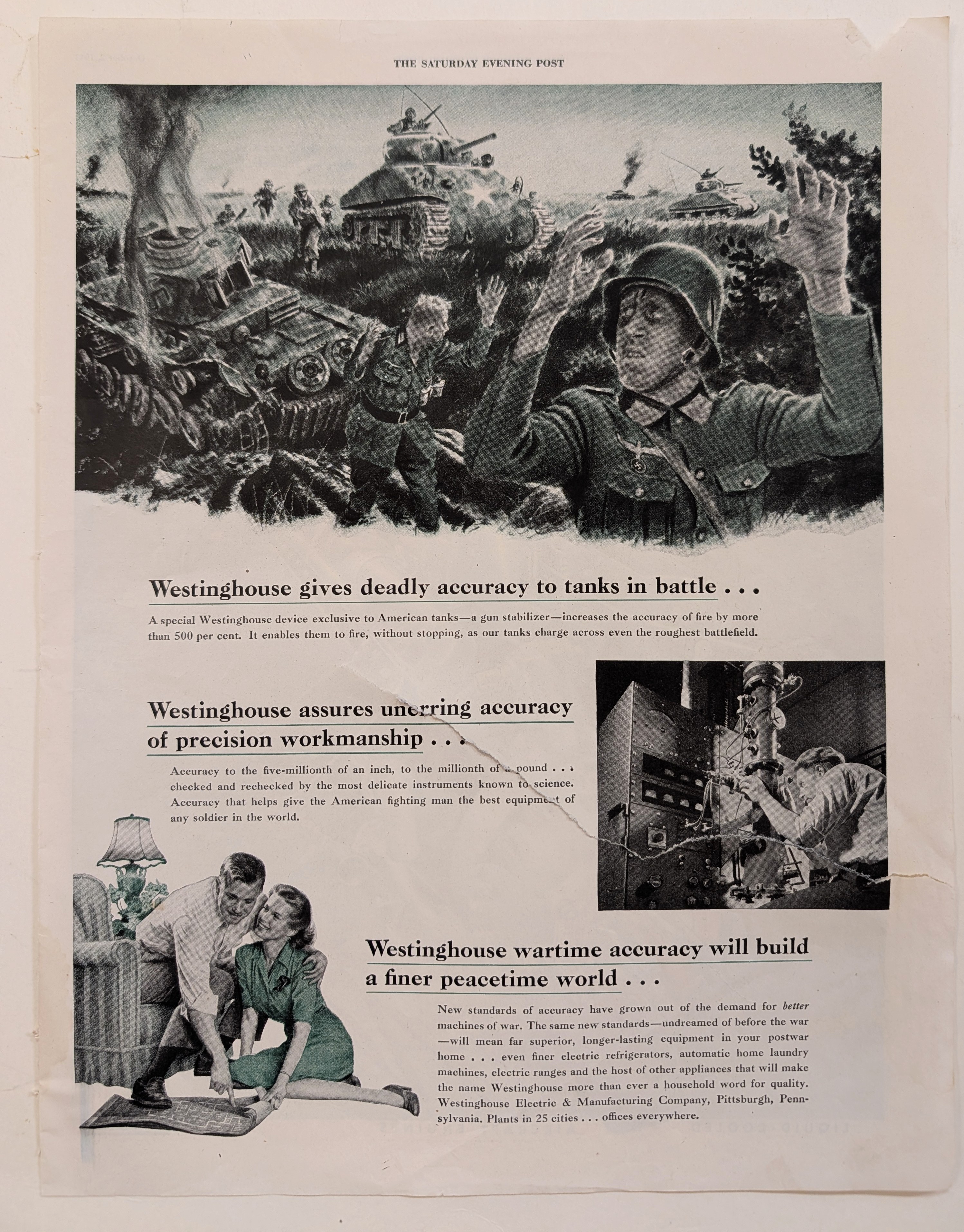
The Time Traveller's Dossier : Westinghouse - The Triptych of the American Century Summary
Before the era of seamless consumer convenience, there was the crucible of total war. Before the algorithm anticipated our domestic needs, heavy industry dictated the shape of our future. This fragment—a physically scarred, wartime advertisement for the Westinghouse Electric & Manufacturing Company, salvaged from the pages of The Saturday Evening Post—is not merely corporate propaganda. It is the
The History
The Monolith of Corporate Mobilization To understand the immense gravity of this artifact, one must first dismantle the context of its creation. Westinghouse was not merely a company; it was a titan of the American industrial foundation. Pioneers of alternating current, they had spent decades electrifying the nation. But when the Second World War erupted, the entire American industrial apparatus was violently and completely repurposed. Factories that stamped toaster chassis were retooled to stamp ammunition casings. Assembly lines that produced washing machines were recalibrated to produce air
The Paper
The substrate is a standard, mass-market magazine stock, composed of highly acidic, mechanical wood pulp. Its weight is estimated between 45 and 55 GSM (Grams per Square Meter). It was engineered for the fleeting lifespan of a weekly periodical, not the eternity of an archive. The lignin within the wood fibers has oxidized severely over the decades, reacting with ambient ultraviolet light and atmospheric oxygen. This chemical degradation has shifted the paper from its original bright finish to a brittle, dusty yellow. The printing utilizes a sophisticated high-resolution halftone screen proces
The Rarity
Classification: Class B In the cold mathematics of archival survival, mass-market publications from the 1940s are not inherently rare. Millions of copies of this specific issue were printed and distributed across the globe. However, its classification is elevated to Class B due to its profound contextual density and structural composition. Finding an advertisement that so perfectly encapsulates the entire sociopolitical narrative of the era—the gritty reality of combat, the sterile exactitude of wartime science, and the promised utopia of postwar consumerism—in a single, three-part layout is u