The Time Traveller's Dossier : What Fathers Know Best - The Architecture of Paternal Legacy
Then, authority was absolute. It was dictated from above, unquestioned, and rigid. Now, authority is negotiated. It is built on shared vulnerability and quiet counsel. This artifact captures the exact moment of that transition. It presents a problem: the inevitable departure of youth into the unforgiving machinery of the adult world. It offers a solution: the transfer of generational capital. Not wealth, but foresight. The artifact is a bridge between the stoic, distant patriarch of the early 20th century and the emotionally available mentor of the late 20th century. It is a calculated piece of sentimentality, engineered to anchor a changing society to the familiar iconography of the domestic sanctuary.
Category: Other
The History
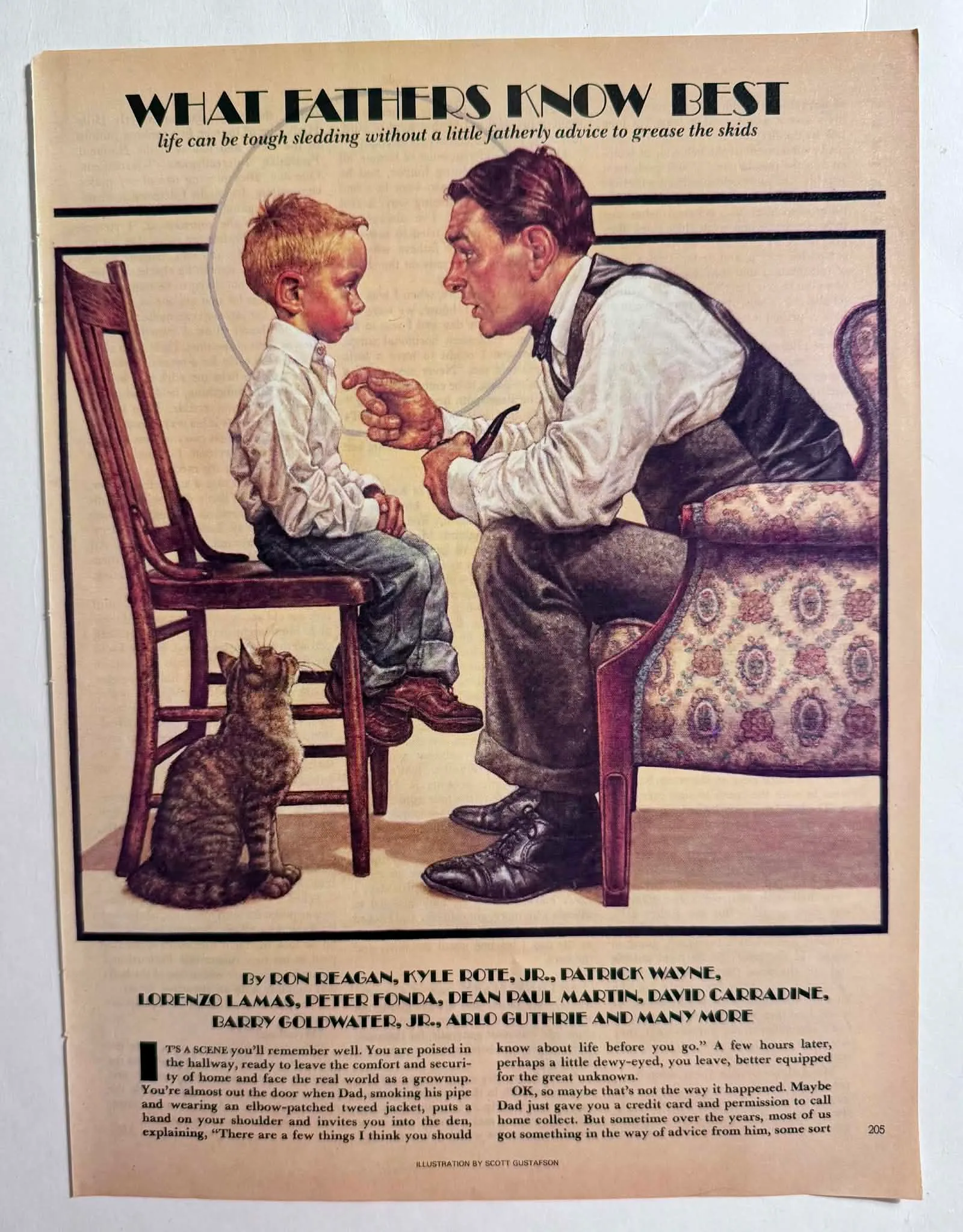
The Societal Blueprint and the Nuclear Ideal This document operates as a cultural mirror. It reflects a very specific, highly curated version of the mid-to-late 20th-century domestic ideal. The imagery relies heavily on the established iconography of the American home. The father sits in a patterned armchair. He wears a vest, a tie, and smokes a pipe. This is not casual domesticity; this is a uniform of paternal authority. Yet, the posture is intimate. He leans forward. The physical distance between the patriarch and the heir is collapsed. Society during this era was grappling with unprecedented generational fracturing. The youth movements had actively dismantled the unquestioned reverence for traditional authority. In response, mass media required a mechanism to reconcile the old world with the new. This artifact serves that precise function. It rebrands the father. He is no longer the disciplinarian holding a rod. He is the strategist offering a map. The text speaks to "tough sledding" and "fatherly advice to grease the skids." It acknowledges that the world outside the hallway is hostile. The home is positioned as the final briefing room before deployment into adulthood. The Burden of Legacy The text beneath the illustration anchors the philosophical concept to tangible reality. It lists names: Ron Reagan, Kyle Rote Jr., Patrick Wayne, Lorenzo Lamas, Peter Fonda, Dean Paul Martin, David Carradine, Barry Goldwater Jr., Arlo Guthrie. These are not arbitrary selections. They are the sons of titans. Politicians, Hollywood icons, musical legends, and athletic giants. By invoking these specific names, the artifact elevates the conversation from common domesticity to the theater of high legacy. It asks the reader to consider the immense psychological weight of standing in such vast shadows. Every name on this list represents a highly public negotiation of identity. Peter Fonda rebelled against the stoic classicism of Henry Fonda. Arlo Guthrie carried the populist folk mantle of Woody Guthrie while navigating the counterculture. Ron Reagan diverged sharply from the conservative orthodoxy of Ronald Reagan. The artifact uses these men as proxies for the universal struggle of separation. It suggests that regardless of the father's magnitude, the fundamental mechanism of departure remains identical. The hand on the shoulder. The invitation into the den. The final transmission of survival tactics. The Economic Engine of Sentiment Advertising and editorial content of this era did not sell products; they sold stability. The economic landscape was defined by rapid industrialization, the rise of the corporate ladder, and the increasing mobility of the workforce. Children no longer necessarily inherited the family farm or the local trade. They left for universities. They moved across the continent for corporate placements. This geographic and economic dispersal created a market for nostalgia. The print syndicates understood this intimately. Magazines like The Saturday Evening Post or similar periodicals functioned as the connective tissue of a fractured nation. This artifact is a prime example of the economics of sentiment. By illustrating a deeply idealized, static moment of connection, the publication creates a psychological anchor for the reader. The reader buys the magazine not just for information, but for the temporary restoration of order. The imagery monetizes the universal anxiety of aging and letting go. The Competitor Landscape: Print Against the Screen When this illustration was commissioned, print media was engaged in a brutal war of attrition with television. Television offered motion, sound, and immediacy. Print had to counter with depth, texture, and permanence. Television broadcasts vanished the moment they aired. A magazine sat on the coffee table for a month. It demanded a different type of attention. This artifact leverages the inherent stillness of the medium. The composition is a masterclass in the "static camera" setup. The viewer is positioned as a silent observer in the room, unmoving. The scene does not rush. It asks the viewer to dwell on the details: the weave of the upholstery, the folds in the boy's shirt, the attentive posture of the cat. Print competitors of the era were shifting toward aggressive, photography-driven layouts. The decision to use a traditional, highly rendered illustration by Scott Gustafson was a deliberate counter-movement. It signals a rejection of the harsh, flash-lit reality of photojournalism in favor of an enduring, mythic warmth. It tells the reader that some truths are better captured by the painter's brush than the camera's shutter. The Mechanics of the Historical Shift The true historical shift represented here is the transition of paternal utility. Historically, the father’s role in mass media was depicted as a provider of capital and discipline. His physical presence was often secondary to his economic function. This illustration documents the pivot toward emotional utility. The father’s value in this image is not derived from his wallet, but from his cognitive experience. "There are a few things I think you should know about life before you go." This line signifies the democratization of family dynamics. It is an admission that the son will face challenges the father cannot fix with money or force. The only tool that can be provided is perspective. This shift laid the groundwork for the modern interpretation of fatherhood. It moved the archetype from a figure of fear to a figure of counsel. It bridged the gap between the rigid stoicism of the Greatest Generation and the emotional introspection demanded by subsequent generations. The artifact is a Rosetta Stone for understanding how the 20th-century male was retaught how to communicate with his offspring.
The Paper
This artifact is a testament to the slow, inevitable chemistry of time. The substrate is likely a standard mid-century magazine stock, estimated around 60 to 70 GSM. It was engineered for mass distribution, not archival survival, which makes its current state profoundly compelling. The paper exhibits advanced lignin oxidation. This is visible in the warm, yellowed halo creeping inward from the margins, creating an organic, aged paper texture that digital filters constantly attempt to mimic. The printing method is classic four-color offset lithography. Upon close inspection, the CMYK rosette patterns are entirely visible, dictating the density of the shadows and the warmth of the skin tones. The ink has settled deep into the fibers, losing the glossy surface tension of its youth and acquiring a matte, historical resonance. It is not just an image printed on paper; it is an artifact that has physically recorded the passage of time through its cellular degradation.
The Rarity
While the physical magazine page itself may not command exorbitant auction prices, its contextual rarity elevates it to a Class A artifact. Its value lies not in scarcity, but in its perfect distillation of a specific cultural psychology. Finding an intact, highly legible representation of this exact transitional moment in advertising history—where traditional illustration meets the shifting dynamics of the nuclear family—is increasingly uncommon. It serves as a vital primary source for sociologists and visual historians tracing the evolution of domestic archetypes.
Cite this article
- MLA
- Naodhinsuk, Ronin. “The Time Traveller's Dossier : What Fathers Know Best - The Architecture of Paternal Legacy.” The Record Institute, 2 September 2026, https://therecord.institute/journal/the-time-travellers-dossier-what-fathers-know-best-the-architecture-of-paternal-legacy.
- APA
- Naodhinsuk, R. (2026, September 2). The Time Traveller's Dossier : What Fathers Know Best - The Architecture of Paternal Legacy. The Record Institute. https://therecord.institute/journal/the-time-travellers-dossier-what-fathers-know-best-the-architecture-of-paternal-legacy
- CHICAGO
- Naodhinsuk, Ronin. 2026. “The Time Traveller's Dossier : What Fathers Know Best - The Architecture of Paternal Legacy.” The Record Institute, September 2, 2026. https://therecord.institute/journal/the-time-travellers-dossier-what-fathers-know-best-the-architecture-of-paternal-legacy.