The Time Traveller's Dossier : Willys Jeep - The Engine of Global Conflict
We measure history by the borders we draw. But borders are defined by our capacity to traverse them. Before 1940, mobility was dictated by infrastructure. Armies required roads. Supply lines required railways. The terrain was the ultimate arbiter of military strategy. Then came the quarter-ton utility vehicle. A paradigm shift wrought in steel and canvas. This artifact is not merely an advertisement. It is a documented claim of ownership over a geopolitical pivot point. It is Willys-Overland declaring that their machinery was the vector of liberation. The problem was a world swallowed by tyranny and impassable geography. The solution was a four-cylinder engine wrapped in an olive-drab box.
The History
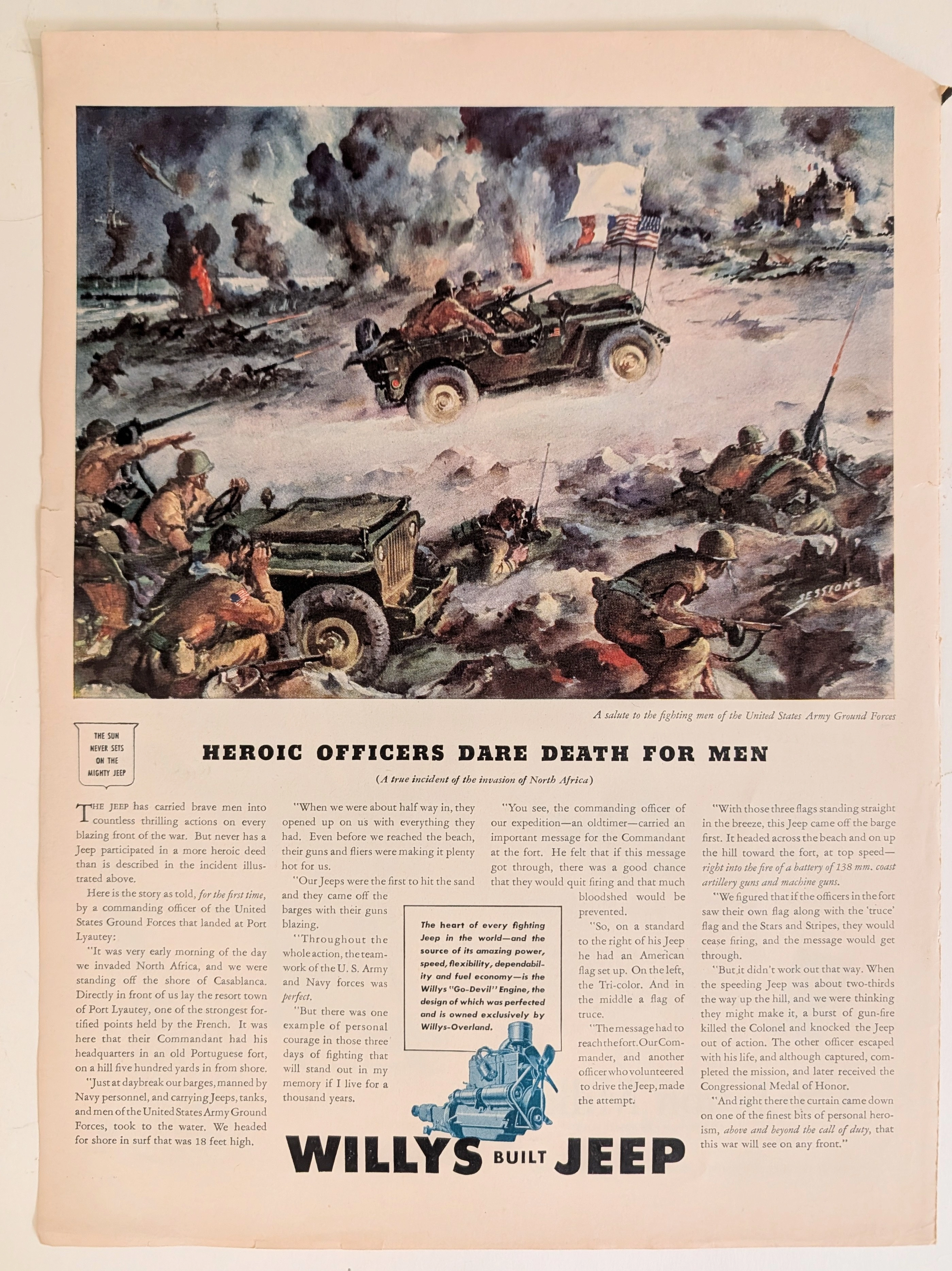
The Void in the Vanguard The year is 1942. The theater is North Africa. Operation Torch has commenced. The United States has violently entered the global fray. But the American military machine was, until this moment, largely untested in this new mechanized reality. Trench warfare was dead. Blitzkrieg had proven that speed and logistics dictated survival. Heavy armor was potent but lumbering. Infantry was versatile but slow. A massive, glaring void existed in the tactical hierarchy. Commanders needed eyes. They needed rapid communication. They needed to move personnel over ground that lacked roads, bridges, or mercy. The horse, the ancient engine of cavalry, was obsolete. The internal combustion engine had to be adapted not just for power, but for ubiquity. The War Department issued a seemingly impossible specification. A general-purpose personnel or cargo carrier. A quarter-ton payload. Four-wheel drive. A wheelbase of no more than 75 inches. Most crucially, an empty weight not exceeding 1,300 pounds. It was a demand for a ghost made of iron. The Crucible of Creation Three entities answered the call. American Bantam. Ford Motor Company. Willys-Overland. Bantam had the initial design. Ford had the manufacturing empire. But Willys-Overland had an engineer named Delmar "Barney" Roos. And Roos had the "Go-Devil" engine. This artifact specifically isolates and glorifies this piece of engineering. The Go-Devil was a 134-cubic-inch, L-head inline-four engine. It produced 60 horsepower. It generated 105 pound-feet of torque. By modern standards, it is a whisper. In 1941, it was a roar. However, the engine was heavy. It pushed the Willys prototype vastly over the military's strict weight limit. Roos engaged in a fanatic process of reduction. He shaved ounces off bolts. He thinned the gauge of non-structural steel. He optimized every physical tolerance. He met the weight limit while retaining the heavy, powerful heart of the machine. The military recognized the superiority of the Go-Devil. Willys secured the primary contract. But war requires scale. Willys could not produce enough. The government forced Willys to share the blueprints with Ford. Thus, a bizarre reality emerged: Ford was building Willys Jeeps. This dynamic is the invisible subtext of this artifact. The Propaganda of Institutional Survival Why advertise a product to civilians when civilians cannot legally purchase it? During World War II, consumer manufacturing ceased. Every factory was mobilized for the war effort. Automakers had nothing to sell to the public. Yet, they poured millions into magazine advertisements. This is the concept of "Institutional Advertising." Willys-Overland was facing an existential threat not from the Axis, but from Ford. Ford was stamping their iconic "F" on the parts of the Jeeps they built. Soldiers were beginning to associate the Jeep with Ford. Willys needed to aggressively reclaim the narrative. They needed the American public to know, unequivocally, that the Jeep was their child. Look at the typography at the bottom of the artifact. "WILLYS BUILT JEEP". Massive, unapologetic. Look at the inset box: "The heart of every fighting Jeep in the world... is the Willys 'Go-Devil' Engine, the design of which was perfected and is owned exclusively by Willys-Overland." This is not an advertisement for a car. This is a legal and historical stake being driven into the ground. It is an act of corporate survival disguised as patriotic reporting. The Incident at Port Lyautey The artifact chooses not to depict an abstract, generalized battle. It grounds itself in granular historical reality. The text recounts a specific event during the invasion of North Africa. Port Lyautey, French Morocco. November 1942. The Allied forces faced unexpected resistance from Vichy French troops. The situation required a delicate, deadly diplomatic maneuver. A message had to be delivered to the French Commandant, urging a ceasefire before mutual slaughter escalated. The vector for this message was the Willys Jeep. The artifact illustrates this exact, desperate run. A Jeep, stripped of armament, speeding across the beach. It flies three flags. The American flag. The French Tricolor. And the white flag of truce. The text outlines the brutal reality: the truce was ignored. The Jeep was targeted by a battery of 138mm coast artillery and machine guns. A burst of gunfire killed the Colonel and knocked the machine out of action. The other officer survived, completed the mission on foot, and received the Congressional Medal of Honor. This is a profound shift in advertising tone. It does not promise safety. It does not promise comfort. It highlights the destruction of its own product to emphasize the courage of the men who drove it. The vehicle is elevated from a machine to a martyred companion. The Shift: Geography Demystified The Willys Jeep engineered a permanent shift in human expectation. Before the Jeep, the wilderness was a barrier. A mountain, a desert, or a muddy trench was a hard limit on human ambition. The Jeep erased these limits. It turned terrain into a mere variable in an equation of forward momentum. It democratized off-road capability. After the war, this military tool birthed entire civilian industries. It inspired the British Land Rover. It laid the architectural foundation for the modern SUV. The crest on the artifact reads: "THE SUN NEVER SETS ON THE MIGHTY JEEP." This is a direct, audacious appropriation of the old British Empire maxim. It implies a new kind of global dominance. Not an empire of borders and monarchs, but an empire of mechanical ubiquity. The American century would be driven on four wheels. The world had shrunk. Not through the airplane, but through the realization that no ground was sacred or impassable anymore. This artifact captures the exact moment that psychological shift occurred.
The Paper
Material Context: This artifact is printed on magazine stock typical of the early-to-mid 1940s. Due to wartime rationing, the paper relies heavily on acidic wood pulp rather than cotton rag. We can estimate the weight at approximately 60 to 70 GSM. It is thin, designed for mass circulation and rapid disposal. Printing Pathology: The manufacturing process is a four-color rotary letterpress (CMYK). A close inspection of the macro images reveals the distinct halftone rosette patterns. The colors are not blended; they are an optical illusion created by overlapping dots of cyan, magenta, yellow, and black. The registration—the alignment of these dots—is remarkably precise for the era, indicating high-tier publication standards (likely Life, The Saturday Evening Post, or Collier's). Chronological Markers: The artifact serves as a physical chronometer. The edges show clear signs of oxidation, a process known as 'foxing'. The lignin in the wood pulp reacts with ambient oxygen and light over eight decades, breaking down the cellular structure and turning the paper yellow-brown. The texture is brittle. It holds the physical memory of the 1940s atmosphere. The paper itself is as fragile as the history it attempts to make permanent.
The Rarity
Classification: Class S (High Contextual & Archival Value) Vintage advertisements are generally abundant. However, this specific artifact transcends typical commercial ephemera due to its density of context. It is an artifact of the Willys vs. Ford intellectual property war. It is an artifact of Operation Torch. It features documented art by a recognized wartime combat artist. Its value is not found in the raw material or extreme scarcity, but in its narrative compression. It is a primary source document capturing corporate maneuvering, military history, and the evolution of transportation, all on a single page. It belongs in an archive analyzing the intersection of wartime propaganda and industrial design.
Cite this article
- MLA
- Naodhinsuk, Ronin. “The Time Traveller's Dossier : Willys Jeep - The Engine of Global Conflict.” The Record Institute, 11 April 2026, https://therecord.institute/journal/the-time-travellers-dossier-willys-jeep-the-engine-of-global-conflict.
- APA
- Naodhinsuk, R. (2026, April 11). The Time Traveller's Dossier : Willys Jeep - The Engine of Global Conflict. The Record Institute. https://therecord.institute/journal/the-time-travellers-dossier-willys-jeep-the-engine-of-global-conflict
- CHICAGO
- Naodhinsuk, Ronin. 2026. “The Time Traveller's Dossier : Willys Jeep - The Engine of Global Conflict.” The Record Institute, April 11, 2026. https://therecord.institute/journal/the-time-travellers-dossier-willys-jeep-the-engine-of-global-conflict.