The Time Traveller's Dossier : WWI Shipbuilding - The Industrial Shift
Then, conflicts were settled by the tactical maneuvering of cavalry. Wars were won by men bearing rifles on shattered fields. Generals were the sole architects of victory or defeat. Now, in the mechanical crucible of the first global conflict, the paradigm fractures entirely. The battlefield has mutated. It extends across oceans, into steel mills, and through the grim arithmetic of rail yards. Victory is no longer a matter of mere courage. It is a strict, unforgiving matter of tonnage. This artifact documents that exact tectonic pivot. It captures the precise moment the American industrialist was elevated to the rank of savior. It is a blueprint of the modern military-industrial state.
Category: Other
The History
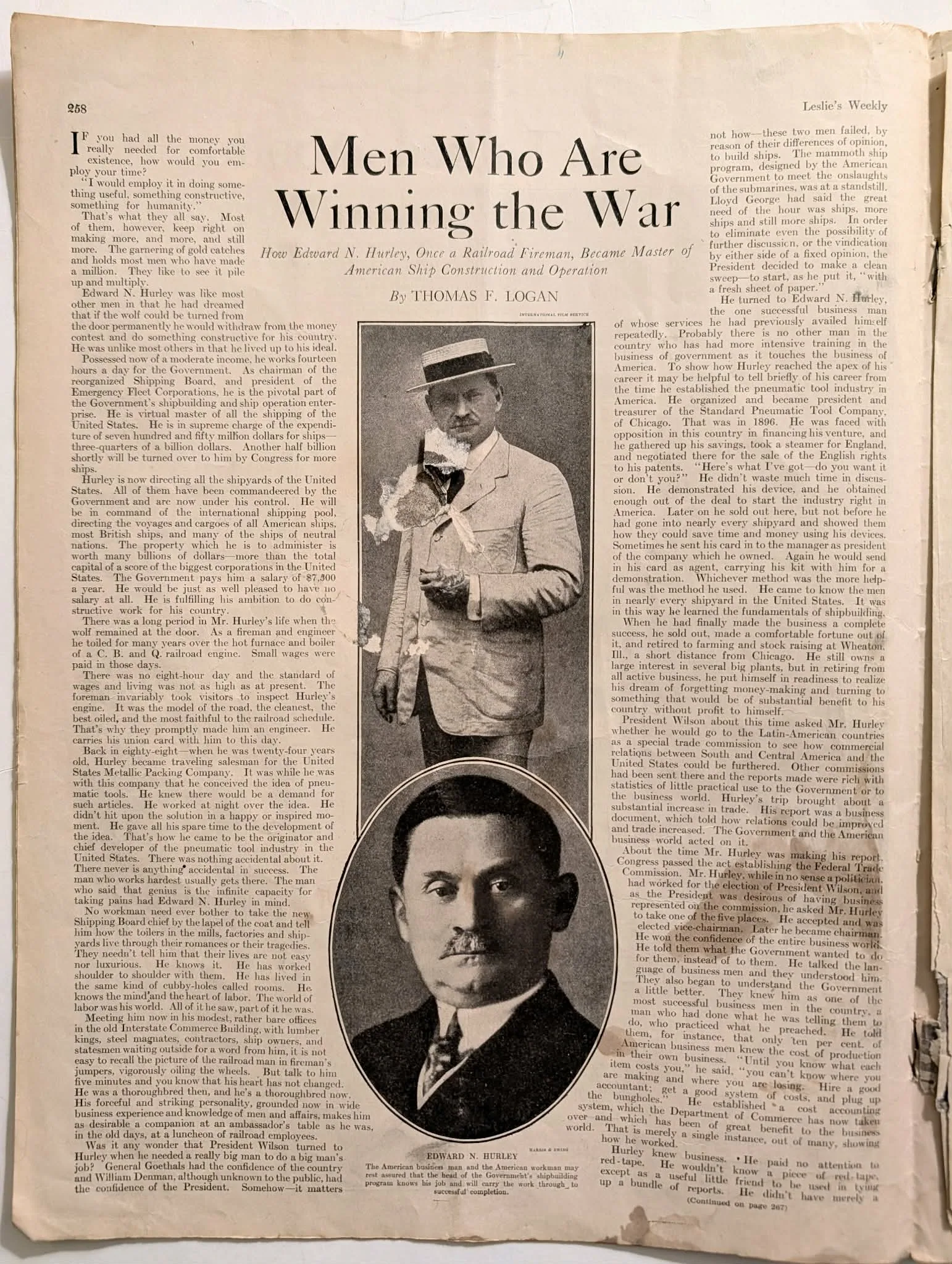
The Geometry of Attrition History is rarely changed by a single bullet. It is changed by supply chains. By 1917, the European continent was locked in a stalemate of unprecedented slaughter. The war had ceased to be a tactical contest. It had devolved into a gruesome mathematical equation. Who could produce the most artillery shells? Who could field the most bodies? And critically, who could transport them across a hostile ocean? The German Empire understood this geometry of attrition perfectly. They unleashed unrestricted submarine warfare. Their U-boats operated with a singular, devastating mandate: sever the transatlantic artery. If the Allied supply lines were cut, Britain would starve. The war would end not with a decisive battle, but with quiet, systemic collapse. Prime Minister David Lloyd George’s desperate plea echoes through the historical record of this era. He demanded “ships, more ships and still more ships.” Without them, the raw industrial output of the United States was entirely useless. The Atlantic Ocean was a graveyard of merchant vessels. The American shipbuilding apparatus was sluggish, fragmented, and wholly unprepared for the velocity of total war. A monumental shift in operational philosophy was required. The government needed to commandeer the mechanisms of private capital. They needed a dictator of logistics. The Architect from the Furnace Enter Edward N. Hurley. The text before us, preserved in the fragile fibers of Leslie's Weekly, profiles the man tasked with an impossible mandate. He was named Chairman of the reorganized Shipping Board and president of the Emergency Fleet Corporation. He was granted dominion over all American shipping. He was handed three-quarters of a billion dollars—a sum of unfathomable weight in that era. Another half billion was imminent. But Hurley was not a military man. He wore no medals. He commanded no battalions in the traditional sense. His inclusion in a series titled "Men Who Are Winning the War" is a structural revelation. It signifies the absolute democratization of American power. The article deliberately anchors Hurley’s origins in the grit of the working class. He was once a railroad fireman for the C. B. & Q. railroad. He shoveled coal into the burning maw of locomotives. He wiped down engines, ensuring his was the cleanest and most faithful to the schedule. He carried his union card with him, a talisman of his origins. This is not a mere biographical detail; it is a vital psychological tool deployed by the writer, Thomas F. Logan. In an era of deep labor unrest, the government needed the working man to buy into the war effort. By placing a former railroad fireman at the helm of the greatest industrial mobilization in human history, the state sent a clear message. The American workman and the American executive were fighting the same war. They were bleeding the same sweat. The Pneumatic Revolution Hurley’s ascent was driven by a specific technological mastery. In 1896, he conceptualized and commercialized the pneumatic tool industry in the United States. He organized the Standard Pneumatic Tool Company of Chicago. This seemingly mundane detail is the hidden engine of the entire shipbuilding effort. Before pneumatic tools, ships were built with sheer, brute manual labor. Rivets were driven by hand, a slow, deafening, and exhausting process requiring teams of men swinging heavy sledges. The introduction of pneumatic riveting hammers fundamentally altered the speed of construction. Compressed air replaced human muscle. It allowed steel plates to be fused at a radically accelerated pace. Hurley did not just manage the shipyards. He had previously invented the very methods that allowed those shipyards to function at wartime velocity. He brought the efficiency of the assembly line to the chaotic environment of the drydock. He navigated the skepticism of financiers. He took a steamer to England and successfully negotiated the sale of the English rights to his patents. He demonstrated the tools himself in American yards, occasionally handing out his card as a demonstrator rather than a president. He understood the friction of labor and the friction of metal. When the government faced the bureaucratic paralysis of his predecessors—General Goethals and William Denman—they did not turn to another politician. They turned to a man who understood mechanical efficiency and the literal nuts and bolts of industrial production. The Commandeering of Capital This article captures the precise moment American capitalism was temporarily subordinated to state survival. The text explicitly notes that Hurley was directing all the shipyards of the United States. It states coldly that all of them had been commandeered by the Government. This was a radical departure from the laissez-faire economic policies of the preceding decades. It was the birth of the command economy in America. Private enterprise was absorbed into the federal apparatus. The international shipping pool, voyages, cargoes, and the movement of neutral vessels were all dictated by this reorganized board. The property he administered dwarfed the capital of the nation's largest corporations combined. Yet, he worked fourteen-hour days for a modest salary of $7,500. He was fulfilling his ambition to do constructive work for his country. The narrative frames this as the ultimate civic sacrifice. It redefines patriotism for the twentieth century. Patriotism was no longer simply enlisting in the infantry. Patriotism was standardizing cost systems. Patriotism was plugging up the leaks of financial waste. Hurley famously told American businessmen that they were losing money because they did not know their own costs. He championed robust cost accounting systems, heavily utilized by the Department of Commerce. He forced a fragmented, competitive, and often inefficient industry to operate as a single, unified organism. He paid no attention to red tape, viewing it merely as a useful little friend to be used in tying up a bundle of reports. The Enduring Shift and The Kinetic Archive The historical gravity of this document cannot be overstated. What Hurley built did not merely supply the troops in 1918. He built the institutional memory that would save the world two decades later. The Emergency Fleet Corporation was the direct ideological ancestor of the War Production Board of World War II. The concept of mass-producing identical ships finds its genesis in Hurley’s mandate. This page from Leslie's Weekly is not just a profile. It is a declaration of the modern technocratic state. It acknowledges that wars are won by ledgers, by coal, by pneumatic pressure, and by the relentless optimization of time. The men who win wars wear suits. They carry blueprints. They understand that a ship launched a day early is a battle won. The romanticism of war died in the trenches, but the industrialization of survival was born in the shipyards. Furthermore, the very aesthetic of this archival artifact—the stark halftone portraits, the rigid columns of serif text, the deliberate juxtaposition of the working-class hero and the stoic executive—provides a profound canvas for modern reinterpretation. The static nature of these printed figures contains a latent, mechanical energy. For those dedicated to animating vintage print advertisements into living 2D artwork, documents like this are pristine source material. The rigid lines of Hurley's face and the structured typography can be imbued with a breathing pulse. By meticulously applying modern motion techniques while strictly preserving the historical illustration styles inherent to this era's mass-market printing, the archivist can resurrect the kinetic urgency of 1917. This continuous process of breathing motion into historical stillness honors the very industrial acceleration that Hurley himself championed. It bridges the gap between the static record of the past and the living memory of the present.
The Paper
The artifact is printed on early 20th-century mass-market newsprint. It is an inherently ephemeral medium. It possesses a remarkably low Grams per Square Meter (GSM), indicating a fragile, lightweight stock intended for immediate consumption and rapid disposal. The heavy presence of wood pulp, rich in lignin, has caused profound oxidation over the decades. The paper has polymerized, turning a distinct, brittle yellow-brown. Upon microscopic inspection, the coarse halftone printing technique is heavily exposed. The image is not a continuous tone; it is a stark matrix of thousands of varied black ink dots. The mechanical impression of the rotary press is evident in the slight indentation of the type. Tears and abrasions mar the surface, exposing the fibrous, unstructured inner layer of the paper stock. This physical damage is not a defect to be mourned. It is a temporal watermark. The artifact is actively recording its own decay, bearing the physical scars of time, handling, and atmospheric degradation.
The Rarity
Classification: Class A. While millions of issues of Leslie's Weekly were printed and circulated during the First World War, intact survivals of this specific contextual nature are scarce. Its rarity does not stem from an exorbitant auction valuation. Its true value lies in its immense historical density. It is a primary source document capturing the exact pivot point of American industrial mobilization. It holds massive contextual value for researchers of military logistics, early corporate propaganda, and economic history. It is a foundational text of the modern command economy.
Cite this article
- MLA
- Naodhinsuk, Ronin. “The Time Traveller's Dossier : WWI Shipbuilding - The Industrial Shift.” The Record Institute, 26 July 2026, https://therecord.institute/journal/the-time-travellers-dossier-wwi-shipbuilding-the-industrial-shift.
- APA
- Naodhinsuk, R. (2026, July 26). The Time Traveller's Dossier : WWI Shipbuilding - The Industrial Shift. The Record Institute. https://therecord.institute/journal/the-time-travellers-dossier-wwi-shipbuilding-the-industrial-shift
- CHICAGO
- Naodhinsuk, Ronin. 2026. “The Time Traveller's Dossier : WWI Shipbuilding - The Industrial Shift.” The Record Institute, July 26, 2026. https://therecord.institute/journal/the-time-travellers-dossier-wwi-shipbuilding-the-industrial-shift.