The Time Traveller's Dossier : WWII War Bonds - Corporate Conscription
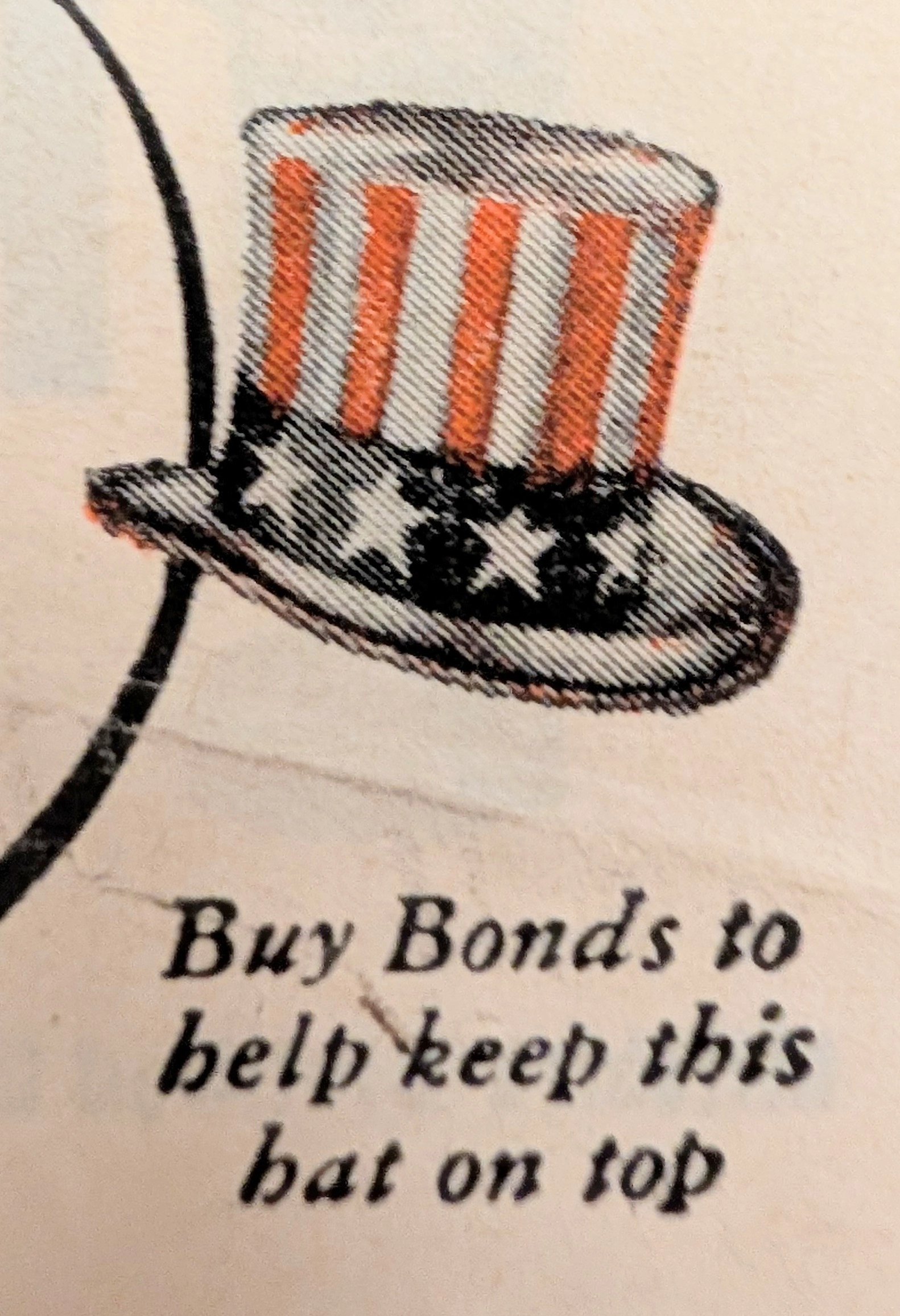
A nation does not wage war with steel alone. It wages war with capital. It fights with belief. Before 1941, the American consumer was a creature of comfort, trained by an emerging advertising industry to desire soda, automobiles, and modern conveniences. Then came the sudden violence of global conflict. The factories pivoted. The supply chains froze. The consumer economy ground to a sudden, devastating halt. Yet, the advertising machinery did not sleep. It was conscripted. The artifacts presented here—fragments of print from 1943, embedded within the commercial messaging of companies like The Seven-Up Co. and Autocar Trucks—represent a monumental shift in human behavior. This was the moment the public was asked to purchase the future instead of the present. The strategy was unprecedented. Convert the civilian into a shareholder of the state. Transform the act of saving into the ultimate act of aggression against an unseen enemy. This is not merely a collection of vintage advertisements. It is the exact inflection point where corporate marketing was weaponized for national survival.
Category: Other
Brand: War Bonds
The History
The Economic Frontline and the Threat of Disintegration To understand the profound weight of these small, seemingly innocuous printed insignias, one must first understand the macroeconomic precipice upon which the United States teetered in the early 1940s. The mobilization for the Second World War required astronomical capital. However, the greater threat was not just a lack of funding; it was the catastrophic potential for hyperinflation. With factories transitioning from manufacturing civilian goods to producing munitions, tanks, and aircraft, consumer products became exceptionally scarce. Concurrently, the wartime economy created full employment. Millions of citizens suddenly possessed disposable income but had virtually nothing to purchase. If this massive wave of capital were allowed to chase a dwindling supply of consumer goods, the economic structure would have collapsed under the weight of runaway inflation. The solution engineered by the Department of the Treasury was a masterpiece of mass psychology and economic suppression. By convincing the populace to funnel their surplus wages into War Bonds and Defense Stamps, the government effectively drained dangerous excess capital from the domestic market while simultaneously financing the European and Pacific theaters. The citizen was not merely donating; they were investing in a promised post-war prosperity, guaranteed by the very state they were funding. It was a closed-loop system of fiscal survival. The Formation of the War Advertising Council The sheer scale of this psychological operation required a distribution network the government did not possess. Enter the War Advertising Council. Formed in 1942, this coalition of ad agencies, media conglomerates, and corporate entities agreed to dedicate significant portions of their advertising budgets to promote government objectives. Notice the copyright of the first artifact: "Copr. 1943, The Seven-Up Co." This is a profound historical marker. A beverage company, unable to effectively sell its sugary product due to severe sugar rationing and logistical constraints, chose instead to sell national resolve. By embedding the "Buy More War Bonds" shield into their national print campaigns, corporations maintained their brand visibility and public goodwill without driving immediate consumer demand they could not fulfill. This represents the absolute genesis of what we now term "cause marketing." The corporate identity became inexorably linked with moral virtue. The shift was absolute: brands stopped selling what they made, and began selling what they stood for. The Iconography of the Minuteman Two of the artifacts prominently feature the "For Victory" minuteman. This is not a random illustration; it is a deliberate, highly calculated evocation of American mythology. The image is a direct translation of Daniel Chester French's famous 1874 statue, The Minute Man, located in Concord, Massachusetts. By resurrecting the imagery of the Revolutionary War, the Treasury Department drew a direct emotional parallel between the foundational myth of American independence and the existential struggle against the Axis powers. The minuteman was the ultimate citizen-soldier—a farmer who dropped his plow to pick up his rifle. In the mechanized, industrialized slaughter of 1943, the minuteman served as an ideological anchor. It told the factory worker, the housewife, and the schoolchild that they, too, were part of an unbroken lineage of patriotic sacrifice. The inclusion of the phrase "For Victory" alongside "United States War Savings Bonds Stamps" conceptually merged the act of handing over a dime or a dollar with the physical act of firing a musket. The wallet became the weapon. The Psychology of the Stamp: Weaponizing the Working Class The Series E War Bond was sold at a discount, costing
The Paper
The physical constitution of these fragments speaks directly to the constraints of the era. The paper stock is a mid-weight, machine-made wood pulp, typical of mass-circulation magazines like Life or The Saturday Evening Post during the early 1940s. Under magnification, the mechanical reality of the era is laid bare. We observe the distinct, regimented clusters of the CMYK halftone process in the color images, and the stark, high-contrast bite of letterpress or early offset lithography in the monochrome minuteman. The ink sits atop the paper with a distinct, tactile aggression. Decades of oxidation have shifted the once-stark white background into a warm, acidic patina—a visual representation of time itself digesting the artifact. The slight bleeding of the red and blue inks, known as dot gain, betrays the high-speed, high-volume nature of wartime publishing. These were not meant to be permanent; they were disposable ammunition in a war of minds. Their survival is an accident of history. They are temporal anchors, holding fast the exact texture of 1943.
The Rarity
Classification: Class A (High Contextual & Archival Value) Individually, war bond advertisements from mass-market magazines are relatively common. Millions were printed. However, their true rarity is not defined by scarcity, but by isolation. These specific fragments have been excised from their larger commercial contexts, isolating the psychological mechanism itself. Their value lies in their utility as uncorrupted historical data points. They are Class A artifacts because they flawlessly demonstrate the corporate-state alliance of WWII. While they may not command exorbitant prices at an auction house, to the historian, the sociologist, or the analyst of human behavior, they are absolutely invaluable primary sources.
Cite this article
- MLA
- Naodhinsuk, Ronin. “The Time Traveller's Dossier : WWII War Bonds - Corporate Conscription.” The Record Institute, 13 April 2026, https://therecord.institute/journal/the-time-travellers-dossier-wwii-war-bonds-corporate-conscription.
- APA
- Naodhinsuk, R. (2026, April 13). The Time Traveller's Dossier : WWII War Bonds - Corporate Conscription. The Record Institute. https://therecord.institute/journal/the-time-travellers-dossier-wwii-war-bonds-corporate-conscription
- CHICAGO
- Naodhinsuk, Ronin. 2026. “The Time Traveller's Dossier : WWII War Bonds - Corporate Conscription.” The Record Institute, April 13, 2026. https://therecord.institute/journal/the-time-travellers-dossier-wwii-war-bonds-corporate-conscription.