Viceroy: Al Unser and the "Taste of Excitement" — The Record Institute Journal
February 23, 2026

Viceroy: Al Unser and the "Taste of Excitement"

Archive Views: 74
Heritage AdvertisementsLuxury

The History

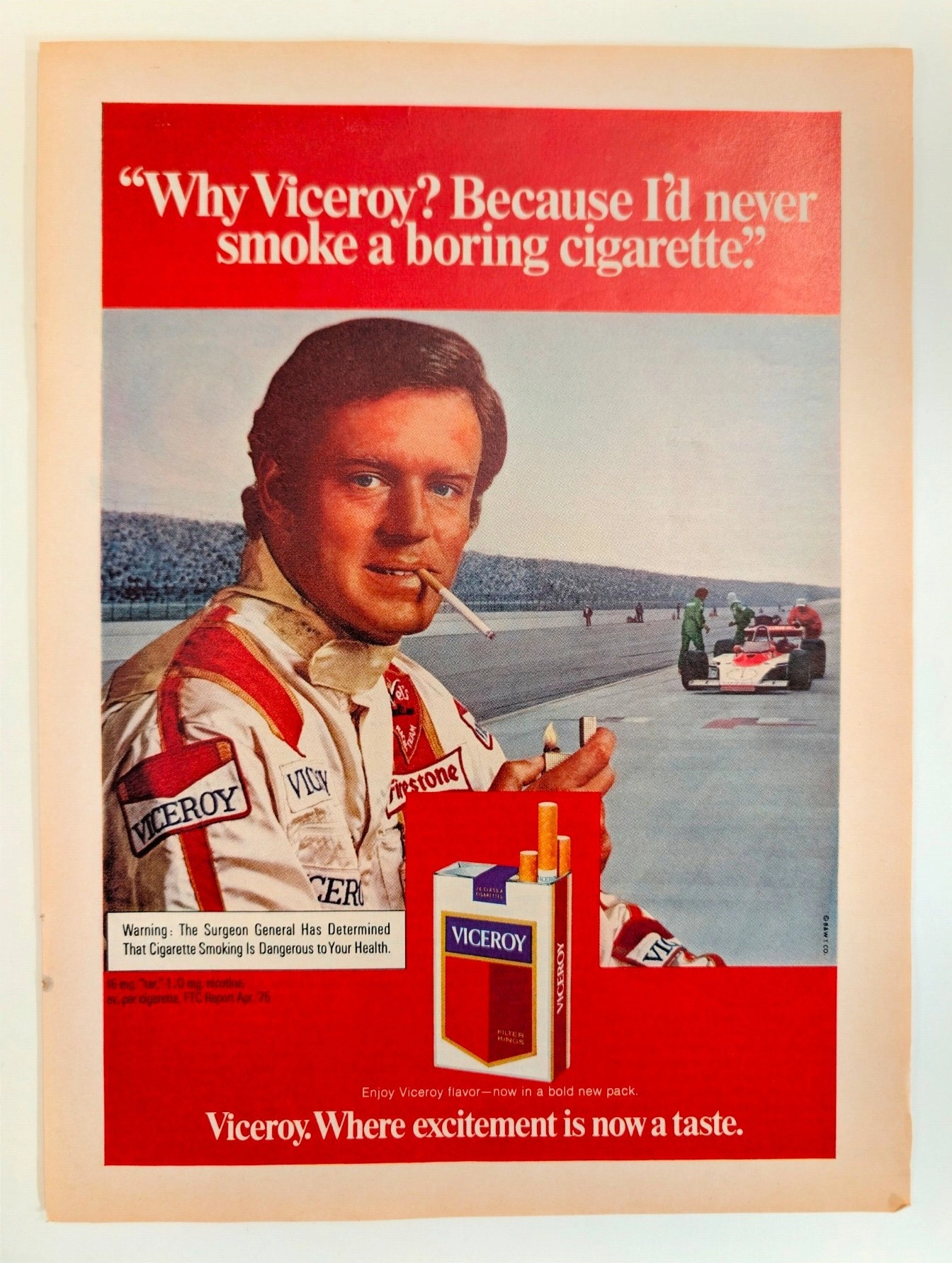
Al Unser (Alfred Unser Sr.): An American racing legend and one of only four drivers to win the Indianapolis 500 four times. His presence in a racing suit featuring Viceroy and Firestone patches serves as a "Champion's Seal," guaranteeing a "Taste of Excitement" in an era where smoke and victory were inseparable.

This is a chronicle of the golden age of "Tobacco Sponsorship" in 1975, when cigarettes were the stars of the racing stage. The claim "I'd never smoke a boring cigarette" challenged consumer norms. Today, this ad series is considered a "forbidden artifact" due to strict tobacco control laws, making it increasingly rare in the vintage market.
Viceroy utilized a "Winning on Sunday" strategy, using the image of a top driver as a bridge to the product. The dominant vibrant red tones evoke intensity, speed, and rebellion. It communicates that smoking Viceroy isn't just a habit, but an entry into the ranks of a world-class winning team.

Iconic 70s Analog Finish: This piece features film photography with saturated colors and natural lighting. The layout, showing Al Unser's face alongside the "Bold New Pack," is a deliberate visual connection intended to make the brain associate success with this specific taste.

▶ Watch Video
Video by: Nitro Mouth

Share This Archive

The Archive Continues

Continue the Exploration

The Time Traveller's Dossier: The Instant Gratification Protocol – The Polaroid Color Pack Camera Exhibitio

Polaroid · Technology

The Time Traveller's Dossier: The Instant Gratification Protocol – The Polaroid Color Pack Camera Exhibitio

The evolution of photography from a delayed, solitary, and highly technical chemical process into an instantaneous, shared, and interactive social event stands as one of the most profound technological and sociological shifts of the twentieth century. The historical artifact securely and elegantly positioned upon the analytical table of The Record Institute today is a majestic, large-format, two-page print advertisement for the Polaroid Color Pack Camera (Automatic 210), originating from the cultural zenith of the late 1960s. This document completely transcends the traditional boundaries of camera marketing and consumer electronics promotion. It operates as a sophisticated, multi-layered declaration of how optical innovation fundamentally altered human interaction, transforming the act of taking a photograph from a mere recording of memory into an active, thrilling focal point of social gatherings and familial bonding. This world-class, comprehensive dossier conducts a meticulous, unyielding, and exceptionally deep examination of the artifact, operating under the absolute most rigorous parameters of historical, sociopolitical, and material science evaluation. We will decode the vibrant, multi-generational suburban scene that perfectly encapsulates the "60-second excitement" phenomenon, analyzing the complex historical lineage of the Polaroid Corporation and the specific cultural impact of the Automatic 210 model. Furthermore, as we venture deeply into the chemical and physical foundations of this analog printed ephemera, we will reveal the precise mechanical fingerprints of the CMYK halftone rosettes and the graceful, natural oxidation of the paper substrate. This precise intersection of visual nostalgia, mid-century commercial artistry, and the immutable chemistry of time cultivates a serene wabi-sabi aesthetic—a natural, irreversible phenomenon that serves as the primary engine driving up its market value exponentially within the elite global spheres of Vintage Photography Ephemera and Americana collecting.

THE TIME TRAVELER'S DOSSIER:THE ENGINEERING OF ELEGANCE, THE GUCCI TRUNK, AND THE ARCHITECTURE OF REASON

Gucci x Mercedes Benz · Fashion

THE TIME TRAVELER'S DOSSIER:THE ENGINEERING OF ELEGANCE, THE GUCCI TRUNK, AND THE ARCHITECTURE OF REASON

The artifact under exhaustive, uncompromising, and unprecedented museum-grade analysis is a remarkably preserved Historical Relic originating from the absolute zenith of West German automotive engineering. This Primary Art Document is a densely informative, multi-column magazine advertisement for the Mercedes-Benz 280SE Sedan (W116 chassis). ​This document is a "Forensic Blueprint of Engineered Elegance and Status Commodification." It aggressively markets the 280SE as the "Heir to a Classic," positioning it as a vehicle that inherits the legendary proportions of the 450 Series but is powered by a highly advanced, fuel-injected 6-cylinder engine. The copywriting reads like an arrogant technical dossier, boasting of the "Continuous Injection System" (CIS) and a fully independent "Suspense-free suspension" derived from the legendary C-111 high-speed research vehicle. ​However, the absolute psychological masterstroke lies in the lower-left illustration. To visually prove the cavernous "18.2 cubic feet of usable space," the artist meticulously illustrated the trunk effortlessly swallowing a bicycle, golf clubs, and a set of Gucci luggage. The unmistakable beige geometric monogram and the iconic red-and-green Web stripe on the suitcases serve as a deliberate, powerful socio-economic signal. It explicitly communicates that the Mercedes-Benz trunk is designed exclusively for the "Jet-Set" elite who travel with Italian haute couture. ​Rescued from a mass-market periodical, this pre-2000s analog artifact exhibits a beautifully authentic warm ivory oxidation across its surface. This majestic chemical aging transforms a mass-produced piece of technical propaganda into an irreplaceable Primary Art Document of automotive and sociological history.

THE TIME TRAVELLER'DOISSIER : SUPERMAN — The Christopher Reeve Flagpole Postcard and the Birth of the Superhero Blockbuster

THE TIME TRAVELLER'DOISSIER : SUPERMAN — The Christopher Reeve Flagpole Postcard and the Birth of the Superhero Blockbuster

The item analyzed is an official Superman movie merchandise postcard or large-format photo card, featuring Christopher Reeve as Superman clinging dramatically to a metal flagpole while a large American flag billows behind him against a pure black background. The image is framed with a bold red outer border and a thin blue inner rule — a design consistent with the official Superman: The Movie (1978) merchandising aesthetic produced under license from Warner Bros. and DC Comics. Christopher Reeve (September 25, 1952 – October 10, 2004) portrayed Superman in four films (1978, 1980, 1983, 1987) and is universally regarded as the definitive cinematic Superman. This specific image — the flagpole scene lit dramatically against black — is one of the most iconic publicity photographs from the original film's promotional campaign. The physical item shows signs of age consistent with approximately 45–47 years, with slight surface wear and minor corner softening visible. The postcard format (estimated 4×6 or 5×7 inches) and the glossy coated stock are typical of high-quality movie merchandise of the late 1970s.

Published by

The Record Institute

Taxonomy Match

Related Articles

True Blood of the Trans-Am: The 1970 Ford Mustang Boss 302 Legacy — related article
Read Article

True Blood of the Trans-Am: The 1970 Ford Mustang Boss 302 Legacy

Experience the raw spirit of an American muscle car legend through an authentic, pre-2000 analog magazine advertisement, carefully extracted as a single sheet.

Vintage 70s Crown Royal Ad: Vanishing Analog Art | The Record — related article
Read Article

Vintage 70s Crown Royal Ad: Vanishing Analog Art | The Record

An in-depth look at the priceless 1970s Crown Royal "Have you ever seen a grown man cry?" advertisement. A masterpiece of authentic analog photography on degrading vintage paper, driving up the value of this original print as global supply inevitably shrinks.

Vintage Chivas Regal x Charles Saxon Ad: The Vanishing Playboy Art | The Record — related article
Read Article

Vintage Chivas Regal x Charles Saxon Ad: The Vanishing Playboy Art | The Record

An in-depth look at the Chivas Regal ad from Playboy magazine, illustrated by legendary artist Charles Saxon. A magazine-sized piece of authentic analog art on degrading vintage paper, driving up its value as an alternative asset.

Magnavox Star System 1981 Leonard Nimoy TV Advertisement | 'The Picture of Reliability' | Deep Analysis Rarity Class A-SS — related article
Read Article

Magnavox Star System 1981 Leonard Nimoy TV Advertisement | 'The Picture of Reliability' | Deep Analysis Rarity Class A-SS

The advertisement analyzed here is a full-page full-color magazine promotion for Magnavox's Star® System color television sets, copyright © 1981 N.A.P. Consumer Electronics Corp. The ad features what is almost certainly Leonard Nimoy — iconic for his role as Mr. Spock in Star Trek — dressed in a black nehru-collar uniform against a surrealist desert landscape, standing above a Magnavox color TV set (Model 4265, 19-inch diagonal) that displays an hourglass on screen. A second hourglass appears behind him. The visual concept communicates timeless reliability. The headline 'The Picture of Reliability' and tagline 'The brightest ideas in the world are here today' frame Magnavox's Star System as the pinnacle of 1981 television technology. The rainbow spectrum stripe at the bottom is a distinctive brand element that ran across Magnavox advertising throughout the early 1980s. N.A.P. (North American Philips) Consumer Electronics Corp. was the American subsidiary of Philips that owned the Magnavox brand at this time, having acquired it in 1974.

THE TIME TRAVELER'S DOSSIER: THE KOREAN WAR ANCHOR AND THE SCARCITY OF LUXURY — related article
Read Article

THE TIME TRAVELER'S DOSSIER: THE KOREAN WAR ANCHOR AND THE SCARCITY OF LUXURY

The artifact under our uncompromising, unprecedented museum-grade analysis is a profoundly preserved Historical Relic excavated from the golden age of post-WWII American opulence. This Primary Art Document is a monumental magazine advertisement for the Imperial by Chrysler, dating to the pivotal 1951-1952 era. This document is a "Forensic Blueprint of American Aristocracy and Geopolitical Crisis." It masterfully weaponizes regal European iconography to elevate Chrysler's flagship model above mere transportation, explicitly targeting "those who can afford any motor car in the world". Yet, its most significant historical anchor is hidden in the microscopic fine print: "WHITE SIDEWALLS WHEN AVAILABLE". This single sentence instantly transforms the advertisement into a wartime relic, reflecting the severe rubber shortages imposed during the Korean War. Grounded by the iconic jeweled emblem and its breathtaking wabi-sabi chemical degradation—highlighted by its violently torn binding edge—this artifact commands an irreplaceable status, cementing its Rarity Class A designation.

"The Bloodline of Champions: Ferry Porsche's Ultimate Test" — related article
Read Article

"The Bloodline of Champions: Ferry Porsche's Ultimate Test"

Uncovering the historical lineage of Porsche's motorsport dominance, from the 1922 Sascha to the legendary 917, and how track technology forged the 911.