What Happened to Piedmont Airlines? The Pacemaker Airline America Loved
In April 1989 Piedmont Airlines had 22,000 employees, 95 airports and a widebody route to London. Four months later it no longer existed — not bankrupt, but bought, at sixty-nine dollars a share, for the very qualities that had made it America's most loved airline. This is the full record of the Pacemaker airline: a Winston-Salem flying service that began with one DC-3 and one paying passenger, the fewest complaints of any airline in America, a bidding war, a two-year goodbye, and a hometown that took eighteen years to empty.
The History
### At its peak, and already sold
In April 1989, Piedmont Airlines stood at the summit of its life. It employed some 22,000 people [S14]. It served 95 airports in its own name [S14], and its aeroplanes were boarding passengers at a pace of more than 23 million a year, by the company's own published count [S4]. That spring its widebody jets were flying from Charlotte, North Carolina, to London — an ocean away from the small Southern towns where the company had begun [S13]. Four months later, Piedmont did not exist. It had not gone bankrupt. It had not been beaten by a better airline, or undone by scandal, or grounded by its regulators. Piedmont was bought — at a premium, after a bidding war between two larger companies — for precisely the qualities that had made it the most admired airline in America: its loyal passenger following, its profitability and its route system [S5][S8]. On 5 August 1989 the Piedmont name came off the fleet, and an airline that had once recorded the fewest passenger complaints in the United States passed into memory [S6][S8]. This is the full record of the Pacemaker airline: how a Winston-Salem flying service became the carrier America loved, and how being loved made it a target. Piedmont may be the only major American airline whose ending was caused, in the plainest sense, by its own excellence.
### A flying service, not an airline
Piedmont began as something considerably smaller than an airline. In July 1940, in Winston-Salem, North Carolina, Thomas H. Davis created Piedmont Aviation, Inc., growing it out of Camel City Flying Service — a local business that sold aeroplanes, serviced them and trained pilots [S1][S2]. There were no routes, no schedules and no passengers; for its first years the company was a flying service in the plain sense, part of the small world of pre-war American aviation. The airline existed on paper before it existed in the air. In 1947 the Civil Aeronautics Board awarded Piedmont its route authority, and the certificate took effect on 1 January 1948 [S2]. Piedmont became an airline in law on New Year's Day; it became one in fact seven weeks later, when the first fare-paying passenger climbed aboard. Eight years separate the founding of the company from the first fare it ever collected — a reminder that Piedmont the airline, for all its later polish, began as a hometown business that had to wait for Washington's permission to carry anyone anywhere. Winston-Salem was Davis's home ground, and it stayed the airline's headquarters for the whole of its life, from the first DC-3 to the last Boeing 767 [S1]. When the end came, it would come to Winston-Salem hardest.
### Flight 41
The first flight, when it finally came, was modest to the point of comedy. On 20 February 1948, Piedmont's Flight 41 left Wilmington, North Carolina, for Cincinnati, Ohio: a single Douglas DC-3, stopping at Pinehurst, Charlotte, Asheville, the Tri-Cities and Lexington on the way, scheduled from 7:05 in the morning until 12:24 in the afternoon [S1][S3][S4]. Five stops, more than five hours — and, for the entire journey, exactly one paying passenger. His name was Bill Turner, and he had paid thirty-four dollars and thirty-five cents for his ticket [S1][S3]. The route itself was the pattern of Piedmont's first decades in miniature: not a dash between great cities, but a chain of small ones — a coastal port, a mill town, a mountain city — linked one short hop at a time, collecting passengers the big airlines flew over. Airlines are not usually founded on a single fare, but Piedmont was, and the detail is worth keeping because the company itself kept it: the first flight was still being retold in the airline's own magazine forty years later, in the last full year of its life [S4]. An airline that begins with one passenger learns to count every passenger. Piedmont built its reputation on exactly that arithmetic — on the idea that the person in the seat was not traffic, but the whole reason for the flight. The record of the next four decades suggests the lesson held.
### Every aeroplane a Pacemaker
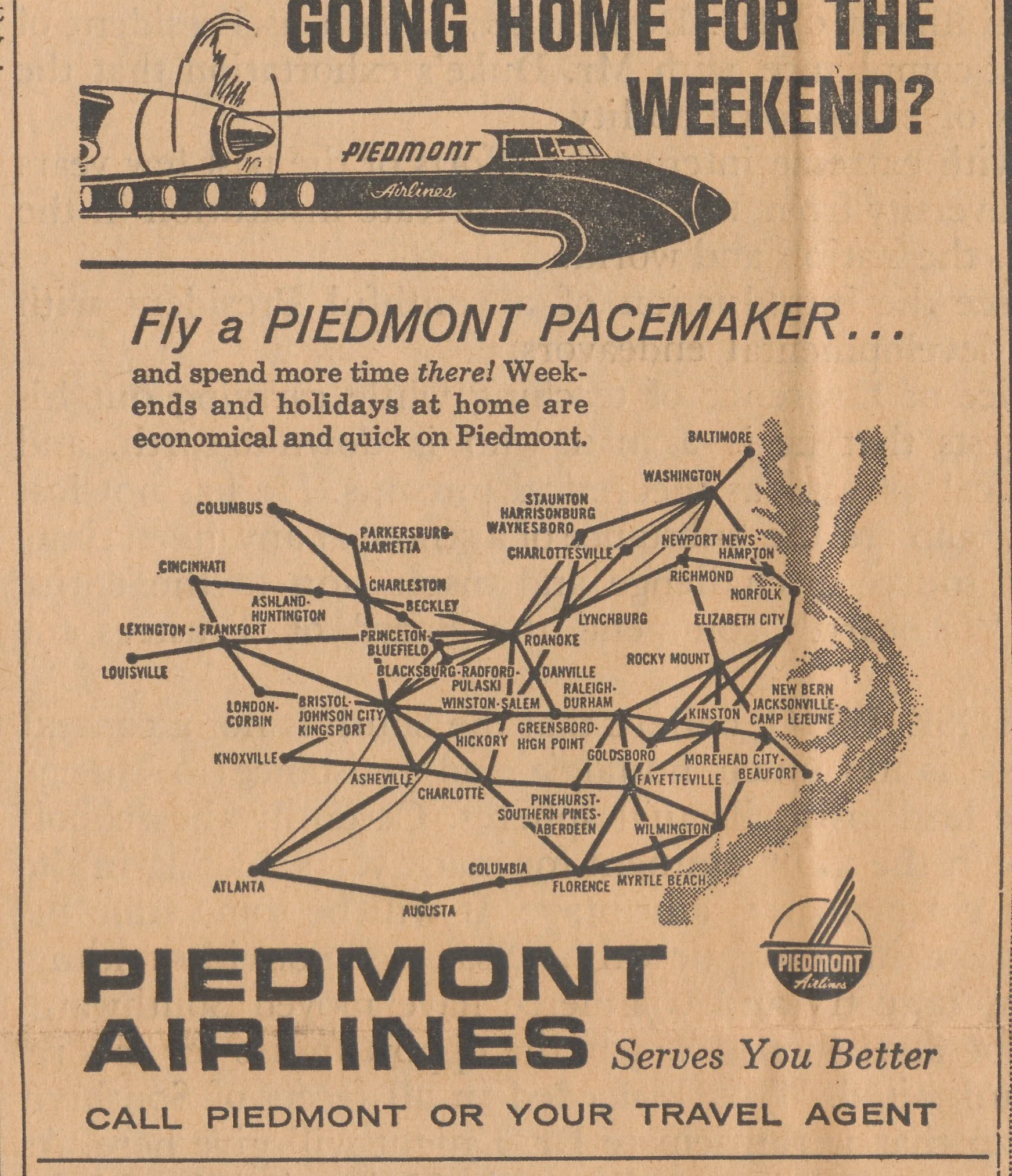
Davis gave the airline a naming habit that became its identity. Every Piedmont aeroplane carried a name on its nose — a place name joined to the word Pacemaker — and the company's motto, in Davis's own formulation, was "Piedmont Sets the Pace" [S11][S5]. The names were not decoration. They were a standard the company then had to meet in public, month after month, and by the measures that existed, it met it. In the first half of the 1970s, for six rolling twenty-four-month periods, Piedmont recorded the fewest passenger complaints of any airline in the United States, according to the Civil Aeronautics Board's Office of Consumer Affairs [S6]. Because the periods rolled forward and overlapped, this was not one good year but a position held continuously, across half a decade, in the regulator's own published figures. No modern ranking is being claimed here, because none exists; the claim rests on the regulator's own complaint ledgers of the time, and on what the institutions chose to keep. The Smithsonian's National Air and Space Museum holds a Piedmont flight attendant's handkerchief from 1989, and its catalogue describes the airline, in the museum's own words, as "noted for its excellent service and 'southern hospitality'" [S3]. In 1984, Air Transport World named Piedmont its Airline of the Year [S7]. Service of that order is not an accident of temperament. It is what happens when a company small enough to know its passengers decides, as a matter of policy, to be known by them.
### From DC-3s to jets
The fleet grew up in public, one generation at a time. The DC-3s that had opened the airline in 1948 flew on until 1963 — fifteen years of service from the type that had carried Bill Turner [S5]. Pressurisation arrived on 4 December 1961 with the Martin 4-0-4: seventeen aircraft bought second-hand from TWA for three and a quarter million dollars, the first Piedmont type whose passengers no longer had to feel the weather on the way up [S5][S6]. The jet age reached Winston-Salem in March 1967, with the first Boeing 727s, and Boeing 737-200s followed in 1968 [S5]. Between them, on 19 May 1968, Piedmont put the Japanese-built NAMC YS-11A turboprop into service; its first example wore the nose name Cherry Blossom Pacemaker, in the house style [S6]. The YS-11s were the last propeller aircraft in the fleet — their final flights came in 1982, and from that year Piedmont was an all-jet airline [S5]. Each step was taken by a carrier the industry had once filed away as a regional feeder: DC-3s to Martins, Martins to jets, jets to widebodies, all inside one working lifetime. By the time the last propeller turned in 1982, the fleet that had begun with DC-3s was flying the same Boeing types as the largest carriers in the country.
### Hubs, and then the Atlantic
Deregulation, which broke so many American airlines, was Piedmont's opportunity. Freed to build a system rather than a web of local routes, it thought in hubs. Charlotte, in its home state, was chosen in 1979 and was operating as Piedmont's first hub in 1981, with a new terminal following in 1982. Dayton, Ohio, became a hub on 1 July 1982, and Baltimore in 1983. Syracuse, in New York, came with the Empire Airlines merger — agreed in October 1985 and completed on 1 May 1986 — giving the final system its four hubs: Charlotte, Baltimore, Dayton and Syracuse [S5][S6]. By September 1988 the system reached 95 airports of Piedmont's own, with 39 more served through its affiliates [S14]. Then, in the spring of 1987, the regional airline did the thing no one had scripted for it. On 21 May 1987 Piedmont took delivery of its first Boeing 767-200ER — registered N603P and named, inevitably, Pride of Piedmont — the only widebody type it would ever fly [S13][S6]. On 15 June 1987 it opened service from Charlotte to London Gatwick: its first transatlantic route, flown under its own name by an airline that had begun, thirty-nine years earlier, with one passenger [S13]. The traffic figures by then were a major airline's. In May 1988 Piedmont boarded 2,385,939 passengers, and 10,977,934 in the first five months of that year — a pace of more than 23 million a year, by the company's own published count [S4]. A carrier that had started with five stops between Wilmington and Cincinnati now crossed the Atlantic without stopping at all.
### The bidding war
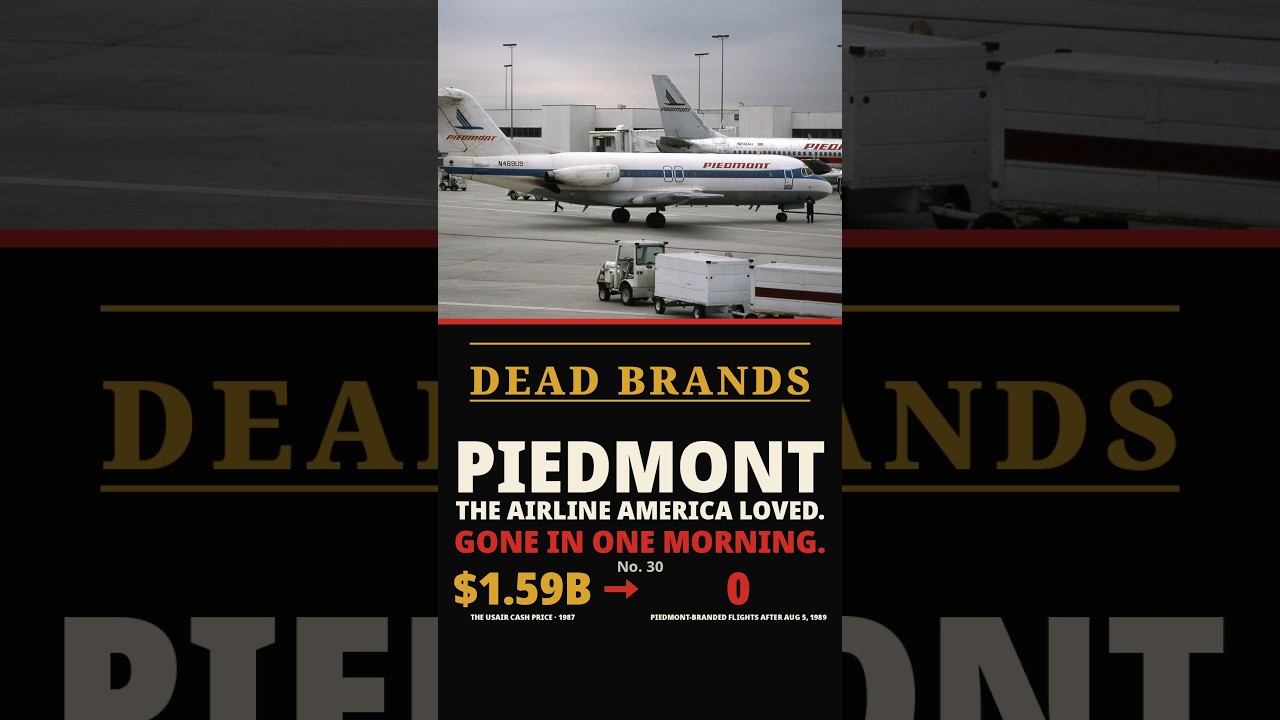
What Piedmont had built was, by 1987, exactly what bigger airlines lacked. R.E.G. Davies, the Smithsonian's historian of American airlines, lists the qualities that made Piedmont a buyout target: "high-quality service, extensive route network, and profitability" — to which the record adds the asset no balance sheet could show, its loyal passenger following [S5]. In February 1987 the contest for it opened. USAir made its first approach on 5 February. Norfolk Southern — a railway company that wanted an airline — bid sixty-five dollars a share on 17 February [S8][S9]. On 6 March 1987, USAir agreed to buy Piedmont for sixty-nine dollars a share, about 1.59 billion dollars in cash [S8][S9]. The price had risen because two buyers wanted the same thing — and what they wanted was not, in the end, aeroplanes. It was the affection of Piedmont's passengers, converted year after year into bookings and profits. The Department of Transportation approved the transaction on 30 October 1987, and ownership closed that November, in a tender valued at about 1.6 billion dollars [S8]. The three dates are worth keeping apart, because Piedmont's ending is so often mistold as a single event. The airline was sold in 1987. But a sale is not a disappearance: Piedmont went on flying in its own colours, under its own name, with its own crews, for almost two more years — a bought airline in no hurry to stop being itself.
### The long goodbye
The delay was structural, not sentimental: integration was held up from November 1987 to August 1989 by regulatory and labour questions that had to be settled before two airlines could be welded into one [S8]. So Piedmont had a long goodbye — two more summers of Pacemakers at the gates, flown and crewed by people who knew the name on the nose was living on borrowed time. The last Piedmont flights operated on 4 August 1989. On 5 August 1989 the airline was absorbed into USAir, and the Piedmont name was removed from the fleet [S8]. What the merger did to its buyer belongs to research rather than to nostalgia. Economists who studied the integration found that afterwards USAir's costs rose and its service deteriorated; its stock fell from fifty-four dollars to twenty-one dollars and thirty-seven and a half cents within a year; and more than 2.5 billion dollars of shareholder value was destroyed within five years [S8]. The hometown's loss arrived more slowly, which is its own kind of hard. At the time of the deal, Piedmont employed 5,600 people in Winston-Salem. That number melted over the years that followed to a low of 485 by October 2005, and of the airline's top forty officials, only four remained when the integration was complete [S10]. The figures are the hometown newspaper's own, gathered for a retrospective published twenty years after the deal — long enough for the melt to be measured rather than guessed at. The aeroplanes were repainted in a season. Winston-Salem took eighteen years to empty.
### The name that did not quite die
One thread of the company survived the absorption, by an accident of corporate housekeeping. In 1983 Piedmont had bought Henson Aviation, a Maryland commuter carrier founded in 1961 that had flown scheduled services since 1962, and operated it as "Henson, The Piedmont Regional Airline". In 1993, USAir renamed that company Piedmont Airlines — to protect the trademark [S12]. The company that carries the name today is that company: a different airline from the one Thomas Davis founded, and honest history has to say so. It flies as an American Eagle carrier, wholly owned by American Airlines Group, with its headquarters at Salisbury, Maryland, and hubs at Charlotte and Philadelphia. In June 2025 it operated 68 Embraer ERJ-145 regional jets and counted some 11,000 team members, and it has 45 new Embraer 175s on order, announced in June 2025 for delivery from the first quarter of 2028; the ERJ-145s are to continue alongside them, and no retirement or shutdown has been announced [S12]. The name Davis put on a flying service in 1940 is still at work, on aeroplanes he never saw, for a company he never knew. Even the map remembers the original. The Charlotte hub Piedmont established, maintained by US Airways in the years after, is now American Airlines' second-largest hub [S5]. And the aeroplanes never entirely left: a DC-3 in full Piedmont colours, kept by the Carolinas Aviation Museum in Charlotte, was still carrying the name to airshows years after the airline ended. The 1948 airline is gone. What it built — and how it treated the one passenger it started with, and the millions who came after — is why its name still draws memories out of the people who flew it, crewed it and grew up beneath its flight paths.
### Watch the story
The Piedmont story is also told on the Dead Brands channel, as a three-minute episode — "Piedmont Airlines", Dead Brands No. 30: https://www.youtube.com/shorts/x-aaucS0ZFs Piedmont has no long-form film; the episode exists as the Short alone. The 1962 Pacemaker advertisement reproduced at the head of this article is catalogued in The Record Institute's Gallery — see the companion record on the Duke Chronicle advertisement of 1962 — and the brand's case file is at /dead-brand-stories/piedmont-airlines.
### The conversation continues
Piedmont's story is still being told by the people who lived it. When the episode was published, its Facebook post became a meeting place: former Piedmont pilots, flight attendants, ground staff and passengers have been posting their own memories there — first flights and last flights, aeroplanes crewed and routes flown, colleagues remembered. The thread drew 120 comments and is still growing. If you flew Piedmont, worked for Piedmont, or grew up watching its Pacemakers, your memory belongs in that thread. The episode's Facebook Reel, with the conversation beneath it, is here: https://www.facebook.com/reel/1538805461405094/
### References / Sources
[S1] North Carolina Department of Natural and Cultural Resources — "Piedmont Airlines Takes Flight" and related state history materials: the July 1940 creation of Piedmont Aviation out of Camel City Flying Service, and the first flight of 20 February 1948.
[S2] NCpedia (State Library of North Carolina) — the entries on Piedmont Aviation and Piedmont Airlines: the Civil Aeronautics Board award of 1947 and the certificate effective 1 January 1948.
[S3] Smithsonian National Air and Space Museum — the Capt. Leon M. Fox Wall of Honor record (Flight 41 and its one passenger, Bill Turner), and catalogue record A19900337000, a Piedmont flight attendant's handkerchief of 1989, for the service description quoted in section 4.
[S4] Piedmonitor, the Piedmont Airlines employee magazine — the February 1988 retelling of the first flight, and the June 1988 issue for the boarding figures of May 1988 and January–May 1988.
[S5] R.E.G. Davies, Airlines of the United States Since 1914 (Smithsonian Institution Press) — the fleet and hub chronology, the buyout-target assessment quoted in section 7, and the Charlotte hub's later history.
[S6] American Aviation Historical Society Journal — the Civil Aeronautics Board complaint record of the 1970s, and fleet and hub corroboration, including the YS-11A's entry into service on 19 May 1968.
[S7] Air Transport World — Airline of the Year 1984; with the Piedmont Aviation Historical Society marker record and the South Carolina House resolution of February 1985.
[S8] Stacy R. Kole and Kenneth Lehn, National Bureau of Economic Research — the study of the USAir–Piedmont merger: the bidding and agreement of February–March 1987, the delayed integration, and the shareholder-value findings stated in section 8.
[S9] Aviation Week, 16 March 1987 — the terms of the March 1987 agreement and the February 1987 approaches and bids.
[S10] Winston-Salem Journal, retrospective of 4 November 2007 — the Winston-Salem workforce figures (5,600 at the time of the deal; a low of 485 by October 2005) and the four of Piedmont's top forty officials who remained.
[S11] Our State magazine — Thomas H. Davis and the motto "Piedmont Sets the Pace".
[S12] Piedmont Airlines (the present-day carrier) — the company history of the Henson lineage and the company release of 10 June 2025; with American Airlines Group reporting for the June 2025 fleet of 68 Embraer ERJ-145 aircraft.
[S13] World Airline News — the chronology of the Boeing 767-200ER delivery of 21 May 1987 and the opening of Charlotte–London Gatwick service on 15 June 1987.
[S14] Flight International Directory, as carried in the episode research file — the April 1989 employment figure of 22,000 and the September 1988 system of 95 airports, with 39 further points served through affiliates.
Archive Film
What Happened to Piedmont Airlines? The Pacemaker Airline America Loved
Runtime not listed
Cite this article
- MLA
- Naodhinsuk, Ronin. “What Happened to Piedmont Airlines? The Pacemaker Airline America Loved.” The Record Institute, 25 November 2026, https://therecord.institute/journal/what-happened-to-piedmont-airlines-the-pacemaker-airline-america-loved.
- APA
- Naodhinsuk, R. (2026, November 25). What Happened to Piedmont Airlines? The Pacemaker Airline America Loved. The Record Institute. https://therecord.institute/journal/what-happened-to-piedmont-airlines-the-pacemaker-airline-america-loved
- CHICAGO
- Naodhinsuk, Ronin. 2026. “What Happened to Piedmont Airlines? The Pacemaker Airline America Loved.” The Record Institute, November 25, 2026. https://therecord.institute/journal/what-happened-to-piedmont-airlines-the-pacemaker-airline-america-loved.