What Happened to Schlitz? The Beer That Made Milwaukee Famous
In 1976 Schlitz sold 24.2 million barrels of beer — the best year in its history — and in that same year, without announcement, it quietly recalled more than ten million bottles and cans of its own beer. Six years later the company was gone. This is the full record of the beer that made Milwaukee famous: a bookkeeper who put his name over the door, a slogan that outlived the brewery, thirteen dry years survived on malt syrup and near beer, and a recipe changed a little at a time, on purpose, until there was nothing left worth saving.
The History
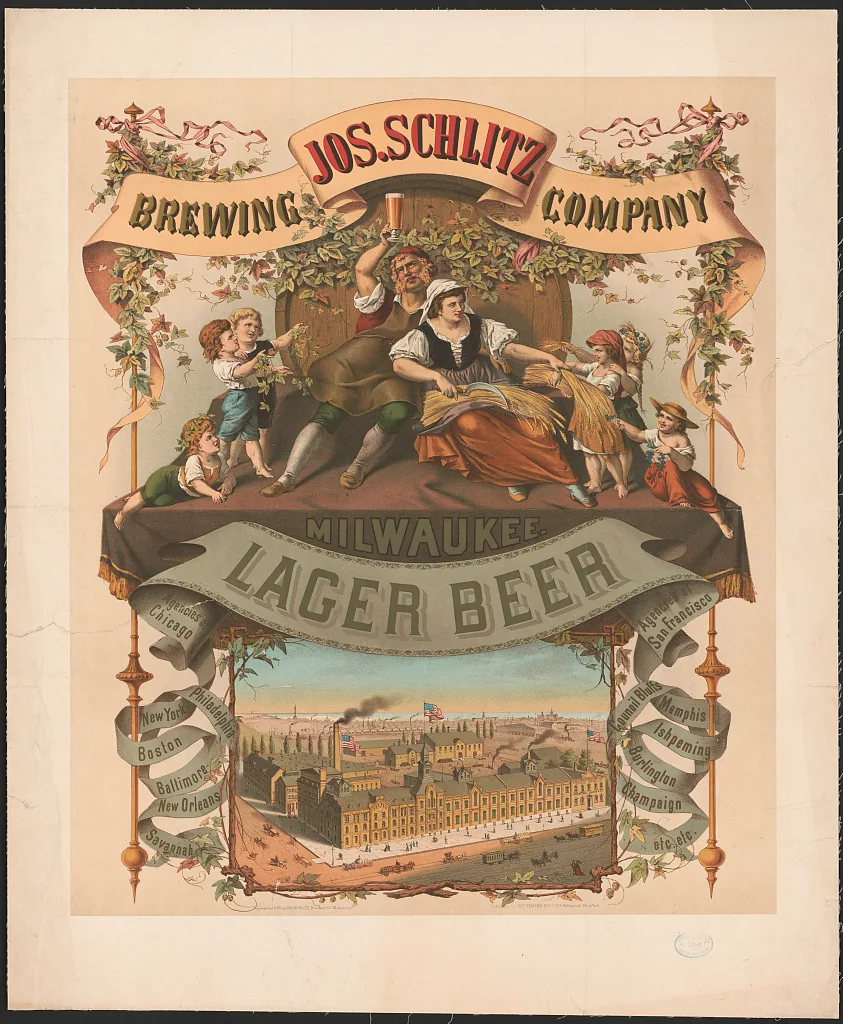
### The best year, and the quiet recall In 1976, the Joseph Schlitz Brewing Company sold more beer than in any year of its life: 24.2 million barrels, a figure its own stockholders' reporting put at 24,162,000 barrels [S2][S4]. The year came with an asterisk — a strike at Anheuser-Busch had helped clear the field [S2]. But 1976 holds a second distinction, and Schlitz never announced it. In that same year, without public statement, the company was quietly taking back its own beer by the millions of bottles and cans, because drinkers were finding things floating in it. The peak and the recall are the same year. Six years after the best year in its history, the company August Krug founded in 1849 no longer existed as an independent brewer. This is the record of how the beer that made Milwaukee famous got to the top of American brewing — and of the recipe changes, made a little at a time and entirely on purpose, that brought it down. ### A bookkeeper's name over the door August Krug, a German immigrant, founded a tavern brewery in Milwaukee in 1849. A year later he hired a bookkeeper, Joseph Schlitz. When Krug died in 1856, Schlitz took over the brewery; in 1858 he married Krug's widow, Anna Maria, and put his own name on the company [S1][S2]. The growth that made the name national ran through Chicago. Schlitz kept a Chicago agency from 1868, and after the Great Chicago Fire of October 1871 a story attached itself to the company that has followed it ever since: that Schlitz rushed free beer into the burned, thirsty city and won Chicago forever. It is a fine story, and the record does not show it. What the record shows is a company already selling in Chicago before the fire, whose Chicago sales more than doubled in the year after it; brewing-history scholarship treats the free-beer donation as a legend added later [S1]. Joseph Schlitz did not live to see the slogan or the summit. On 7 May 1875 he died in the wreck of the SS *Schiller*, and control passed to the Uihlein brothers — Krug's nephews — who kept the Schlitz name and ran the company for the next hundred years [S1][S2]. The chromolithograph in this article, printed in 1878, shows what they inherited: a harvest couple above a panorama of the Milwaukee brewery, its ribbons naming agencies from New York to San Francisco. ### The beer that made Milwaukee famous The slogan arrived in the early 1890s — the Encyclopedia of Milwaukee dates it to 1894, while several accounts place it in 1893, at Chicago's Columbian Exposition — and it stated the company's position as a fact of geography: this was "the beer that made Milwaukee famous" [S1]. In 1902 the claim underneath it became measurable: Schlitz passed Pabst to become America's largest brewer, producing about one million barrels a year [S1][S2]. A barrel of beer holds 31 gallons, so a million barrels was already a river of beer for 1902 — and worth holding, because at its peak Schlitz would sell twenty-four times as much. The advertising of these years is confident to the point of theatre. The 1888 chromolithograph in this article shows two presidents of the United States raising glasses of Schlitz before the Capitol — imagery, not endorsement, and the presidents are left unnamed here as the sheet leaves them emblematic. A 1900 newspaper advertisement gives the belted-globe trademark a body: a Gambrinus-style figure wearing the globe itself, under the words "THE WORLD IS MINE!" ### Made pure, kept pure Before the First World War, Schlitz's printed argument settled on a single word: purity — and on the bottle that was supposed to guarantee it. The 1913 newspaper advertisement reproduced in this article is headed "Schlitz in Brown Bottles", and its promise runs "made pure, kept pure". Three years later the company bought a full page of the *San Francisco Chronicle* to make the same argument as a riddle: "Remember how your mother always kept her fruit in a dark place in the cellar? Why?" The answer the advertisement supplied was its own pitch — that light, and ultra-violet rays in particular, spoil beer, and that the brown bottle was the drinker's protection against them. These are the advertiser's claims, printed as persuasion, and they are presented here as claims: what matters is that for decades the brand's public promise was care — a beer made carefully and kept carefully, in the dark, all the way to the glass. The company would eventually be undone by the distance between what its advertising said it did and what its brewing ledgers were doing. ### Thirteen dry years, then second place Prohibition closed the taps from 1920 to 1933, and Schlitz survived it as the Schlitz Beverage Company — on malt syrup, sodas and bakery goods, and on Famo, its de-alcoholized "cereal beverage", a near beer [S1][S6]. The famous slogan was adjusted to fit the times: for thirteen years Schlitz was "the *drink* that made Milwaukee famous". The 1920 *Boston Globe* advertisement in this article, headed "Don't Jazz Your Stomach — Drink Schlitz", belongs to that in-between world — a fully fermented drink with the alcohol reduced to the federal limit, sold by a brewer not, for the moment, allowed to sell beer. After Repeal, Schlitz and Anheuser-Busch exchanged the top spot repeatedly through the 1950s, until, in 1957, Budweiser pulled ahead for good [S1][S2]. What followed was not decline but a long, stable second place: Schlitz remained America's No. 2 brewery as late as 1976, first or second in the nation from 1902 into the middle of the 1970s, losing the No. 2 position to Miller only in 1977 [S1]. That is the altitude from which the next section's decisions were taken — by the family that had built the position. ### The Schlitz Mistake Robert Uihlein Jr. had been the company's president since 1961 and its chairman since 1967. His problem was the one the scoreboard set him: he could not outsell Anheuser-Busch. His answer, in *The Beer Connoisseur*'s account, was to stop trying — if Schlitz could not outsell its rival, it would out-profit it, spending less on every barrel [S7][S11]. The programme began in 1967 with accelerated batch fermentation, a process that cut weeks out of the brewing cycle. Then the ingredients followed: corn syrup replaced some of the malted barley; cheaper hop pellets and extracts replaced fresh hops; the fermenters ran hotter than the traditional method allowed [S7]. Each change was small, and made one at a time, on the belief that drinkers would not notice any single step. Cumulatively, the reformulated beer lost flavour and consistency, and spoiled faster on the shelf. The rushed beer created a technical problem of its own: beer not aged long enough does not clear, and proteins that would have settled out in a long lagering instead turned it hazy when chilled. Schlitz answered with silica gel, an additive that prevented the haze [S3]. Then came the swap at the centre of this story. Fearing that regulators would require ingredients to be listed on the label, Schlitz replaced the silica gel with Chill-garde, a clarifying agent filtered out at the end of production and therefore not disclosable. No regulator ever forced the issue; the labelling rule Schlitz feared was never enacted in the record [S3]. Inside the beer, Chill-garde reacted with Kelcoloid, the foam stabilizer — a seaweed-derived alginate — forming tiny white flakes that clumped together like mucus and grew worse the longer the beer sat on the shelf [S3]. The beer was perfectly safe to drink. It looked tainted. When Schlitz tried the other way out — dropping the Kelcoloid instead — the beer poured flat and headless, "flat as apple cider" [S3]. How the story is usually told, the flakes belong to 1976. The record requires more care. Complaints about flaky beer had surfaced as early as September 1975, and quiet removals of beer from sale — more than half a million cases, across seventeen states — had already taken place by then; what caused those earlier flakes, the research behind this article does not establish, and no line is drawn here between them and the clarifier [S3]. What is established is the scale of the response in the peak year itself. Schlitz quietly recalled the beer — more than 10 million bottles and cans. The recall cost 1.4 million dollars. That November, on 12 November 1976, Robert Uihlein Jr. died of leukemia, weeks after his diagnosis, aged 60 — and leadership passed out of the Uihlein family for the first time in a century [S4][S1]. An accountant, Eugene B. Peters, took the president's chair and resigned within about a year. It is sometimes said that the accountants ran Schlitz into the ground; the recipe decisions all predate Peters. It happened under the family's own chairman [S4]. ### The failed repair The rescue, when it came, came from the rival. Frank J. Sellinger, a chemist and brewmaster who had worked at Anheuser-Busch from 1964, joined Schlitz in November 1977 and became vice chairman and chief executive in 1978. One of his first tasks was to return the company to a traditional brewing process. He reworked the beer's taste, staged live televised taste tests, and from 1978 appeared on television himself in the "Taste My Schlitz" campaign; he also pared expenses, cut excess capacity and tightened quality control [S4][S8]. The *New York Times* recorded the depth of it: shortly after Sellinger started, his own daughter telephoned from the West Coast — "Daddy, I don't like that beer" — and he answered, "Honey, do me a favor. Try Schlitz Malt Liquor. If you still don't like it, go back to Budweiser" [S4][S8]. Advertising had already produced a wound of its own. In 1977 the agency Leo Burnett made a television campaign in which Schlitz drinkers jokingly threatened an off-screen voice urging them to switch brands. Audiences found the joke menacing; Schlitz pulled the advertisements after ten weeks and fired Burnett. The campaign is remembered by the nickname the advertising industry gave it — "Drink Schlitz or I'll kill you" — a name Schlitz never chose and never used [S9]. Then the law arrived. On 15 March 1978, after a federal investigation that had run for years, a grand jury indicted Schlitz on 747 counts of illegal marketing practices under the Federal Alcohol Administration Act: three felony counts, one misdemeanor conspiracy count, and 743 misdemeanor counts, alleging inducement payments made to win placements between 1972 and 1977 — payments later reporting said had been concealed in a second set of books [S9]. An indictment is an accusation, not a verdict, and this article states no outcome, because the research behind it establishes none. The money told its own story: a company that had made almost 50 million dollars in profit five years earlier posted a loss of 50.6 million dollars in 1979 [S4]. ### The flagship closes The barrels chart the fall more plainly than any headline. From 24.2 million barrels in 1976, sales fell to 19.6 million in 1978, then to 14.9 million in 1980 and 14.3 million in 1981 — the last two figures from the Department of Justice's own complaint in the merger case that followed [S5]. By 1980 the company that had defined second place stood fourth, behind Anheuser-Busch, Miller and Pabst. On 1 June 1981, about 700 production workers struck at Milwaukee. Schlitz answered by closing the Milwaukee brewery — the flagship plant of 1870, its oldest and least efficient — permanently, effective 30 September 1981 [S1][S2]. In 1982, Schlitz was sold to Stroh, for about 500 million dollars; Stroh became America's third-largest brewer, and federal approval required it to sell either Schlitz's Memphis plant or its Winston-Salem plant [S5]. Sellinger stayed until his retirement in 1983 — outlasting the independent company itself [S8]. ### The name outlives the company On 8 February 1999, Stroh sold its labels in a split breakup: Pabst took most of the brands, Schlitz among them, while Miller took Henry Weinhard's and Mickey's. Pabst did not acquire the Stroh company itself, and Stroh dissolved the following year [S9]. In 2008 Pabst relaunched Schlitz — but the original formula no longer existed, lost in the reformulations of the 1970s, so the "Classic 1960s Formula" was reconstructed from documents and interviews with former Schlitz brewers. It was contract-brewed for Pabst by Miller, and sold first in Chicago, Florida, Boston, Minneapolis–Saint Paul and Milwaukee; Pabst reported its best sales trend since 1999 that year, and from 2009 some Schlitz was brewed in Milwaukee again, at the MillerCoors brewery [S10][S2]. The company had died in 1982. The name lived on. In May 2026, the name reached its own ending — or, in Pabst's chosen word, its pause. On 15 May 2026 Pabst announced it would stop producing Schlitz; its head of brand strategy, Zac Nadile, cited the rising costs "to store and ship" the beer. Pabst's own word for the move is "hiatus": the trademark is retained, and no return date has been announced [S2]. Before production stopped, one last batch was made. With Pabst's permission, the Wisconsin Brewing Company of Verona, Wisconsin brewed 80 barrels on 23 May 2026, working from the company's 1948 specifications; it was released on 27 June 2026 [S2][S10]. Eighty barrels, for the beer that once sold 24.2 million barrels in a single year. Schlitz did not lose to a better beer. It lost to its own recipe — changed a little at a time, until there was nothing left worth saving. ### Watch the story The Schlitz story is also told on the Dead Brands channel: the three-minute version, "IT CHANGED ITS OWN RECIPE TO SAVE MONEY" (https://www.youtube.com/shorts/HLHE0B9Fcik); the full-length film, "What Happened to Schlitz Beer? The Recipe Change That Sank It" (https://youtu.be/MTGn2BtVUS8); and the side story on the Chicago Fire legend, "Did Schlitz Really Save Chicago?" (https://youtu.be/IsO2_4AbSBc). The advertising here is catalogued in The Record Institute's Gallery — see the companion records on the Schlitz chromolithograph of 1888 and the full-page brown-bottle advertisement of 1916 — and the brand's case file, with the films embedded, is at /dead-brand-stories/schlitz. ### References / Sources [S1] Encyclopedia of Milwaukee (University of Wisconsin–Milwaukee), entry on the Joseph Schlitz Brewing Company — the 1849 founding, the Schlitz succession of 1856 and the 1858 marriage, the slogan's introduction in the early 1890s (dated there to 1894), the Prohibition product line, and the company's standing at first or second in American brewing into the mid-1970s. [S2] Milwaukee Journal Sentinel — the Schlitz timeline (18 May 2026) and the report of 15 May 2026 on Pabst's production announcement, including the 1902 passing of Pabst at about one million barrels, the 1957 Budweiser date, the 1976 peak and strike context, the 1981 closure, the 2008 revival, and the 2026 "hiatus" with the Wisconsin Brewing Company final batch. [S3] William Knoedelseder, *Bitter Brew* (2012) — the silica gel and Chill-garde account, the Kelcoloid reaction and the flakes, the September 1975 complaints and removals, and the 1976 recall. [S4] New York Times — the report of 1 March 1981, "Trying to Stop the Flight from Schlitz" (the earnings swing, Sellinger's programme, the daughter's telephone call), and the obituary of Robert Uihlein Jr. (14 November 1976). [S5] United States Department of Justice, complaint in *U.S. v. Stroh/Schlitz* (1982) — company-wide shipments of 14.9 million barrels in 1980 and 14.3 million in 1981, and the divestiture condition attached to the Stroh acquisition. [S6] Chicago Landmark Designation Report (2011) on the Schlitz tied houses, and Daniel Okrent, *Last Call* — the Schlitz Beverage Company's Prohibition survival on malt syrup, sodas, bakery goods and Famo, and the temporary "drink" slogan. [S7] *The Beer Connoisseur*, account of Robert Uihlein Jr.'s strategy and of the recipe changes — the out-profit strategy, accelerated batch fermentation, corn syrup, hop pellets and high-temperature fermentation, and the incremental method. [S8] Brookston Beer Bulletin — the obituary of Frank J. Sellinger, reprinting the New York Times account of 1 March 1981: Sellinger's career, the return to traditional brewing, the "Taste My Schlitz" campaign, and his retirement in 1983. [S9] Reference summaries of the Stroh Brewery Company and of the 1977 Leo Burnett campaign and the 1978 indictment (the latter drawn from the *Esquire* "Beer War" account and the *Texas Observer* of 7 July 1978) — the campaign's ten weeks and industry nickname; the indictment's 747 counts and alleged inducement payments; the 8 February 1999 Stroh breakup; the debt observation concerning Stroh. [S10] OnMilwaukee (20 June 2008) on the Schlitz relaunch; Milwaukee Magazine, via Gear Patrol, and Tasting Table (28 August 2026) on the 2026 hiatus and the final batch — the reconstructed "Classic 1960s Formula", the first markets, and the 1948-specification batch. [S11] Uihlein Family Papers, finding aid (Wisconsin Historical Society) — Robert Uihlein Jr.'s presidency from 1961 and chairmanship from 1967.
Cite this article
- MLA
- Naodhinsuk, Ronin. “What Happened to Schlitz? The Beer That Made Milwaukee Famous.” The Record Institute, 24 November 2026, https://therecord.institute/journal/what-happened-to-schlitz-the-beer-that-made-milwaukee-famous.
- APA
- Naodhinsuk, R. (2026, November 24). What Happened to Schlitz? The Beer That Made Milwaukee Famous. The Record Institute. https://therecord.institute/journal/what-happened-to-schlitz-the-beer-that-made-milwaukee-famous
- CHICAGO
- Naodhinsuk, Ronin. 2026. “What Happened to Schlitz? The Beer That Made Milwaukee Famous.” The Record Institute, November 24, 2026. https://therecord.institute/journal/what-happened-to-schlitz-the-beer-that-made-milwaukee-famous.