The Time Traveler’s Dossier: The Silver Arrow in Ink – J. Crandall, the Mercedes-Benz 300 SL, and the Golden Age of Automotive Editorial Illustration
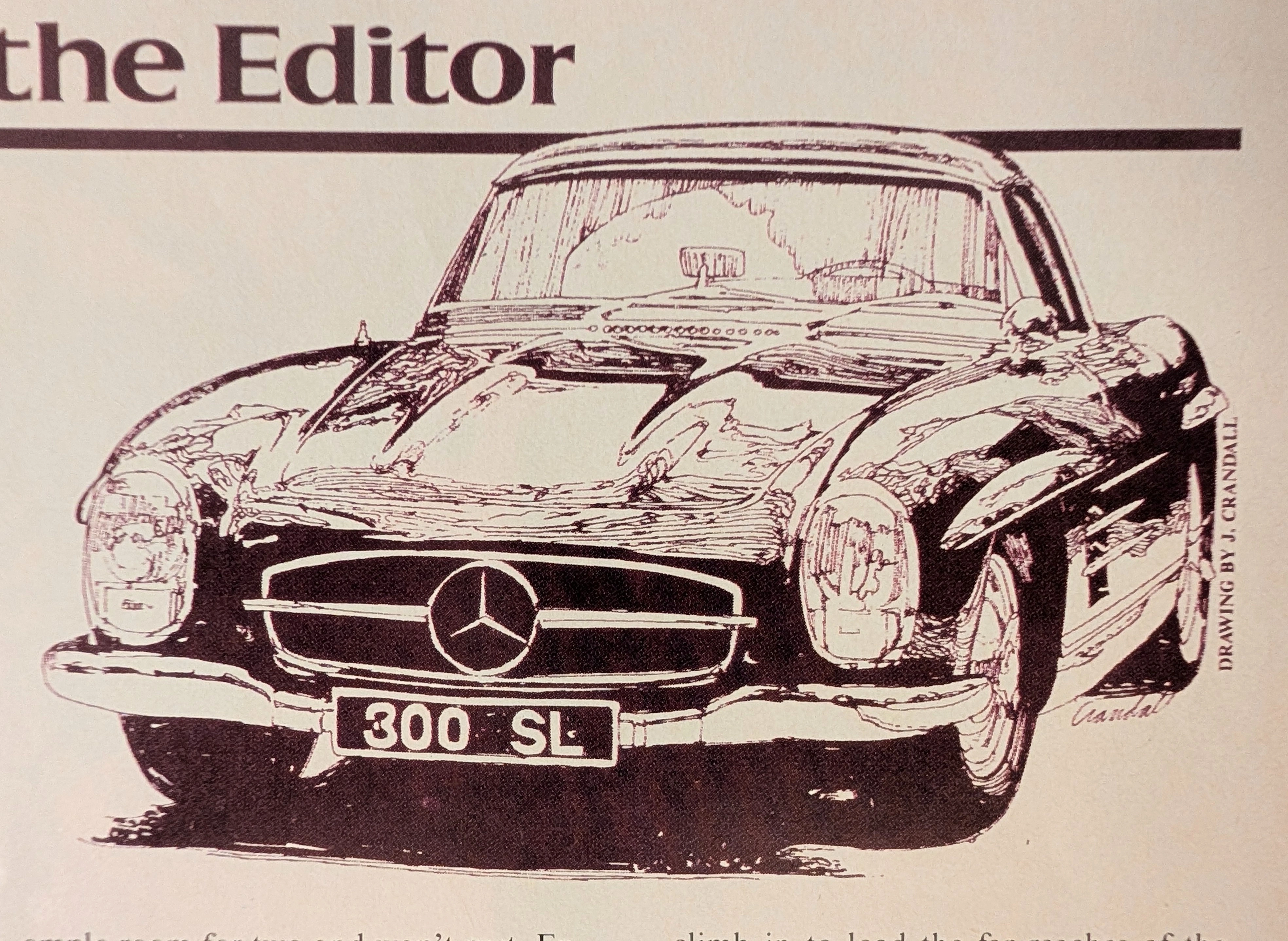
The evolution of global automotive culture in the mid-twentieth century was not solely driven by the manufacturers who built the machines, but equally by the specialized print publications that chronicled, critiqued, and mythologized them. Elegantly and securely positioned upon the analytical table of The Record Institute today is a visually striking, historically dense, and beautifully rendered e
Category: Automotive
Brand: Mercedes Benz
The History
To fully appreciate the immense historical gravity, cultural magnitude, and sociological importance of this artifact, one must meticulously and exhaustively contextualize both the machine it depicts and the highly specific, intellectual landscape of automotive print journalism in the mid-to-late twentieth century. The story embedded within the fibers of this editorial illustration is an epic saga of German industrial resurrection, relentless technological pursuit, transatlantic marketing genius, and the democratization of automotive passion through the printed word. The narrative of the vehicl
The Paper
As a physical entity, this printed artifact functions as a living, breathing, and profoundly detailed record of late-twentieth-century editorial illustration, graphic reproduction, and substrate chemistry. Under exceptional, high-magnification macro-lens examination, this document reveals the stunning complexity and mathematical precision of analog offset lithography utilized for high-volume magazine printing. The visual brilliance of this artifact is anchored by its capacity to render the intricate, hand-drawn linework of J. Crandall using microscopic deposits of liquid pigment. The macro pho
The Rarity
RARITY CLASS: B (Very Good Archival Preservation with Natural Margin Toning) Evaluated under the most exacting, rigorous, and uncompromising archival parameters established by The Record Institute (which spans a meticulous classification system from Pristine Class OMEGA down to Heavily Degraded Class D), this specific artifact is definitively and securely designated as Class B. The remarkable and defining paradox of mid-to-late century editorial ephemera is that these specific documents were produced by the millions as explicitly and intentionally "disposable media." Inserted into high-volume,