The Time Traveller's Dossier : Lipchitz - Death of Archives
An artifact is rarely a single, static entity. It is a layered compression of human intent, institutional pride, and, ultimately, societal entropy. In the mid-twentieth century, knowledge possessed physical weight. If a citizen sought to understand the trajectory of modern European sculpture, they did not query a void; they walked into a civic temple, pulled a heavy wooden drawer, and retrieved a
Category: Other
The History
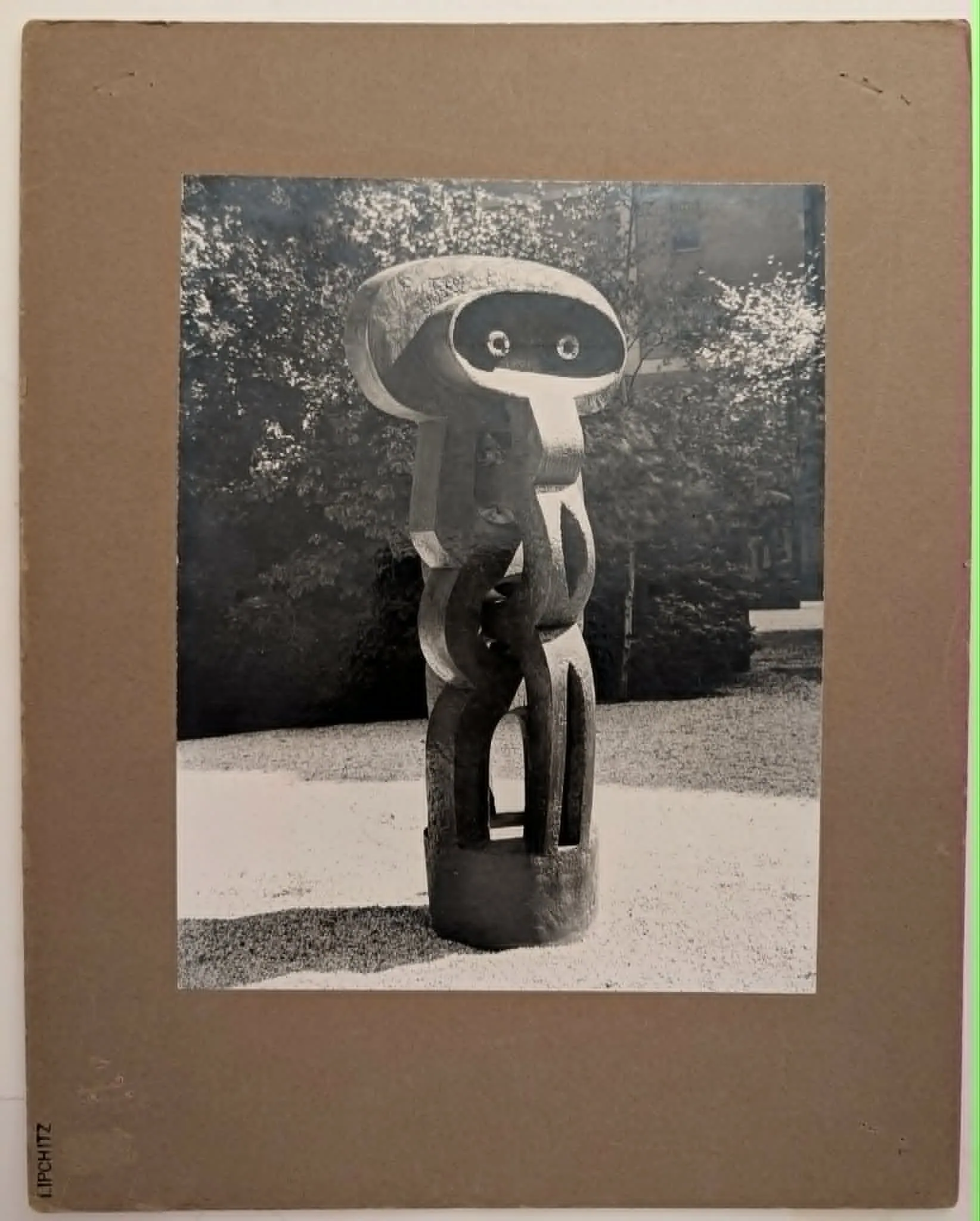
The Forging of the Totem in an Anxious Age To truly comprehend the gravity of this surviving artifact, we must first dissect the subject it so coldly catalogs. The photograph captures Jacques Lipchitz’s "Figure," a towering bronze cast between 1926 and 1930. During this volatile interwar period, Lipchitz, alongside the global consciousness, was undergoing a radical metamorphosis. The strict, analytical, and highly mathematical geometry of his early Cubist phase felt suddenly insufficient to capture the psychological dread and organic complexity of a world that had just torn itself apart and wa
The Paper
The structural reality of this artifact is an exercise in mid-century industrial endurance. It is fundamentally composed of two distinct materials bound together to survive the hostile environment of public circulation. The image itself is a classic gelatin silver print. This photographic process relies on a suspension of silver salts in gelatin. Over time, as we see in the subtle degradation of the image's deeper shadows, the silver begins to oxidize, subtly shifting the tonal range and causing a faint, metallic mirroring effect in the blacks. However, it is the mounting board that tells the
The Rarity
Classification: Class B (Contextual Relic). The raw photographic print of Lipchitz's "Figure" is not inherently rare; museums distributed thousands of promotional images of their collections. However, the exact configuration of this object elevates its rarity immensely. It is a "survivor" of a systemic, nationwide purge. When libraries digitized, these boards were thrown into dumpsters by the tens of thousands. This specific artifact, complete with its conflicting stamps of aggressive ownership ("Property of...") and ultimate rejection ("DISCARDED"), is a profound historical document. Its valu