The Time Traveller's Dossier: The Masquerade of Quality – Nabisco's 1968 Ritz "Can't Disguise" Campaign and the Golden Age of Snack Branding
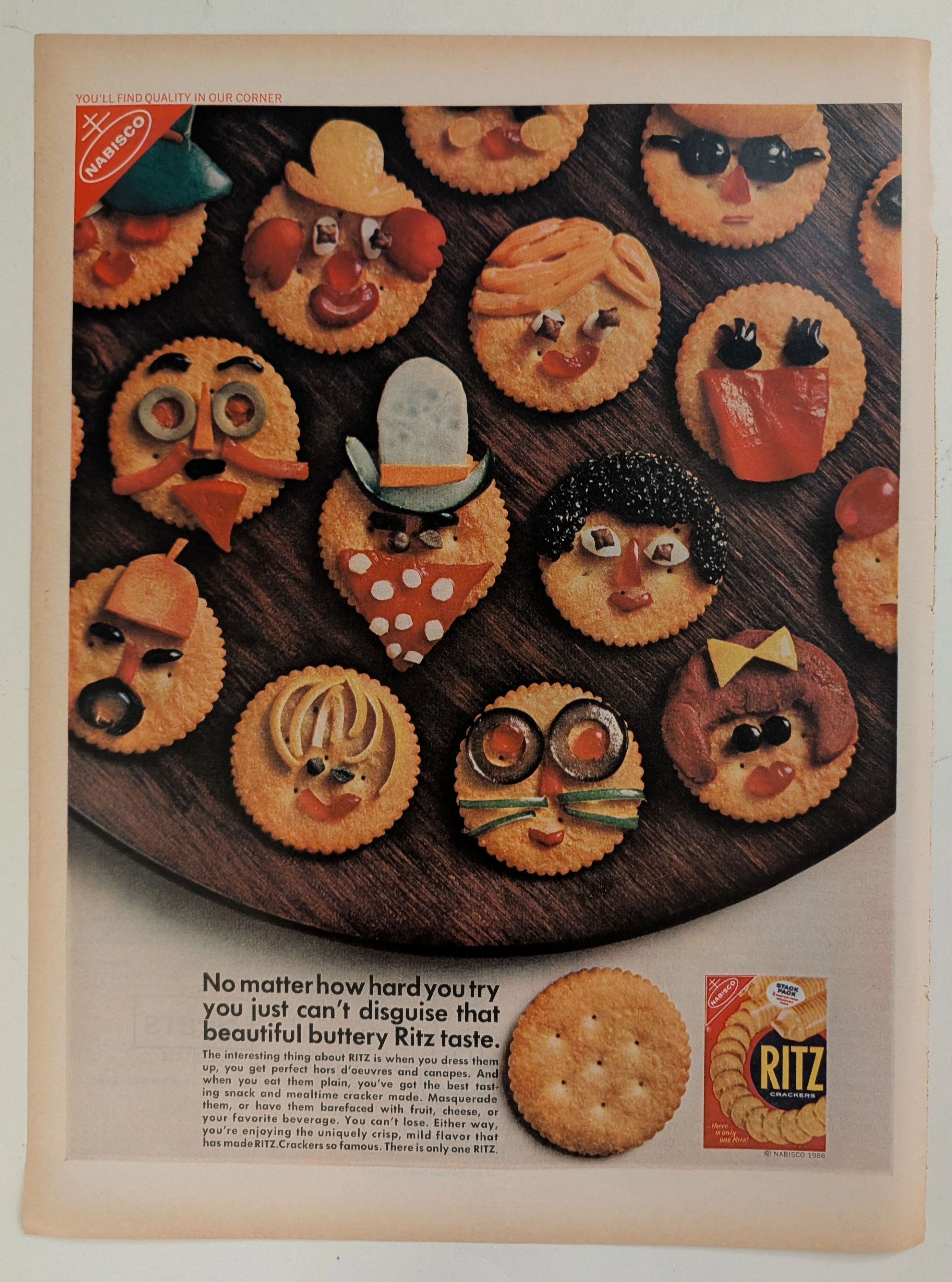
The evolution of the twentieth-century American pantry was fundamentally defined by the rise of standardized, nationally recognized "anchor" brands. The historical artifact elegantly positioned upon the analytical table of The Record Institute today is a striking full-page advertisement for Ritz Crackers, originating from 1968. This document represents a pivotal era in consumer psychology where sn
Category: Food
Brand: Ritz
The History
To fully appreciate the immense historical gravity, cultural magnitude, and sociological importance of this artifact, one must meticulously contextualize the complex, highly dominant landscape of the National Biscuit Company (Nabisco) and the broader history of the American processed food industry leading up to 1968. The foundation of Nabisco’s monumental corporate supremacy began at the very end of the 19th century, marking the definitive transition of the American food supply from the localized "cracker barrel" era—where goods were sold in bulk, exposed to air, moisture, and pests—to the mod
The Paper
As a physical entity, this printed artifact functions as a living record of mid-twentieth-century graphics reproduction. Under high-magnification macro-lens examination, the document reveals the stunning complexity of analog color printing. The extraordinary macro photographs of the Nabisco logo and the "clown" cracker faces provide a textbook visualization of the CMYK halftone rosette pattern. The vibrant "Nabisco Red" and the "Ritz Yellow" are not solid swatches of ink; they are meticulously constructed from a precise, mathematically rigorous galaxy of microscopic ink dots. Cyan, Magenta, Ye
The Rarity
RARITY CLASS: B (Very Good Archival Preservation with Natural Margin Toning) Under the exacting archival parameters of The Record Institute, this artifact is securely designated as Class B. The defining paradox of 1960s commercial ephemera is that these documents were produced by the millions as "disposable media"—destined to be briefly observed and discarded. For a full-page, graphically saturated advertisement to survive without catastrophic structural tearing or destructive moisture staining is a statistical archival anomaly. The structural integrity of this paper remains exceptionally soun