The Time Traveller's Dossier: The Suburb's Sea – Avon for Men, the Windjammer Mythos, and the Commodification of Mid-Century Masculinity
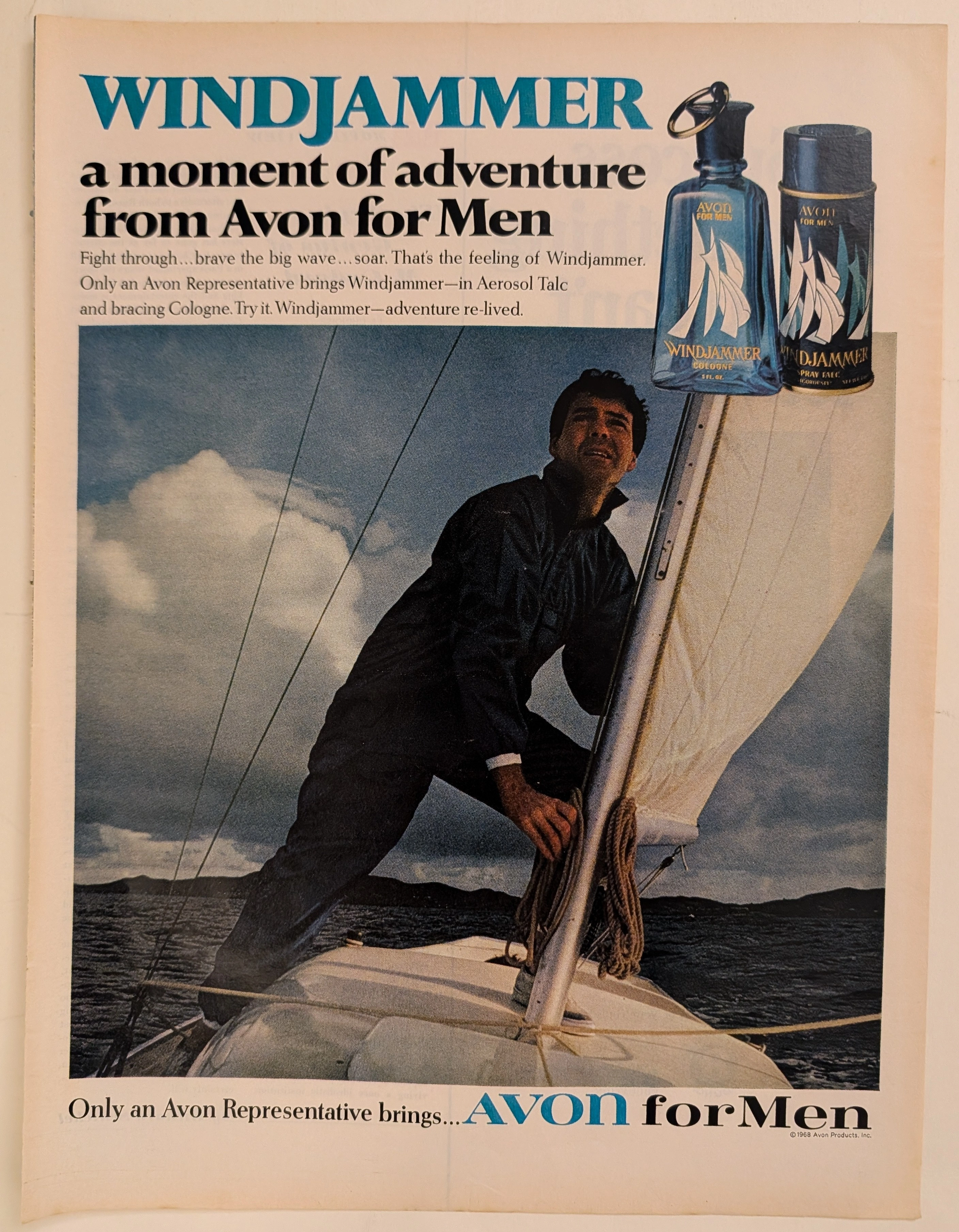
The evolution of mid-twentieth-century American domestic commerce was fundamentally reshaped by the aggressive expansion of the direct-sales model into the male grooming sector. The historical artifact elegantly and securely positioned upon the analytical table of The Record Institute today is a visually arresting, full-page print advertisement for Avon for Men: Windjammer, definitively dated by i
Category: Other
Brand: Avon
The History
To fully appreciate the immense historical gravity, cultural magnitude, and sociological importance of this artifact, one must meticulously contextualize the complex, highly specific landscape of the American cosmetics and fragrance industry leading up to 1968. Avon Products, Inc., originally founded in 1886 as the California Perfume Company, had built a monumental corporate empire upon a singular, revolutionary distribution model: direct-to-consumer sales via independent female representatives, universally known as "Avon Ladies." By the mid-20th century, the iconic "Ding Dong, Avon Calling" c
The Paper
As a physical entity, this printed artifact functions as a living, breathing, and profoundly detailed record of mid-twentieth-century graphic reproduction and substrate chemistry. Under exceptional, high-magnification macro-lens examination, this document reveals the stunning complexity and mathematical precision of analog color offset printing. The extraordinary macro photographs of the Windjammer cologne bottle and aerosol talc provide a textbook, museum-grade visualization of a CMYK halftone rosette pattern. The deep, abyssal oceanic blues of the glass bottle and the crisp, stark whites of
The Rarity
RARITY CLASS: B (Very Good Archival Preservation with Natural Margin Toning) Evaluated under the most exacting, rigorous, and uncompromising archival parameters established by The Record Institute (which spans a meticulous classification system from Pristine Class A down to Heavily Degraded Class D), this artifact is definitively and securely designated as Class B. The remarkable and defining paradox of mid-century commercial ephemera is that these specific documents were produced by the millions as explicitly and intentionally "disposable media." Inserted into high-volume, mass-market consume