Nina Ricci "L'Air du Temps": The Eternal Dove of Peace (1948–Present)
카테고리|Luxury Brands
하위 카테고리|Fashion
연도|1980
희귀도|CLASS S
Last updated: 15 Mar 2026
Historical Context
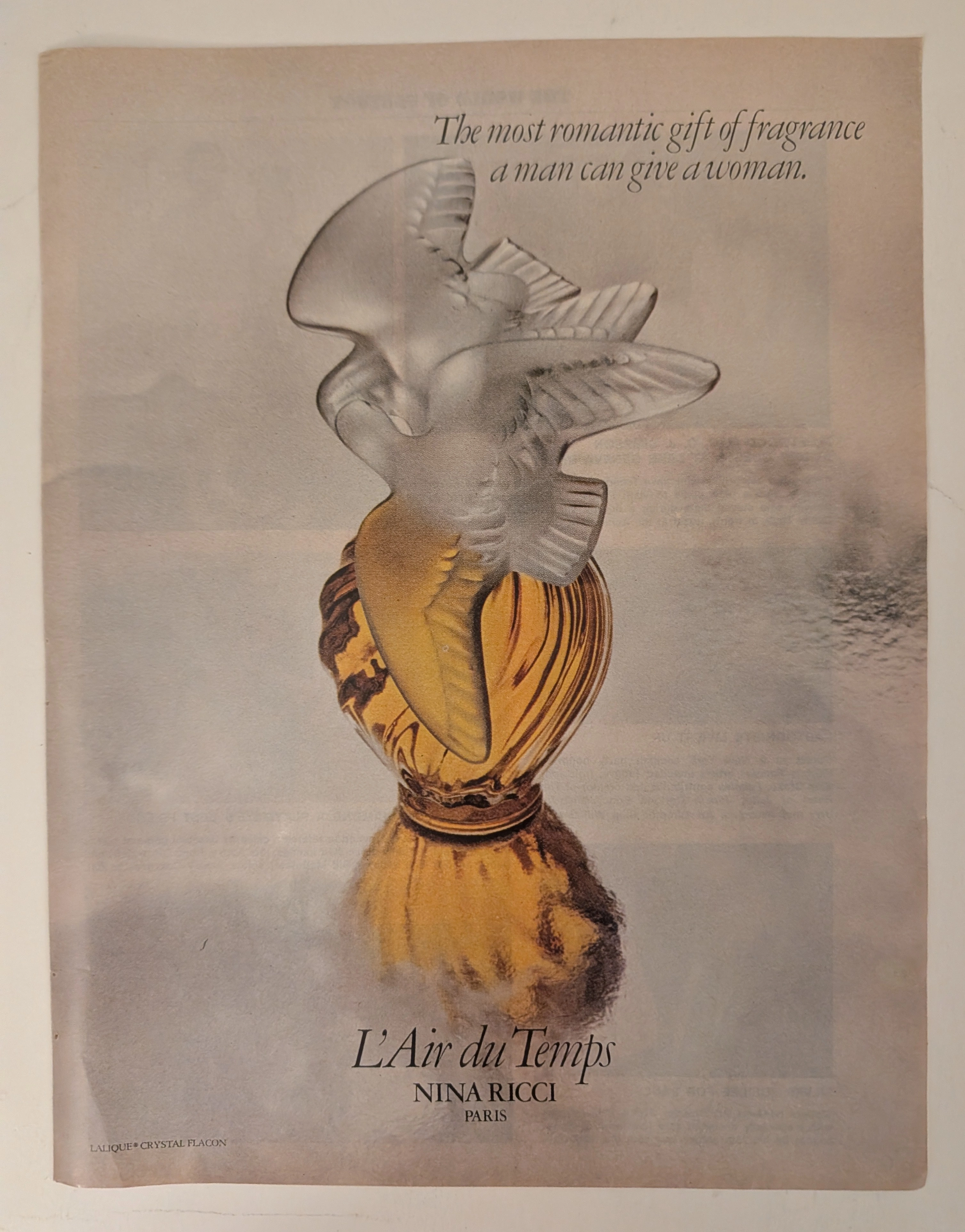
In the realm of vintage ephemera, few images evoke such profound emotion as the interlaced doves of L'Air du Temps. This advertisement is more than marketing; it is a visual manifesto of post-war recovery and timeless French elegance.
The Visionaries Behind the Icon:
Maria "Nina" Ricci (1883–1970): An Italian-born couturière who founded her house in Paris in 1932. Her aesthetic was defined by effortless femininity and impeccable craftsmanship, providing the foundation for the brand's prestige.
Robert Ricci (1905–1988): Nina’s son and a marketing genius. He sought to expand the house into fragrance, commissioning L'Air du Temps in 1948. He understood that after the horrors of WWII, women didn't just want a scent—they wanted a symbol of freedom.
Marc Lalique (1900–1977): The legendary glassmaker. His collaboration with Robert Ricci resulted in the "Twin Doves" crystal flacon. This bottle is widely considered one of the most beautiful in history, capturing the fragility and strength of peace.
The Cultural Significance:
Launched in the late 1940s, the fragrance arrived at a pivotal moment. The world was transitioning from the grit of war to the glamour of the 1950s. The name itself, L'Air du Temps, suggests the "vibe" or "spirit of the moment." In this specific print ad, the use of Film Photography captures the amber liquid and the intricate Lalique glass with a depth that modern digital renders cannot replicate. The subtle Halftone Printing and the natural patina of the paper serve as a testament to its authenticity. It represents a time when luxury was measured by the soul of the artisan, not just the brand name.
Paper & Print Condition
The paper exhibits exceptional structural integrity, resisting the brittleness common in 80s newsstand prints. The uniform warm cream patina enhances the amber tones of the fragrance without clouding the white space. The ink saturation remains vivid, with halftone dots appearing crisp under magnification, suggesting a low-wear press run. No signs of foxing or UV damage are present, indicating a decades-long shielding from light.
Provenance & Rarity
Sourced from a curated European fashion archive, this full-page specimen is a rare survivor of the pre-digital era. Most high-format ads were either damaged by moisture or extracted for mood boards, making a pristine A4-scale page a "High-Yield" asset. This 1980s iteration represents a critical bridge in art direction between 70s romanticism and 80s bold minimalism.