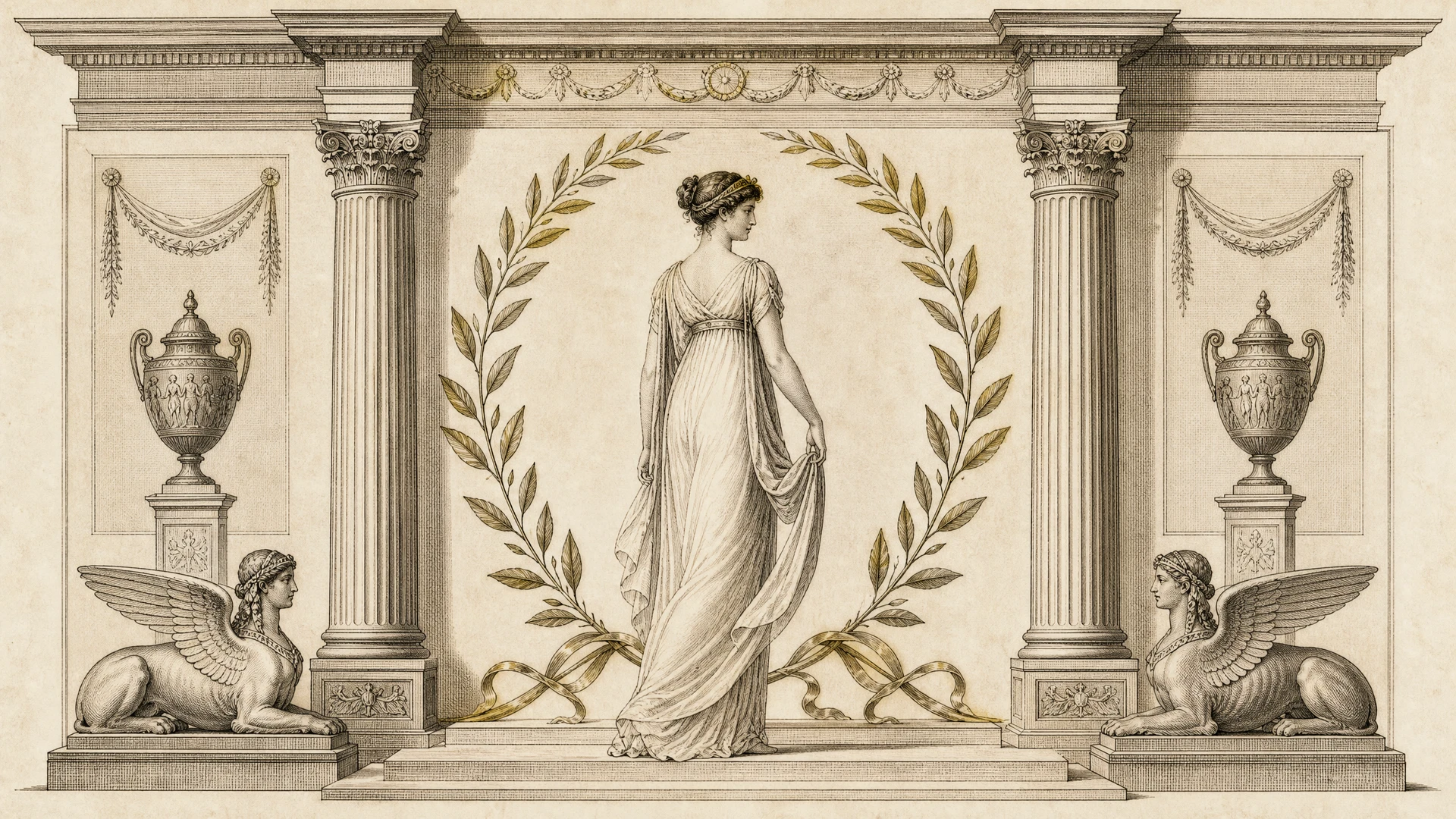
Directoire / Neoclassical Revival
The Directoire revival names the return of French Directoire (1795–1799) and Empire (1804–1815) forms in early twentieth-century fashion illustration, poster design and commercial print. Its immediate impetus was Paul Poiret's abandonment of the corseted S-bend silhouette in 1908 for a high-waisted columnar line, promoted through the pochoir albums Les Robes de Paul Poiret (Paul Iribe, 1908) and Les Choses de Paul Poiret (Georges Lepape, 1911), which simultaneously revived the eighteenth-century fashion plate as a collectable printed format. The formal vocabulary is consistent: a waistline raised to just below the bust, a narrow columnar silhouette in which drapery reads as a fluted column, symmetrical arrangement, and an ornamental repertory of laurel wreath, palmette and anthemion, Greek key, urn, lyre, swan, bee, torch and cameo profile, frequently in a restrained Pompeian palette of black, terracotta, ivory and gold. In printed ephemera the classification applies to the Gazette du Bon Ton and its imitators, perfume and cosmetics packaging, theatre and exposition posters, sheet music covers, and commemorative or civic printing seeking classical authority. A second, harder-edged phase runs through the 1920s and 1930s as Art Deco absorbs the classical repertory and geometricises it. The Record Institute applies the classification interpretively: ornament alone is not sufficient, since a laurel border on a diploma or a Greek key rule on a letterhead is stock printers' ornament. Assignment requires the classical vocabulary to govern proportion, silhouette or compositional structure rather than merely decorate the margins. The classification does not cover material actually produced during the Directoire or Empire periods, which is dated by period, and it stands in deliberate opposition to the asymmetric organic line of Art Nouveau, which it displaced.
Era: 1905–1935
Region: Europe & North America