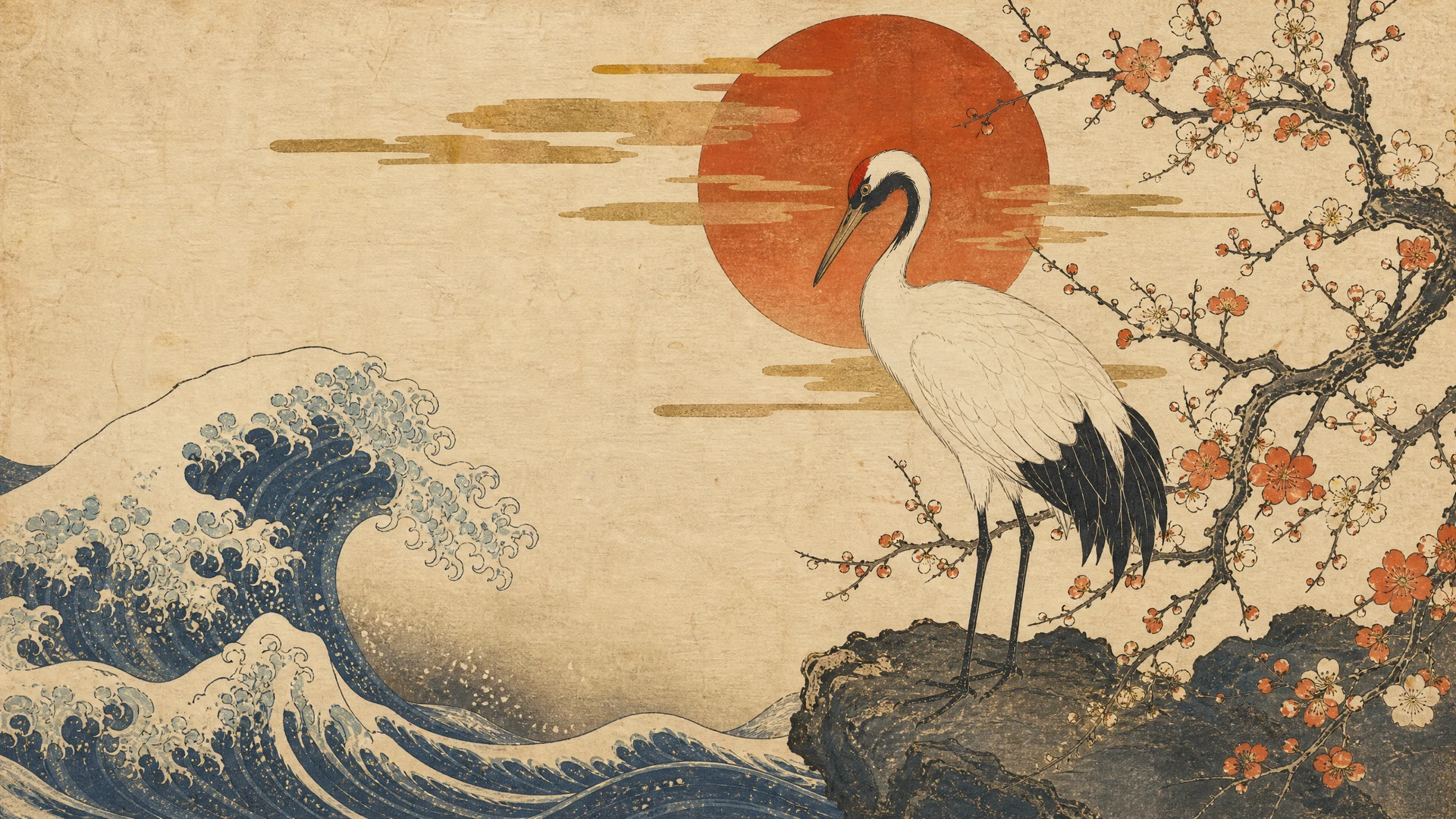
Japonisme
Japonisme names the absorption of Japanese visual conventions into Western art and commercial print culture after the reopening of Japanese trade in the 1850s and the Japanese displays at the London (1862) and Paris (1867) international expositions. Ukiyo-e woodblock prints supplied the vocabulary most often borrowed: flattened picture planes, asymmetric and abruptly cropped compositions, unmodulated fields of colour bounded by contour line, oblique or elevated viewpoints, and the integration of lettering, seal and image within a single design. In printed ephemera these devices are most legible in poster design, magazine and sheet music covers, packaging and trade cards, where they also answered the practical constraints of flat-colour lithography. The Record Institute applies Japonisme as an interpretive classification rather than a self-declared school. Few designers used the term for their own work, so attribution rests on formal evidence within the artefact, not on documented affiliation. Motif alone — a fan, a kimono, a cherry branch — is not sufficient; assignment requires structural borrowing of composition, spatial handling or colour. The classification describes Western works responding to Japanese art, never artefacts produced in Japan, and commonly co-occurs with Art Nouveau, the Aesthetic Movement and early modernist poster design.
Era: 1860–1920
Region: Europe & North America