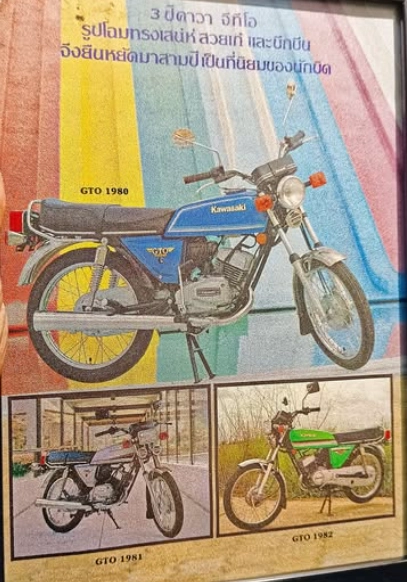
โฆษณารถจักรยานยนต์คลาสสิก Kawasaki GTO ปี 1980
This vibrant archival print from Thailand celebrates the enduring legacy of the Kawasaki GTO motorcycle during the early 1980s. Featuring the 1980, 1981, and 1982 models side-by-side, the advertisement highlights the aesthetic evolution and robust engineering that cemented the GTO's status as a beloved and trusted workhorse among Southeast Asian riders. The early 1980s marked a pivotal era for motorcycle adoption in Southeast Asia, with Thailand serving as one of the most critical and highly competitive markets for Japanese manufacturers. This distinct print advertisement serves as a fascinating historical document, charting the progressive design and market staying power of the Kawasaki GTO over a three-year span. At the core of this marketing campaign is the assertion of enduring quality and proven reliability. The Thai typography translates roughly to a celebration of "3 years of GTO stars," proudly proclaiming the motorcycle's "charming, beautiful, classic, and tough" characteristics. It notes the model's unyielding popularity among local riders for three consecutive years. During this period, the Thai market demanded motorcycles that were not merely recreational but vital instruments of daily commerce, agricultural transport, and urban commuting. The Kawasaki GTO, utilizing a highly durable two-stroke engine and a remarkably robust frame, perfectly answered this socioeconomic need, competing fiercely alongside contemporary rivals from Yamaha and Honda. Visually, the advertisement employs a striking juxtaposition of graphic design techniques typical of the era's regional marketing. The primary focal point is the 1980 Kawasaki GTO, finished in a brilliant metallic blue and set against a stark, multicolored geometric backdrop. This bold, almost pop-art sensibility reflects the optimistic, forward-looking aesthetic of the turn of the decade. Conversely, the inset photographs of the 1981 (silver) and 1982 (green) models situate the motorcycles in real-world environments—a modern architectural setting and a natural, rural landscape, respectively. This structural design choice subtly but effectively communicates the machine's versatility, suggesting it is equally at home in rapidly modernizing urban centers as it is navigating unpaved rural terrain. For historians of industrial design and automotive marketing, this piece brilliantly illustrates the shift in how Japanese motorcycles were positioned internationally. Rather than relying solely on raw horsepower metrics or technical specifications, Kawasaki’s Thai advertising agency appealed directly to the rider's sense of style, emotional connection, and trust over time. The campaign effectively transformed a utilitarian commuting vehicle into an object of sustained desire and a trusted companion on the varied roads of Thailand.
Category: Motorcycles
Year: 1980
Rarity Class: A
Paper & Print Condition
ชิ้นงานจัดเก็บถาวรนี้พิมพ์ลงบนกระดาษนิตยสารผิวมันเชิงพาณิชย์มาตรฐาน ซึ่งเป็นวัสดุที่บ่งบอกถึงลักษณะเฉพาะของสื่อสิ่งพิมพ์ในตลาดระดับมวลชนของเอเชียตะวันออกเฉียงใต้ช่วงต้นทศวรรษ 1980 เมื่อตรวจสอบด้วยหลักวิชาการจดหมายเหตุ จะพบร่องรอยของการพิมพ์แบบสกรีนฮาล์ฟโทน (Halftone) ที่มองเห็นได้ชัดเจน รวมถึงการเหลื่อมตัวของแม่สี CMYK เล็กน้อย (Register shifts) บริเวณขอบของตัวอักษรและภาพรถจักรยานยนต์หลัก ซึ่งเป็นข้อพิสูจน์ถึงความเก่าแท้ดั้งเดิมและข้อจำกัดของเทคนิคการพิมพ์ออฟเซตลิโทกราฟี (Offset Lithography) ในยุคนั้น แม้จะมีการซีดจางของสีไปบ้างและมีรอยเหลืองปรากฏตามขอบกระดาษ ซึ่งเป็นผลสอดคล้องกับการเสื่อมสภาพตามธรรมชาติและการสัมผัสแสงรังสียูวีอ่อนๆ ตลอดระยะเวลากว่าสี่ทศวรรษ แต่โครงสร้างทางกายภาพโดยรวมของกระดาษยังคงแข็งแรงสมบูรณ์ ความสดใสของหมึกสีน้ำเงินเมทัลลิกบนตัวรถรุ่นปี 1980 ยังคงได้รับการรักษาไว้เป็นอย่างดีเยี่ยม และองค์ประกอบทางตัวพิมพ์ทั้งหมดก็ยังคงอ่านได้อย่างชัดเจน โดยไม่มีรอยด่างจุดเชื้อรา (Foxing) หรือการเปื่อยยุ่ยของกระดาษที่รุนแรง
Provenance & Rarity
ชิ้นงานจัดเก็บถาวรนี้มีแหล่งที่มาจากการไหลเวียนของนิตยสารยานยนต์และไลฟ์สไตล์ภายในประเทศไทยในช่วงประมาณปี ค.ศ. 1982 ประวัติความเป็นมาของสื่อสิ่งพิมพ์ประเภทนี้มีความหายากโดยธรรมชาติ เนื่องจากโฆษณารถจักรยานยนต์สำหรับการใช้งานทั่วไปในชีวิตประจำวันถูกออกแบบมาเพื่อการบริโภคข้อมูลในระยะสั้นแล้วทิ้งไป มากกว่าที่จะตั้งใจเก็บรักษาไว้ในระยะยาว ยิ่งไปกว่านั้น สภาพภูมิอากาศแบบเขตร้อนของภูมิภาคเอเชียตะวันออกเฉียงใต้ ซึ่งมีความชื้นสูงและอุณหภูมิที่ผันผวน ยังเป็นปัจจัยทางธรรมชาติที่เร่งการเสื่อมสภาพของกระดาษ ทำให้การอยู่รอดของภาพพิมพ์วินเทจจากภูมิภาคนี้ในสภาพที่สมบูรณ์นั้นเป็นเรื่องที่หาได้ยากยิ่งนัก ด้วยเหตุนี้ การค้นพบโฆษณาที่รวบรวมรถหลายรุ่นปีไว้ด้วยกันและได้รับการอนุรักษ์ไว้อย่างดีเช่นแคมเปญ Kawasaki GTO ชิ้นนี้ จึงถือเป็นความพิเศษอย่างยิ่ง ชิ้นงานนี้ได้รับการจัดให้อยู่ในระดับความหายาก Class A ในคลังข้อมูลของเรา ไม่ใช่เพราะมูลค่าของวัสดุ แต่เป็นเพราะคุณค่าทางประวัติศาสตร์และวัฒนธรรมอันลึกซึ้ง มันคือหลักฐานสำคัญที่ยังมีชีวิต ซึ่งบันทึกถึงกลยุทธ์การเจาะตลาดอย่างจริงจังของ Kawasaki รูปแบบการโฆษณาในระดับภูมิภาค และความสำคัญทางเศรษฐกิจและสังคมของรถจักรยานยนต์อเนกประสงค์ในประเทศไทยยุคทศวรรษ 1980
Rarity & Condition Summary
ชิ้นงานประวัติศาสตร์ระดับความหายาก Class A ที่ได้รับการอนุรักษ์ไว้อย่างดีเยี่ยม ถือเป็นหลักฐานสำคัญที่ช่วยให้เราเข้าใจถึงการเจาะตลาดและร่องรอยทางวัฒนธรรมของ Kawasaki ในประเทศไทยยุคทศวรรษ 1980 การที่ชิ้นงานสามารถคงสภาพโครงสร้างที่สมบูรณ์ไว้ได้เช่นนี้ ทั้งที่สื่อสิ่งพิมพ์ระดับภูมิภาคสำหรับมวลชนมักมีอายุการใช้งานสั้นและต้องเผชิญกับสภาพอากาศเขตร้อน ยิ่งเป็นการยกระดับคุณค่าทางจดหมายเหตุและประวัติศาสตร์ให้สูงขึ้นอย่างมาก