ทดสอบ
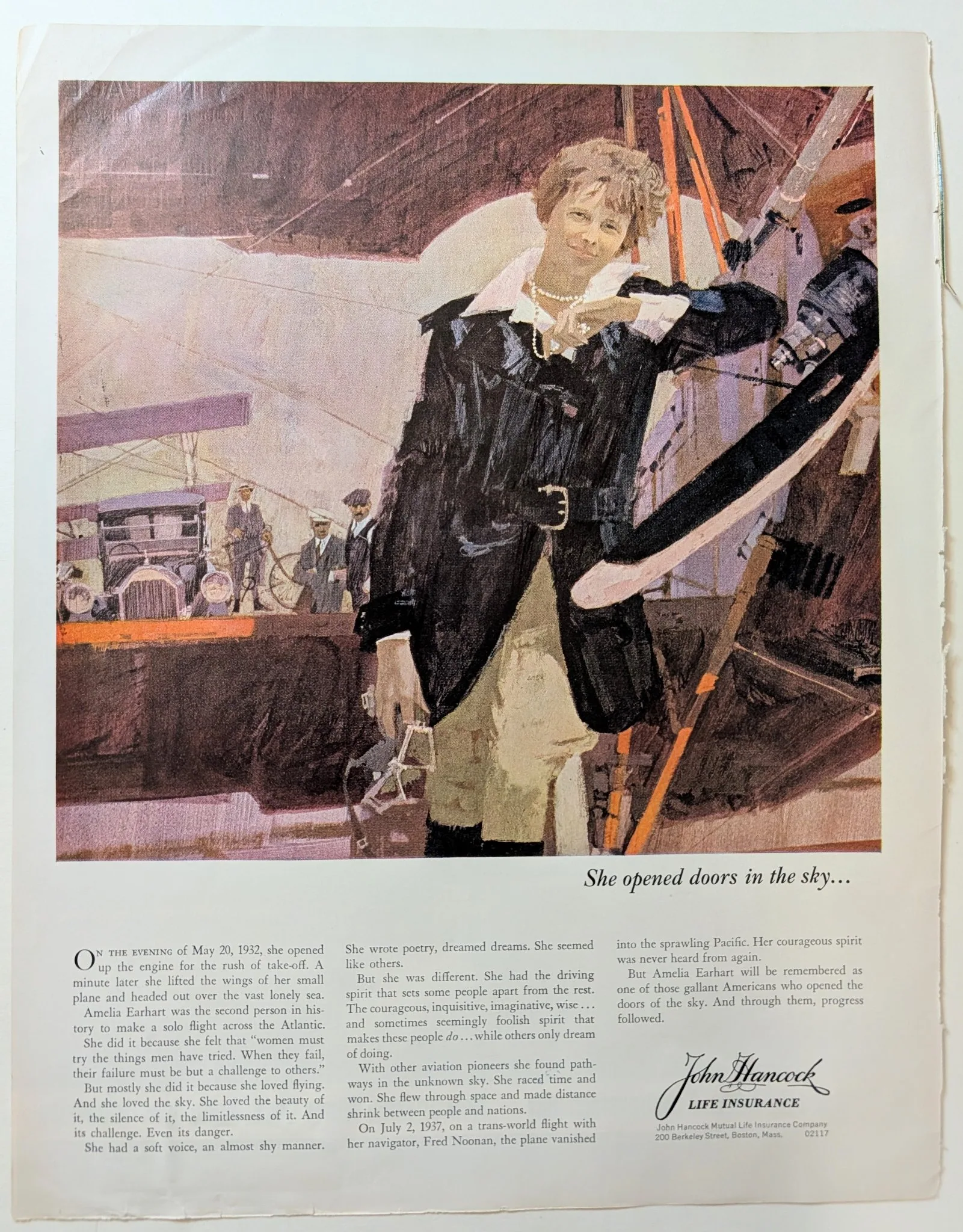
The image supplied for this draft shows a single full-page magazine advertisement leaf for the John Hancock Life Insurance Company, built around a painted portrait of the aviator Amelia Earhart. The physical date is undated but not before 1963: the printed ZIP code 02117 in the signature block postdates the introduction of US ZIP codes in July 1963. The working estimate is c. 1960s-1970s on stylistic grounds, though style alone cannot fix the decade. The exact magazine issue has not been identified; Purdue University's Earhart archive lists an advertisement under the same headline as undated [S1][GAP-01]. The leaf was supplied as four photographs (full page, signature-block close-up, halftone macro, detail crop); the reverse side and acquisition documentation were not supplied. The painting dominates the upper two-thirds of the page: Earhart in a leather flight jacket, holding her goggles, standing beside her high-wing monoplane; a background vignette shows a vintage automobile and male onlookers, and the detail crop reveals the aircraft's nose, the car's radiator grille, and a bystander with a bicycle. The headline, in italic serif at the right, reads "She opened doors in the sky..." Below, three columns of body copy recount her story: the evening of May 20, 1932, when she lifted off for the solo Atlantic flight; the statement that she "was the second person in history to make a solo flight across the Atlantic" (transcribed as printed — the standard historical qualifier is "nonstop," which the ad's copy omits); her quoted words, "women must try the things men have tried. When they fail, their failure must be but a challenge to others" (transcribed as printed; commonly reproduced versions word it slightly differently); and her disappearance on July 2, 1937, with navigator Fred Noonan over the Pacific during their round-the-world attempt. The page closes with the script "John Hancock" signature, "LIFE INSURANCE," and the company address: 200 Berkeley Street, Boston, Mass. 02117. The halftone macro shows a rosette dot pattern, evidence of color halftone reproduction; the specific printing process is not confirmed. The history behind the copy is well documented. On May 20-21, 1932, Earhart flew her red Lockheed Vega 5B from Harbor Grace, Newfoundland, to near Londonderry, Northern Ireland — the first woman and, after Charles Lindbergh, the second person to fly nonstop and solo across the Atlantic (Smithsonian, National Air and Space Museum). On July 2, 1937, she and Noonan vanished on the Lae-Howland Island leg of their attempted circumnavigation. The advertiser, John Hancock Mutual Life Insurance, had a long tradition of institutional magazine advertising built around American historical figures: a 1951 Buffalo Bill Cody creative survives as an earlier example of the approach, and as early as 1953 the company was noted for telling its story in full-page magazine advertisements (The Harvard Crimson). This Earhart leaf belongs to that prestige-advertising tradition — advertising that sells the company's character rather than a policy. The advertisement works by biography, not by pitch. There is no premium table, no agent, no policy name anywhere on the page. Instead, the copy builds Earhart into an emblem — "one of those gallant Americans who opened the doors of the sky. And through them, progress followed" — and lets the reader complete the equation: a company that honors such people is a company to trust with your family's future. In the curator's reading, the intended reader is the mid-century magazine reader for whom Earhart was already a legend and for whom life insurance was bought on character as much as on price. Note what the ad borrows and what it trims: it keeps her daring and her words, and it trims the technical qualifier ("nonstop"), because the legend, not the logbook, is doing the selling. This leaf matters for three reasons. First, it is a textbook specimen of institutional or prestige advertising — the genre in which a company buys a full page to talk about anything except its product. Second, it captures Amelia Earhart's posthumous image at a moment when she had fully passed from news into myth: the ad does not explain who she is, because by the 1960s no explanation was needed. Third, it documents John Hancock's decades-long illustrated use of American historical figures, a campaign form that turned the company's magazine presence into a small gallery of national memory. The painting itself — unsigned, in the visible copy, and uncredited — is part of that practice: original art made for a single advertising use. The leaf is a witness to the moment when a life-insurance company decided the best way to sell the future was to paint the past. What remains unknown: the exact magazine and issue this leaf was printed in; the name of the illustrator; and the full extent of the company's historical-figure advertising it belongs to. The reverse side was not supplied, so nothing can be said about it. No acquisition documentation was supplied for this draft. References: Purdue University Archives MSP 188 Earhart collection finding aid (http://collections.lib.purdue.edu/fa/pdf/msp188_earhart_supp.pdf); Smithsonian Institution NASM Amelia Earhart object page (https://www.si.edu/object/amelia-earhart:nasm_A19500108000); mistercola.com 1951 John Hancock Buffalo Bill ad (https://mistercola.com/products/vintage-magazine-ad-john-hancock-life-insurance-1951-buffalo-bill-cody-artwork); The Harvard Crimson March 26, 1953 "The Real John Hancock" (https://www.thecrimson.com/article/1953/3/26/the-real-john-hancock-pthose-who/). All accessed 2026-10-15.
Category: Financial Services
Rarity Class: B
Paper & Print Condition
Photographs only; no direct physical examination. The full-page image shows a clean, flat leaf with strong color and legible copy. No tears, stains, or losses apparent at the supplied resolution. Reverse side, margins, and sheet dimensions not supplied.
Provenance & Rarity
Publication source unconfirmed; Purdue University's Earhart archive lists an advertisement under the same headline (undated). No acquisition history supplied. Rarity class B proposed (pending curator approval): nationally distributed magazine ad, no census figures, above-average documentary value.