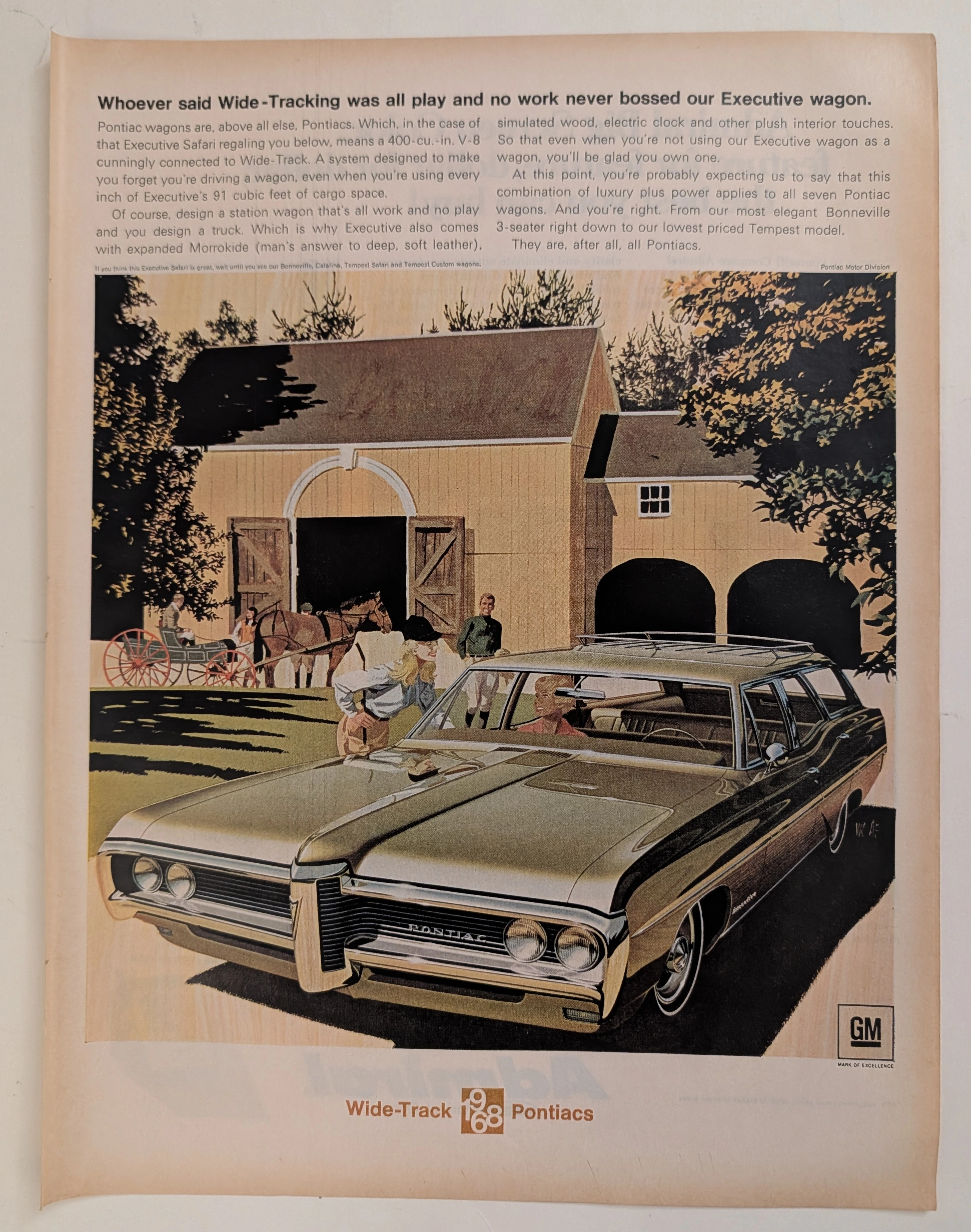
"All Play and No Work": โฆษณารถยนต์ 1968 Pontiac Executive Wagon "Wide-Tracking"
ในช่วงปลายทศวรรษ 1960 อุตสาหกรรมยานยนต์ของอเมริกาได้ก้าวขึ้นสู่จุดสูงสุดอย่างแท้จริง ทั้งในแง่ของอิทธิพลทางวัฒนธรรม เศรษฐกิจ และการออกแบบ ภายใต้การนำที่มีวิสัยทัศน์ของผู้บริหารอย่าง John DeLorean แบรนด์ Pontiac ประสบความสำเร็จในการสลัดภาพลักษณ์รถยนต์อนุรักษ์นิยมยุคหลังสงคราม และพลิกโฉมตัวเองขึ้นเป็นแผนกรถยนต์สมรรถนะสูงอันดับหนึ่งของ General Motors หัวใจสำคัญของการเปลี่ยนแปลงนี้คือแคมเปญการตลาด "Wide-Track" อันโด่งดัง ซึ่งมีรากฐานมาจากการตัดสินใจทางวิศวกรรมที่ต้องการขยายฐานล้อให้กว้างขึ้นเพื่อการทรงตัวที่ดี แต่นักการตลาดได้นำมาสร้างเป็นตำนานและไลฟ์สไตล์ เพื่อสะท้อนถึงความมั่นคง ความดุดันบนท้องถนน และพลังที่เหนือชั้น โฆษณารถสเตชันแวกอน Executive Safari รุ่นปี 1968 ชิ้นนี้ ถือเป็นจุดเปลี่ยนทางสังคมวิทยาที่น่าสนใจของลัทธิบริโภคนิยมอเมริกัน เมื่อระบบทางหลวงระหว่างรัฐขยายตัวและย่านชานเมืองกลายเป็นแหล่งที่อยู่อาศัยของผู้มีฐานะ รถสเตชันแวกอนจึงไม่ได้ถูกทำการตลาดในฐานะเพียง "รถครอบครัวที่เน้นประโยชน์ใช้สอย" อีกต่อไป Pontiac วางตำแหน่งรถรุ่นนี้ให้เป็นสิ่งจำเป็นที่หรูหราสำหรับชนชั้นกลางระดับสูงที่มีไลฟ์สไตล์แอคทีฟ ท่ามกลางความวุ่นวายทางวัฒนธรรมในปี 1968 โฆษณาชิ้นนี้ขายวิสัยทัศน์ของความมั่งคั่งแบบดั้งเดิมที่ปลอดภัย ฉากหลังของคฤหาสน์และสโมสรขี่ม้าส่วนตัว เชื่อมโยงรถยนต์คันนี้เข้ากับชีวิตที่เต็มไปด้วยการพักผ่อนแบบเอ็กซ์คลูซีฟและความหรูหราแบบผู้ดีเก่าอย่างชัดเจน นอกจากนี้ ผลงานศิลปะชิ้นนี้ยังเป็นตัวแทนของความร่วมมือระดับตำนานระหว่าง Art Fitzpatrick (AF) และ Van Kaufman (VK) กว่าทศวรรษที่คู่หูคู่นี้ครองอิทธิพลเหนือภาพลักษณ์ของ General Motors อย่างที่ไม่เคยมีมาก่อน Fitzpatrick ซึ่งเป็นปรมาจารย์ด้านภาพลวงตาของรถยนต์ ได้ดัดแปลงสัดส่วนอย่างสุดขั้ว โดยการตัดต่อภาพถ่าย ลดระดับหลังคาลง และยืดความกว้างและความยาวของรถยนต์อย่างจงใจ เพื่อสร้างความโดดเด่นทางสายตาให้มากที่สุด เพื่อให้เครื่องจักรที่ดูโฉบเฉี่ยวเกินจริงเหล่านี้ดูมีชีวิต Kaufman (อดีตนักสร้างแอนิเมชันของ Disney) ได้วาดฉากหลังที่หรูหราและเต็มไปด้วยแรงบันดาลใจจากการเดินทางรอบโลกของเขา ผลงานของพวกเขาเข้าถึงจิตใต้สำนึกและตอบสนองต่อความปรารถนาด้านสถานะทางสังคม พื้นที่กว้างขวาง และความเร็วของชาวอเมริกันในยุคกลางศตวรรษได้อย่างตรงจุด
Category: Cars
Year: 1968
Rarity Class: B
Paper & Print Condition
Printed on standard mid-century, lightweight clay-coated magazine stock, typical of high-circulation prestige publications like Life or Look. High-resolution macro photography of the vehicle's grille and typography reveals the classic, overlapping rosettes of the CMYK (Cyan, Magenta, Yellow, and Key/Black) halftone dot structure. This specific dot spread is the distinct, uncounterfeitable signature of 1960s mass-market four-color commercial lithography. Tactilely, the paper retains its characteristic slickness, though it exhibits mild, uniform oxidation (acidic yellowing) predominantly along the margins—a natural degradation consistent with its half-century age and the lignin content of period paper pulp. Crucially, the ink saturation remains vibrant, and there are no significant tears, creases, or water damage apparent in the primary image field.
Provenance & Rarity
Extracted from a mainstream American periodical distributed in late 1967 or early 1968. Because these advertisements were ephemera—bound into magazines intended to be read once and subsequently discarded or recycled—their survival rate is remarkably low. While millions of impressions were originally struck, finding a surviving example carefully excised from the binding without tearing, and that has escaped the ravages of moisture, folding, and UV fading over five decades, is increasingly difficult. They are heavily sought after by automotive historians and mid-century modern design archivists.
Rarity & Condition Summary
his piece stands as a beautifully preserved, primary-source artifact of the golden age of American commercial art and automotive optimism. Its true historical and museum value lies not in absolute, single-item scarcity, but in its pristine, highly legible representation of the Fitzpatrick-Kaufman artistic partnership. It is a flawless time capsule that perfectly encapsulates the aesthetics, aspirations, and consumer psychology that defined a decade of American design.