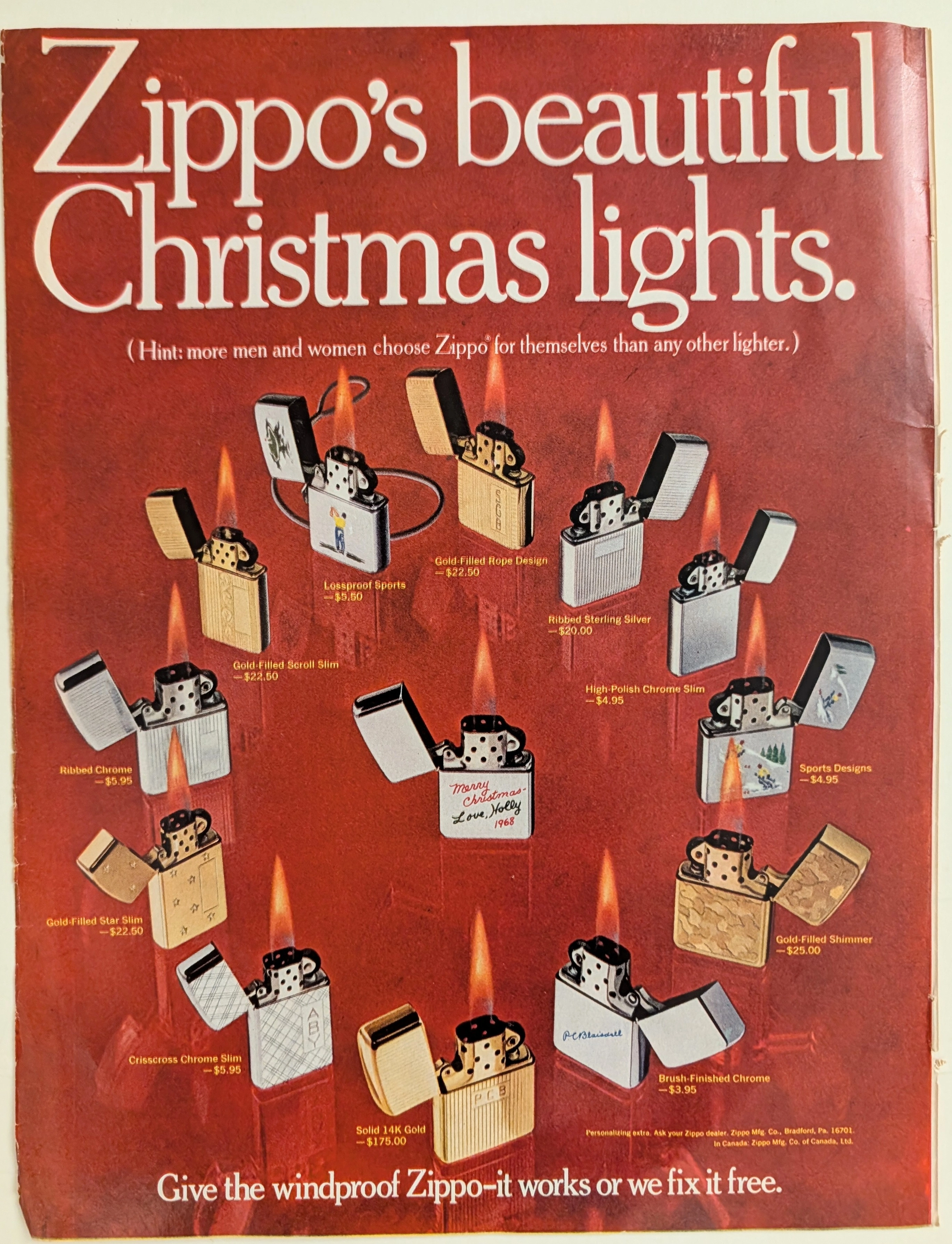
The Time Traveller's Dossier : 1968 Zippo - The Enduring Flame
The year is 1968. The world is characterized by profound volatility. Societies fracture. Wars escalate. Economies shift toward the disposable. Amidst this era of impermanence, an artifact is presented. It is not complex. It is not digital. It is mechanical, primitive, and entirely absolute. Then, a lighter was merely a tool for combustion. Now, through the lens of this document, we recognize it as
Category: Tobacco
Brand: Zippo
The History
The Era of Impermanence and the American Psyche To understand this document, we must first contextualize the chronological coordinates of its creation. The year 1968 was a crucible of global tension. The Tet Offensive altered the trajectory of the Vietnam War. Political assassinations shook the American foundation. The Apollo program pushed humanity toward the vacuum of space. The societal mood was anchored in uncertainty. The future felt incredibly fragile. Simultaneously, the post-war economic boom was reaching a new phase of consumerism. Plastics were rapidly replacing metal. Mass productio
The Paper
The physical medium of this document provides critical forensic data. It is printed on lightweight, glossy magazine stock, likely between 60 and 70 GSM. The printing utilizes a standard mid-century CMYK four-color offset lithography process. Under microscopic inspection, the halftones reveal a distinct rosette pattern. The deep, rich reds of the background are achieved through a heavy saturation of magenta and yellow inks. The aging process is evident. The paper exhibits slight oxidation around the edges, a chemical reaction caused by the acidic content of the wood pulp used in mass-market pub
The Rarity
Class A - High Contextual Value The physical lighters depicted in this advertisement are, depending on the model, relatively common or exceptionally rare (in the case of the Solid 14K Gold variant). However, the advertisement itself holds Class A archival status. Its value lies not in its monetary worth, but in its pristine preservation of the era's commercial psychology. Finding vintage magazines is common; finding a perfectly preserved, center-cut advertisement that so perfectly encapsulates the juxtaposition of holiday warmth against the cold realities of mid-century industrialism is rare.