The Time Traveller's Dossier : Schenley '43 - The Distiller's War
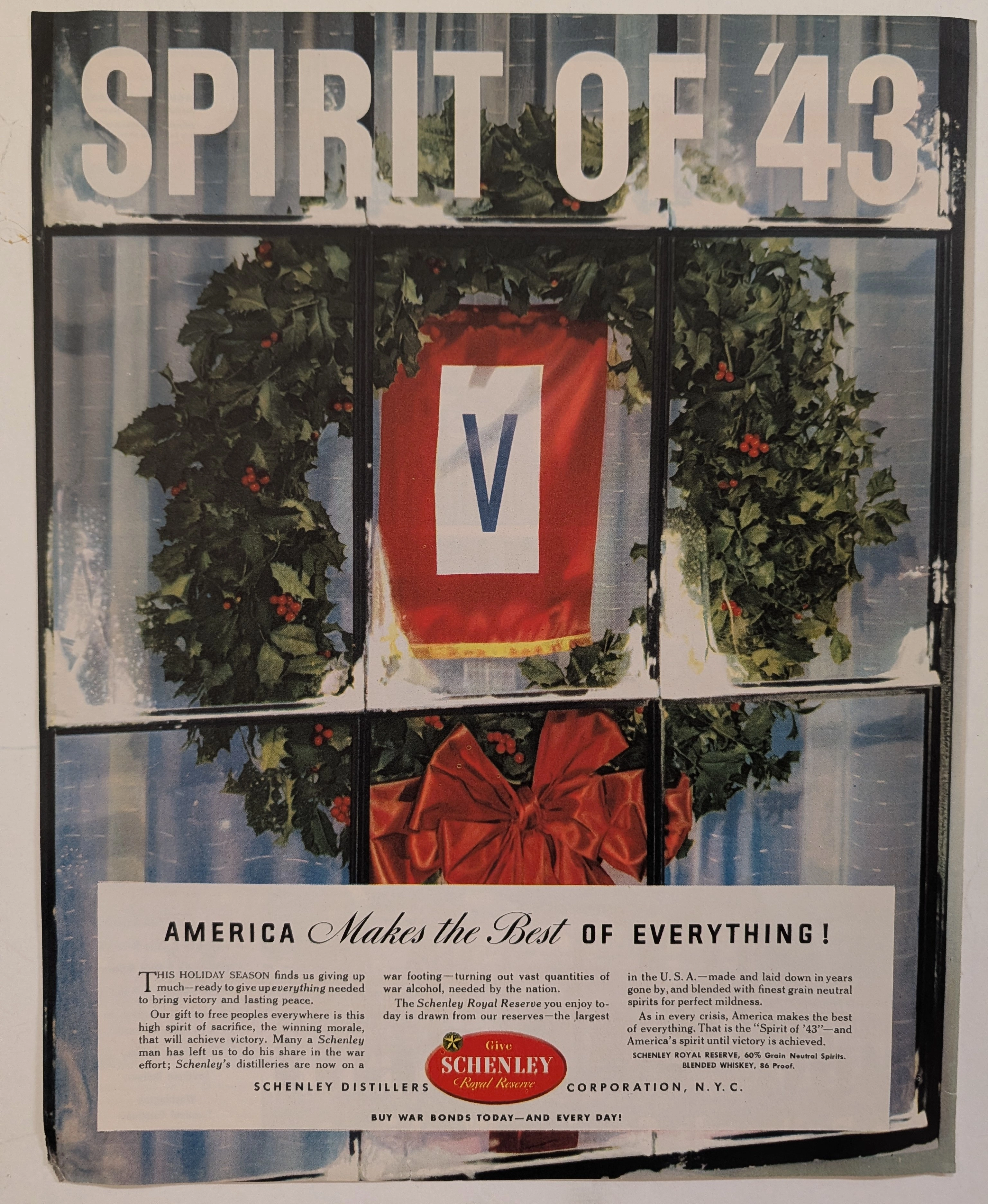
Once, the distillation of spirits was a pursuit of leisure. A craft dedicated to the quiet moments of peace. Then came the total war. This artifact represents the absolute inversion of purpose. It is a portal to 1943, a moment when the machinery of pleasure was forcefully repurposed into the machinery of survival. The product is no longer the whiskey. The product is sacrifice. The brand is selling
Category: Beverage
Brand: Schenley
The History
To understand this artifact, one must first calibrate to the crushing gravity of 1943. The world was entirely consumed by fire. The Axis powers had stretched the map to its breaking point. For the United States, the initial shock of Pearl Harbor had crystallized into a grim, unyielding industrial marathon. The nation was no longer merely fighting a war; it had become a colossal, singular organism dedicated solely to the production of lethality and logistics. In this era, consumerism died overnight. The American economy, previously built on abundance and choice, was radically restructured by th
The Paper
This artifact is a study in mid-century mass-market lithography, heavily influenced by wartime austerity. The substrate is a standard magazine stock of the era, likely hovering around 60 to 70 GSM. Due to wartime rationing of high-quality paper pulp and bleaching agents, the paper possesses an inherent warmth, a slight yellow-brown oxidation that was present even before decades of aging took hold. The printing employs the classic CMYK halftone process. If you examine the gradients in the frosted window panes or the deep reds of the Schenley logo, the microscopic rosettes of ink dots are visibl
The Rarity
Class B: High Contextual Rarity / Moderate Physical Availability. This advertisement was printed in major national magazines (likely Life, Collier’s, or the Saturday Evening Post) during the late months of 1943. Millions of copies existed at the moment of distribution. However, the survival rate of standard magazine pages from WWII is fractional. Most were recycled for paper drives during the war itself, or discarded in the decades following. Its true rarity lies not in its monetary value, but in its historical encapsulation. It is highly sought after by military historians, advertising archiv