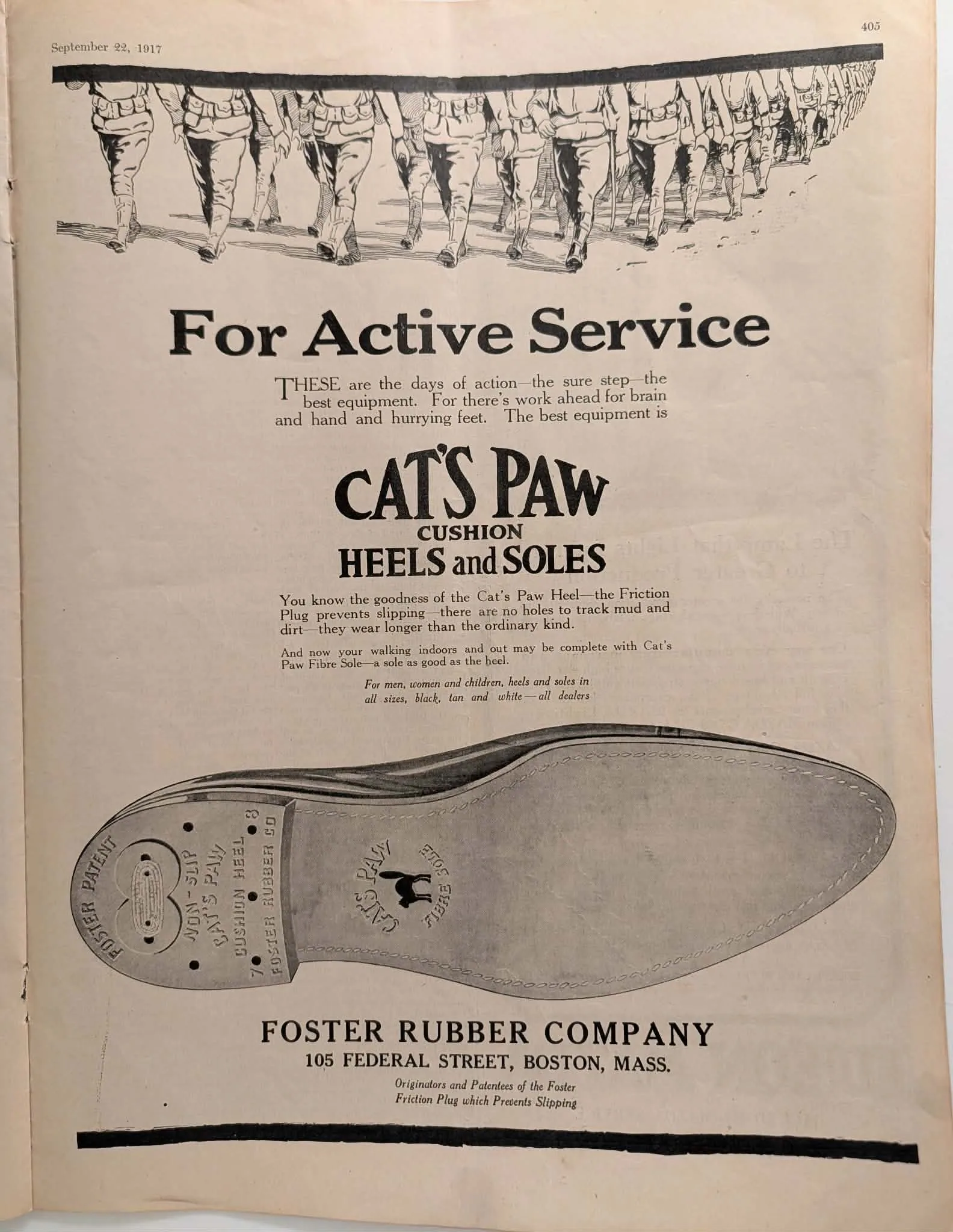
1917 Cat's Paw Cushion Heels Vintage Advertisement
Published during the height of World War I, this advertisement for Cat's Paw Cushion Heels perfectly captures the urgency and mobilization of the era. The Foster Rubber Company masterfully aligned its product with the national war effort, utilizing the commanding headline "For Active Service" positioned beneath a dynamic, horizontal illustration of marching infantrymen. By emphasizing that these are "days of action," the copywriter logically positions the patented Foster Friction Plug as an essential utility for "hurrying feet," seamlessly bridging the gap between military necessity and everyday civilian practicality. Beyond its historical and cultural resonance, the advertisement is a masterclass in early 20th-century commercial drafting. The artwork maintains a rigorous flat illustration style, relying entirely on high-contrast, monochromatic ink application rather than photographic halftones. The detailed rendering of the prominent shoe sole utilizes precise, hand-drawn stroke quality and meticulous stippling to convey the physical texture of the rubber, the stitching, and the raised friction plugs. The typographic layout—featuring the iconic arched "CAT'S PAW" lettering and the silhouetted black cat logo—guides the viewer’s eye with authoritative balance. For contemporary archivists, designers, and visual researchers, this piece provides an exceptional structural foundation. The naturally aged paper texture offers a warm, period-accurate color palette that beautifully offsets the graphic weight of the black ink. Because the artist's original linear economy is flawlessly preserved, this advertisement serves as an ideal blueprint for projects focused on translating static historical media into living 2D artworks. The crisp line work and structural solidity make it highly adaptable for 2D animation techniques that seek to faithfully emulate the distinct, handcrafted illustration styles of the mid-1910s.
Category: Menswear
Year: 1917
Rarity Class: A
Paper & Print Condition
Printed on standard uncoated periodical stock, this piece demonstrates a beautifully authentic, aged paper texture that establishes a warm, period-accurate color palette for the underlying artwork. The structural integrity of the paper is exceptionally well-preserved, displaying only minor, expected peripheral oxidation. The black ink application remains remarkably deep and consistent without any signs of fading. This pristine, high-contrast preservation perfectly highlights the distinct hand-drawn stroke quality and meticulous stippling characteristic of the era's flat illustration style, making it an invaluable physical reference for modern 2D animation translations. The page number "405" is clearly visible in the upper right corner, indicating its extraction from a substantial bound publication.
Provenance & Rarity
Authentic 1917 print advertisements featuring World War I military tie-ins alongside the complete Foster Rubber Company patent illustrations are highly coveted in this pristine state of preservation. Finding the prominent "marching soldiers" header fully intact without peripheral cropping damage is increasingly uncommon. Beyond its historical military significance, the true rarity of this artifact lies in its flawless preservation of flat illustration techniques. Surviving examples that so clearly articulate the original hand-drawn stroke quality and authentic period color palettes are highly sought after. This piece serves not merely as a collectible, but as an essential, high-fidelity structural foundation for meticulously translating these specific historical print aesthetics into living 2D artworks and dynamic animations.
Rarity & Condition Summary
Classified as a Rarity Class A artifact, this 1917 Cat's Paw advertisement represents an exceptionally crisp survival of WWI-era commercial art. The structural integrity of the paper and the sharp contrast of the original ink application make this a premium-grade archival asset. Because it flawlessly retains its authentic aged paper texture, period color palettes, and distinct hand-drawn stroke quality, it provides an invaluable, high-fidelity reference point. This immaculate preservation of flat illustration techniques ensures the piece transcends mere collectability; it functions as a vital structural blueprint for meticulously translating historical print aesthetics into dynamic 2D animations and contemporary graphic frameworks.