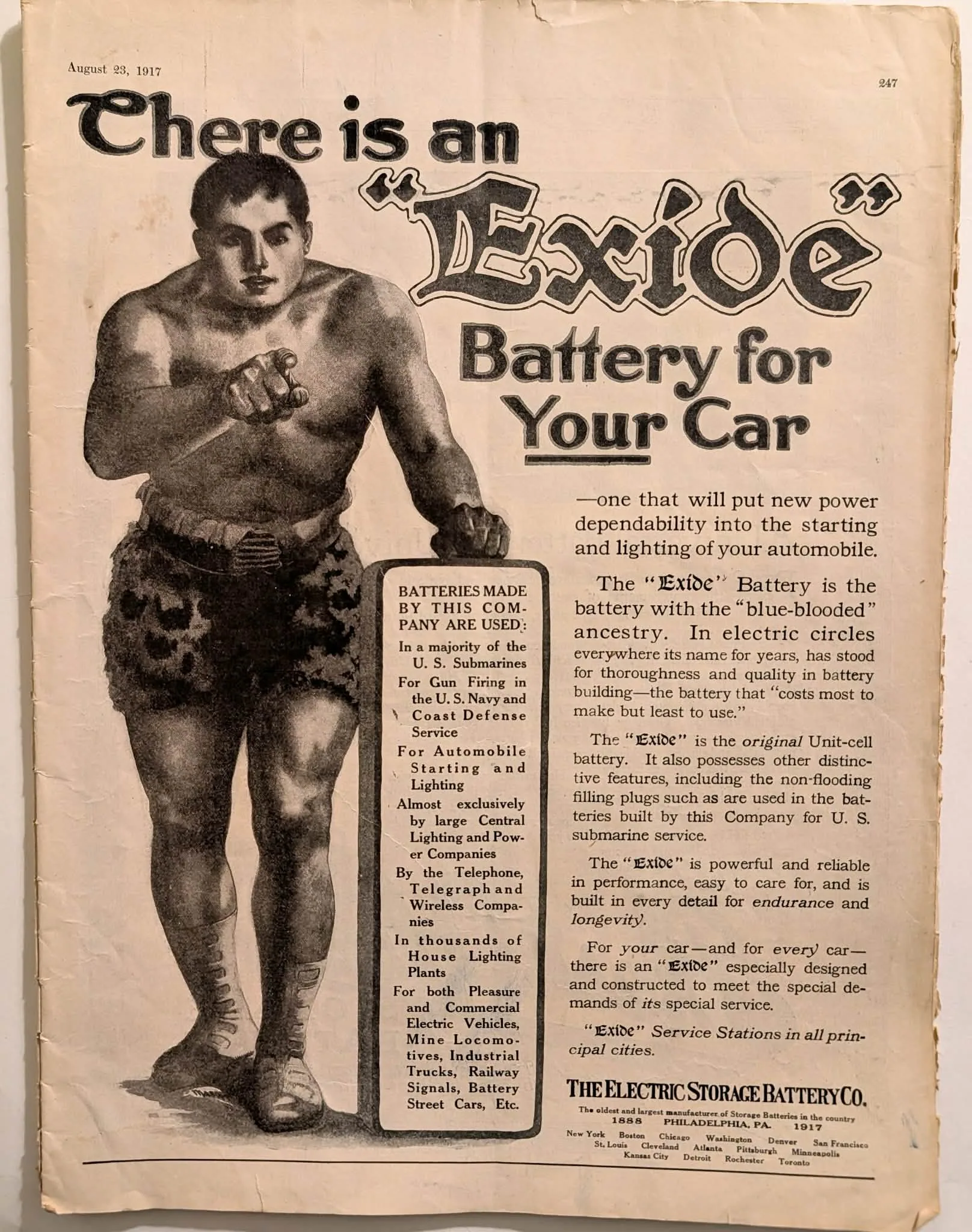
1917 Exide Battery "For Your Car" Vintage Advertisement
Founded in 1888 in Philadelphia, Pennsylvania, The Electric Storage Battery Company established itself as a pioneer in power storage. By 1917, the automotive landscape was undergoing a massive shift: the dangerous and physically demanding hand-crank starters were being rapidly replaced by electric starting and lighting systems. This August 1917 advertisement for the "Exide" Battery captures this technological tipping point perfectly, positioning the brand not just as an accessory, but as the pulsating heart of the modern automobile. The visual strategy is intensely psychological. The central figure is an imposing, bare-chested man draped in an animal pelt, exuding primitive strength and raw power. He points directly at the viewer—a confrontational visual motif highly popularized during WWI, reminiscent of the iconic Uncle Sam "I Want You" poster published that very same year. This personification of raw energy serves to materialize the invisible force of electricity. The stark separation between this commanding foreground subject and the structured typography makes the piece highly dynamic, presenting excellent planar depth for modern digital preservation and adaptation into living 2D motion artwork. Textually, the copy leverages the company's military contracts as the ultimate proof of quality. The sidebar proudly declares that their batteries are used "In a majority of the U.S. Submarines" and "For Gun Firing in the U.S. Navy." This establishes what the ad calls a "blue-blooded ancestry" for the consumer car battery. By assuring drivers that the same robust engineering that fires naval guns and powers underwater vessels is available for their personal vehicles, Exide executed a masterclass in "trickle-down" military marketing. It reflects an era where American industrial prestige and wartime readiness were deeply intertwined with emerging consumer luxury, making this artifact a vital document of early 20th-century automotive history.
Category: Automotive Parts
Year: 1917
Rarity Class: A
Paper & Print Condition
The artifact exhibits characteristic age-toning (foxing and uniform yellowing) typical of century-old wood-pulp publication stock. Close examination reveals a pronounced, coarse halftone dot structure, indicative of standard mass-publication letterpress printing techniques of the late 1910s. While minor edge wear and slight micro-tears are present along the margins, the structural integrity remains robust, and these superficial imperfections do not detract from the striking central graphic and crisp typography.
Provenance & Rarity
Dated August 23, 1917. This piece holds significant provenance as it originates from the height of World War I, capturing a pivotal moment in American industrial history. Advertisements from this specific period that explicitly link consumer automotive technology to active military apparatus—specifically U.S. Navy submarines—are historically vital. Surviving examples featuring this level of bold, psychological illustration, which breaks the fourth wall to confront the viewer, are increasingly rare in the archival market. Its direct association with The Electric Storage Battery Company of Philadelphia further solidifies its standing as a premier document of early 20th-century electrical engineering marketing.
Rarity & Condition Summary
Classified as a Class A artifact, this piece is highly preserved. Its structural integrity, combined with the clarity of its bold illustrative elements and WWI-era messaging, makes it a museum-quality document representing the dawn of modern automotive electrical systems.