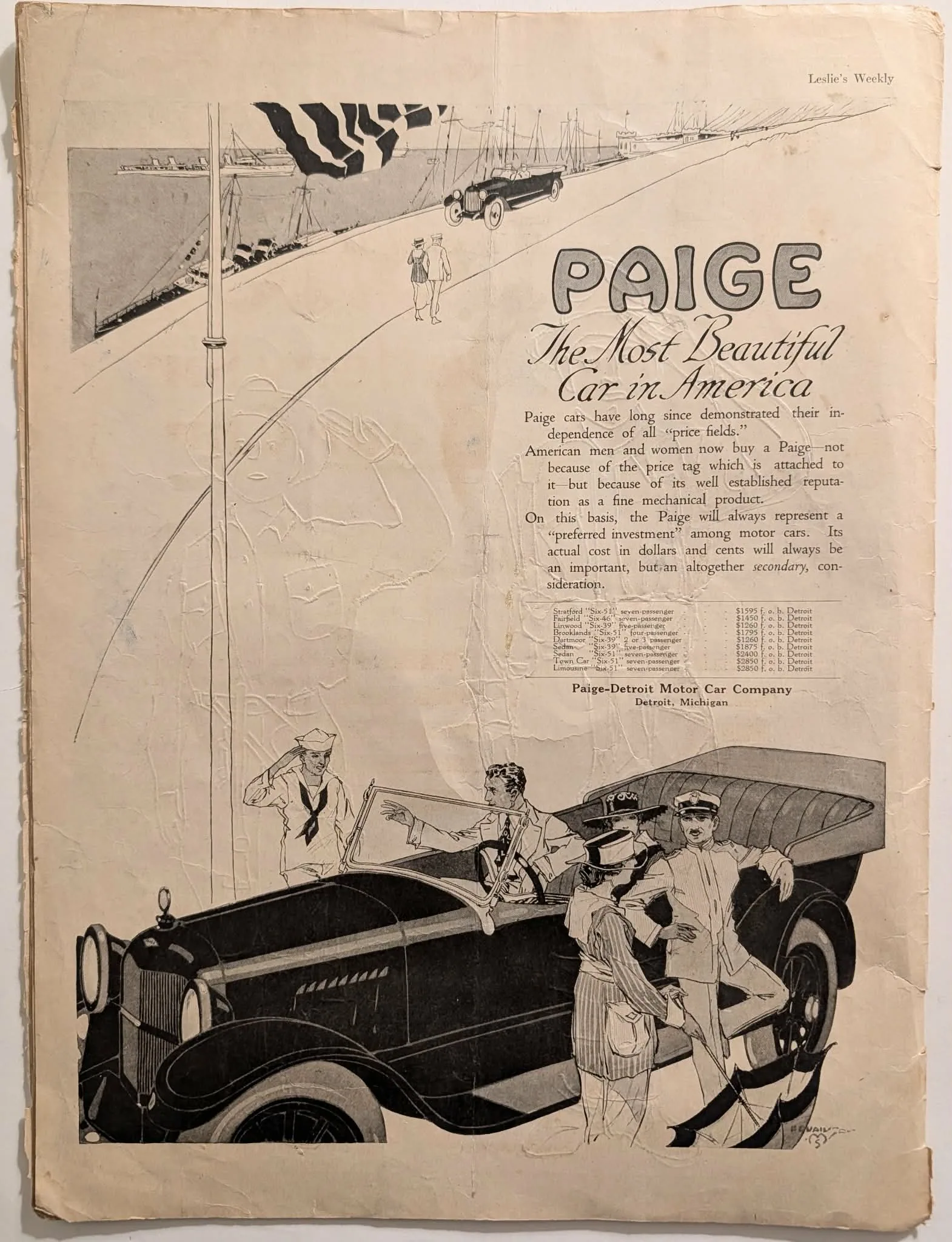
1917 Paige "The Most Beautiful Car in America" Vintage Advertisement
The Paige-Detroit Motor Car Company, operating out of Detroit, Michigan, positioned its vehicles as a "preferred investment" rather than a mere commodity. This advertisement, published in the widely read Leslie's Weekly, exemplifies the brand's confident marketing strategy, anchoring its appeal in both mechanical reliability and exceptional aesthetics. The bold declaration—"The Most Beautiful Car in America"—was not just a slogan; it was the central pillar of Paige’s identity during the late 1910s. Visually, the composition is a masterclass in period illustration. The foreground features a sleek, dark Paige touring car—likely the Stratford "Six-51" or Fairfield "Six-46" seven-passenger model—contrasting sharply with the pale, uniform-clad figures around it. The nautical theme is inescapable. A naval officer and elegant female passengers occupy the vehicle, while a sailor delivers a crisp salute. In the background, majestic naval dreadnoughts and signaling flags reinforce a patriotic atmosphere, heavily resonant with an American audience during the First World War. The typography is equally deliberate, utilizing elegant, sweeping scripts for the primary slogan while relying on structured, highly legible serif fonts for the detailed pricing matrix. The listed models—ranging from the
Category: Cars
Year: 1917
Rarity Class: A
Paper & Print Condition
The artifact exhibits visible signs of its century-old provenance. Distinct vertical and horizontal creases suggest it was folded for an extended period. The paper shows general waviness and edge wear typical of early 20th-century newsprint magazines. Close inspection reveals a prominent, coarse halftone dot pattern characteristic of mass-market printing techniques of the era.
Provenance & Rarity
Sourced from an original 1917 issue of Leslie's Weekly, a prominent American illustrated news and literary magazine that ceased publication in 1922. Automotive advertisements from the World War I era that intertwine civilian luxury with patriotic military motifs are highly sought after by historical automotive archivists. Surviving examples of this specific Paige-Detroit campaign, particularly those featuring detailed halftone printing and early 20th-century nautical themes, are increasingly rare in good condition, elevating its archival significance.
Rarity & Condition Summary
Classified as a Class A artifact, this piece represents a structurally complete but well-worn example of WWI-era automotive marketing. While it exhibits standard physical imperfections such as creases and edge wear typical of century-old newsprint, its historical and archival value significantly supersedes these condition issues. It remains a vivid, highly collectible glimpse into the intersection of early consumerism and wartime patriotism, making it a vital asset for historical preservation.