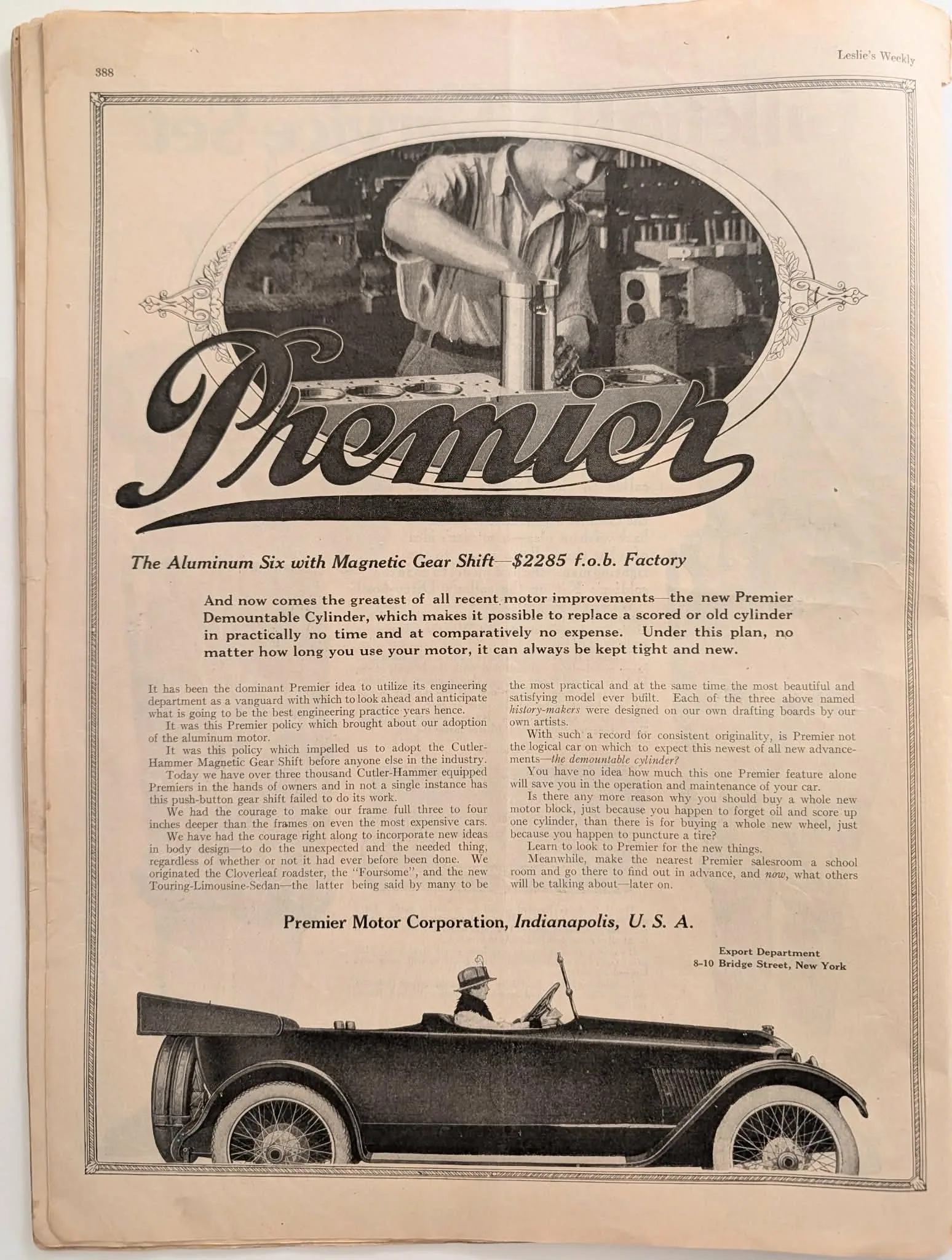
1917 Premier Aluminum Six Vintage Advertisement
During the late 1910s, the American automotive landscape was a fierce proving ground for new technologies. The Premier Motor Corporation of Indianapolis sought to distinguish itself not merely through luxury, but through profound engineering advancements. As seen in the complete archival document, the focal point of their campaign was the "Aluminum Six" engine paired with a revolutionary push-button transmission system. The advertisement proudly champions the Cutler-Hammer Magnetic Gear Shift. Long before the normalization of automatic transmissions, this system allowed drivers to pre-select gears using buttons mounted on the steering column, relying on electromagnets to execute the shift when the clutch was depressed. This promised a driving experience free from the physical exertion and mechanical grinding typical of early manual gearboxes. Furthermore, the ad introduces the "Premier Demountable Cylinder," a pragmatic engineering solution allowing for the replacement of a scored cylinder without the prohibitive cost of replacing the entire engine block. From a visual and curatorial perspective, the advertisement's structural composition is remarkable. The piece utilizes distinct horizontal planes that effectively separate the mechanical proposition from the lifestyle appeal. As detailed in the upper vignette, a mechanic is shown interacting with the demountable cylinder. The flat, carefully layered illustration style of this section provides a sharp, analytical view of the technology. This meticulously drafted upper plane transitions downward through dense, confident typography into the lifestyle representation at the base. The lower portion of the advertisement features the sleek "Cloverleaf roadster." The stark contrast and sharp linework used to render the vehicle create a highly stylized, two-dimensional presence. A closer inspection reveals the elegant profile of the female driver, strategically emphasizing the ease of use afforded by the magnetic gear shift. These distinct visual layers—the mechanical action above and the smooth, forward motion below—invite a dynamic interpretation of the artwork. The flat lithographic qualities breathe a sense of living, kinetic energy into the static page, making it a pristine source for transformation into a living 2D animated artwork, evoking the ambient mechanical symphony and low rumble of the era's roadways.
Category: Cars
Year: 1917
Rarity Class: A
Paper & Print Condition
Sourced from page 388 of Leslie's Weekly, the original artifact exhibits a remarkably even, warm toning consistent with premium periodical stock of the late 1910s. The typographic elements remain exceptionally crisp against the aged paper. Notably, the halftone shading within the mechanical and lifestyle vignettes retains pristine contrast and sharp linework. This distinct visual separation of the flat lithographic layers makes the piece exceptionally well-suited for digital extraction, allowing the static artwork to be seamlessly transformed into a living, two-dimensional animated sequence. The structural integrity is excellent, with minimal edge wear preserving the precise decorative borders that frame the composition.
Provenance & Rarity
Automotive advertisements from this specific decade detailing the Cutler-Hammer Magnetic Gear Shift are highly sought after by both engineering archivists and automotive historians. Because this electromagnetic push-button transmission was a relatively brief, experimental precursor to fluid-driven automatic transmissions, surviving print materials documenting its consumer marketing are exceedingly scarce. Furthermore, the explicit and mechanically precise depiction of the "Demountable Cylinder"—a rare engineering approach to engine block longevity—elevates the academic and curatorial value of this specific piece. As a primary source document from the World War I era of American industrial manufacturing, it holds significant historical weight.
Rarity & Condition Summary
Designated as a Class A (Rare) artifact, this exceptionally preserved and structurally complex layout details pivotal, experimental automotive technology from the 1910s. Its pristine lithographic flat planes and sharp contrast not only preserve the mechanical ingenuity of the era but also make this piece an exceptional candidate for precise digital extraction and transformation into living 2D animated artwork. It stands as a masterclass in early 20th-century American commercial illustration.