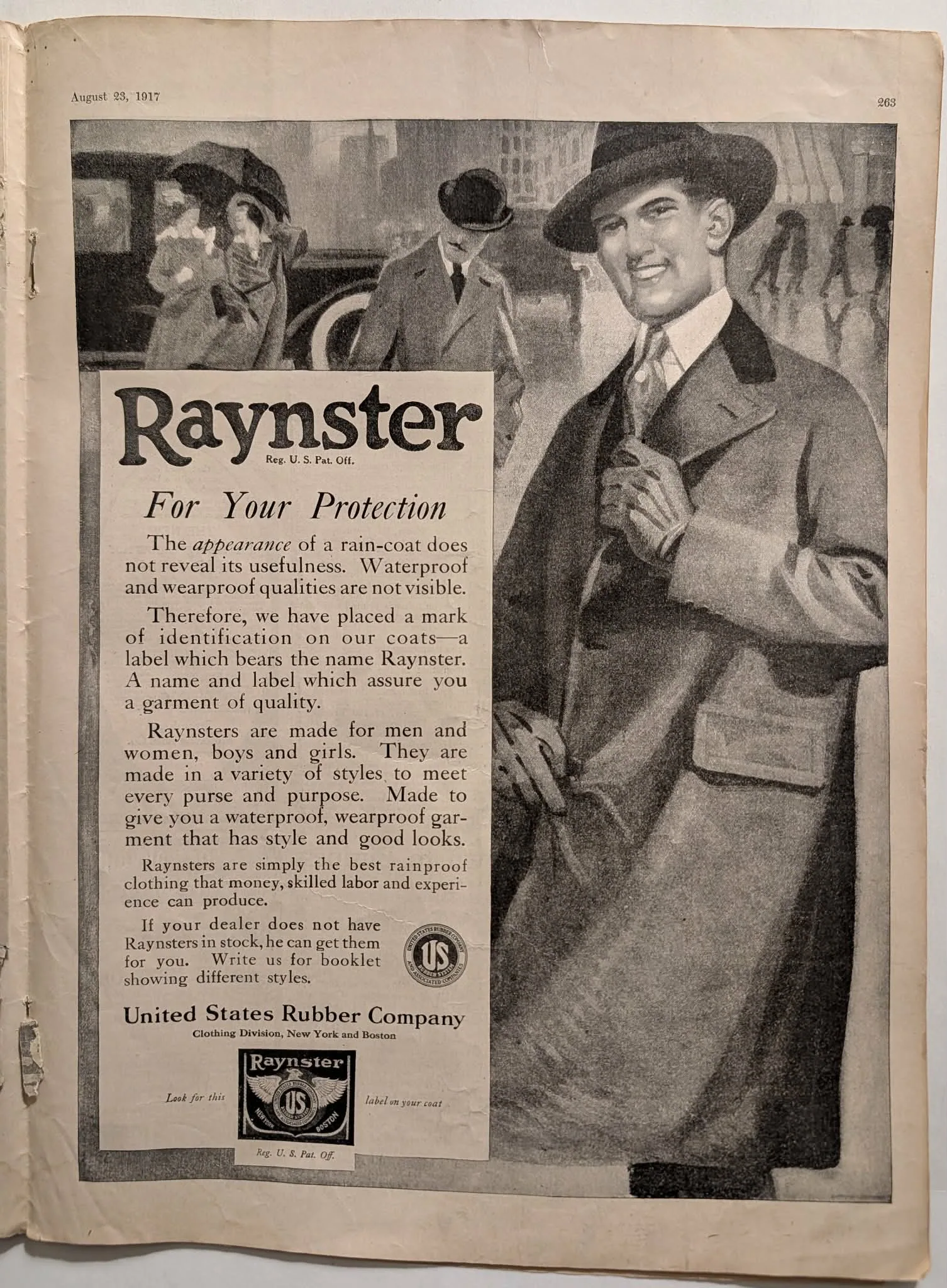
1917 United States Rubber Company Raynster Raincoat Vintage Advertisement
In the late 1910s, the concept of brand trust was undergoing a massive evolution. The United States Rubber Company, a conglomerate of various rubber manufacturers, launched this specific campaign to educate consumers on a highly practical problem: the invisible nature of waterproofing. The compelling headline, "For Your Protection," immediately addresses consumer anxiety regarding product quality in an unregulated era of manufacturing. The accompanying copy elaborates on this pain point, stating, "The appearance of a rain-coat does not reveal its usefulness. Waterproof and wearproof qualities are not visible." By establishing this problem, the advertisement masterfully positions the "Raynster" label—featuring the distinguished eagle and the U.S. Rubber System seal—as the ultimate guarantor of quality. This reflects a pivotal moment in commercial history where the physical label itself became as valuable as the garment it was sewn into. Visually, the advertisement utilizes a striking halftone illustration to convey elegance alongside utility. The central figure—a dapper gentleman sporting a tailored raincoat, fedora, and gloves—smiles confidently amidst a bustling, rain-slicked city street. In the background, an automobile and umbrella-wielding pedestrians establish a modern, urban atmosphere. The striking linear depth, precise shading, and vivid character expression captured in this historical illustration style make such artifacts exceptional candidates for modern preservation and dynamic digital animation studies. The visual narrative assures the consumer that they do not need to sacrifice sartorial sophistication for practical weather protection. This piece stands as a masterclass in early consumer psychology. By transforming a utilitarian rubberized garment into a symbol of smart, stylish protection, the United States Rubber Company effectively bridged the gap between heavy industrial manufacturing and everyday personal fashion.
Category: Menswear
Year: 1917
Rarity Class: A
Paper & Print Condition
The artifact exhibits the characteristic patina of early 20th-century periodical stock, with slight, even toning across the page that speaks to its century-old provenance. The halftone ink remains remarkably crisp, preserving the nuanced shading of the central figure's overcoat and the detailed typography of the Raynster logo. Minor edge wear is present on the left margin, indicative of its original binding. Its high-fidelity print quality and structural integrity make it an exceptional candidate for meticulous digital preservation and adaptation into living 2D artwork, strictly maintaining its historical illustration style.
Provenance & Rarity
Sourced from an American publication dated August 23, 1917, this piece is a rare surviving example of domestic consumer advertising produced during a period heavily dominated by wartime rationing and military manufacturing efforts of World War I. Surviving print artifacts from this specific era that successfully bridge heavy industry (The United States Rubber Company) and everyday consumer fashion are exceedingly uncommon. Furthermore, the pristine preservation of the original illustrator's intricate line work, proportion, and halftone shading ensures this artifact serves not only as a vital historical document but as an immaculate baseline for adaptation into dynamic, living 2D artwork. This level of physical integrity allows modern archival efforts to breathe new life into the piece while strictly preserving the authenticity of early 20th-century historical illustration styles.
Rarity & Condition Summary
A superbly preserved, century-old document. Its high-fidelity print quality and structural integrity make it an invaluable primary source for researchers of historical fashion, typography, and early corporate branding. Crucially, the immaculate retention of the original halftone shading and precise character linework makes this Class A artifact an exceptional foundation for adaptation into dynamic, living 2D artwork. This remarkable condition allows modern archival efforts to seamlessly breathe life into the piece while strictly preserving and animating the authentic historical illustration style.