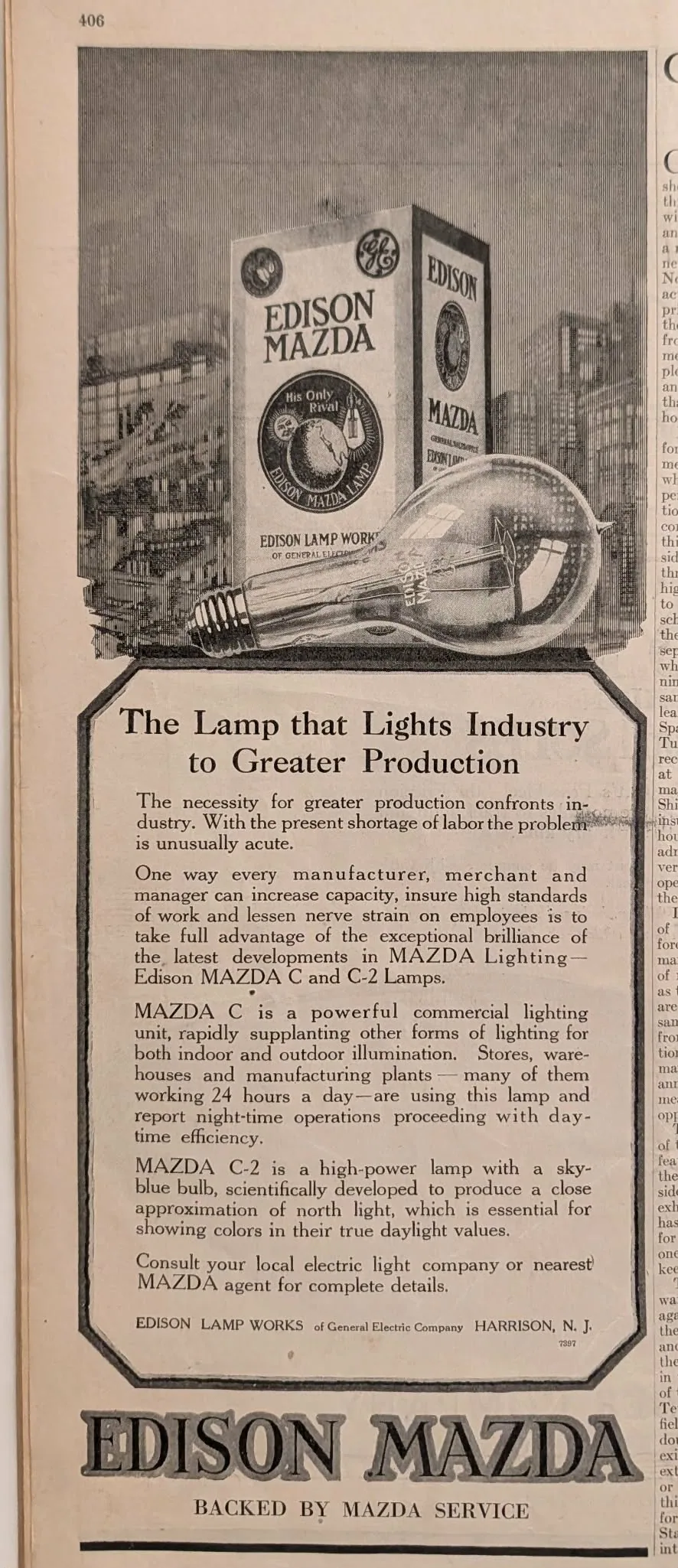
1918 Edison MAZDA Lamp Vintage Advertisement
Published against the backdrop of World War I, this Edison MAZDA advertisement directly addresses the "present shortage of labor" and the acute necessity for greater industrial output. General Electric strategically positioned its lighting technology not merely as a utility, but as a vital component of the national production effort. By promoting the MAZDA C for broad illumination and the MAZDA C-2 for accurate "north light" color rendering, the copywriter effectively bridges the gap between technological innovation and the practical demands of 24-hour manufacturing cycles. The bold typographic layout anchors the persuasive text, guiding the reader from the urgent headline down to the authoritative "BACKED BY MAZDA SERVICE" insignia. Beyond its historical marketing significance, the advertisement is a masterclass in early 20th-century commercial drafting. The artist strictly preserves a flat illustration style, relying entirely on graphic black-and-white contrast without the use of photographic halftones. The hand-drawn stroke quality is remarkably bold and deliberate. Intricate, directional cross-hatching is employed to define the luminous volume of the glass bulb, the rigid geometry of the packaging, and the towering, shadowy industrial skyline in the background. The iconic "His Only Rival" trademark—depicting a disgruntled sun looking at the brilliant bulb—adds a touch of allegorical charm to the highly technical aesthetic. This masterclass in linear economy and period-accurate color palettes, dictated by the monochromatic ink and the natural warmth of the aged paper texture, makes the advertisement an invaluable reference for visual studies. It serves as an exceptional structural foundation for modern creatives and archivists looking to translate static, historical print media into living 2D artworks. The crisp line work, heavy shadowing, and structural solidity make it highly adaptable for dynamic 2D animation techniques that seek to faithfully emulate the distinct, handcrafted illustration styles of the late 1910s. Every element functions as a time capsule of industrial consumer culture.
Category: Electronics
Year: 1918
Rarity Class: A
Paper & Print Condition
Printed on standard uncoated periodical stock, this artifact demonstrates a beautifully authentic, naturally aged paper texture that establishes a warm, period-accurate color palette for the underlying artwork. The structural integrity of the paper is well-preserved, displaying only expected peripheral oxidation. The black ink application remains remarkably deep and consistent, without any signs of fading. This pristine, high-contrast preservation perfectly highlights the distinct hand-drawn stroke quality and intricate cross-hatching characteristic of the era's flat illustration style. Maintaining access to these exact physical and stylistic parameters provides a vital structural blueprint for meticulously translating static historical aesthetics into dynamic 2D animations. The page number "406" is clearly visible in the upper left corner, indicating its extraction from a substantial bound publication.
Provenance & Rarity
Authentic circa-1918 print advertisements featuring the complete "His Only Rival" logo alongside deep-contrast industrial skyline illustrations are increasingly uncommon in cleanly preserved states. Beyond its significance in WWI-era industrial history, the true rarity of this artifact lies in its flawless preservation of early 20th-century flat illustration techniques. Surviving examples that so clearly articulate the original hand-drawn stroke quality, intricate cross-hatching, and authentic period color palettes dictated by the naturally aged paper are highly sought after. This piece serves not merely as a collectible, but as an essential, high-fidelity structural foundation for contemporary creatives and archivists seeking to meticulously translate these specific historical print aesthetics into living 2D artworks and dynamic animations.
Rarity & Condition Summary
Classified as a Rarity Class A artifact, this 1918 Edison MAZDA advertisement represents an exceptionally crisp survival of WWI-era commercial art. The structural integrity of the paper and the sharp contrast of the original ink application elevate this piece to a premium-grade archival asset. Because it flawlessly retains its authentic aged paper texture, period color palettes, and distinct hand-drawn stroke quality, it provides an invaluable, high-fidelity reference point. This immaculate preservation of early 20th-century flat illustration techniques ensures the piece transcends mere collectability; it functions as a vital structural blueprint for meticulously translating historical print aesthetics into dynamic 2D animations and contemporary graphic frameworks.