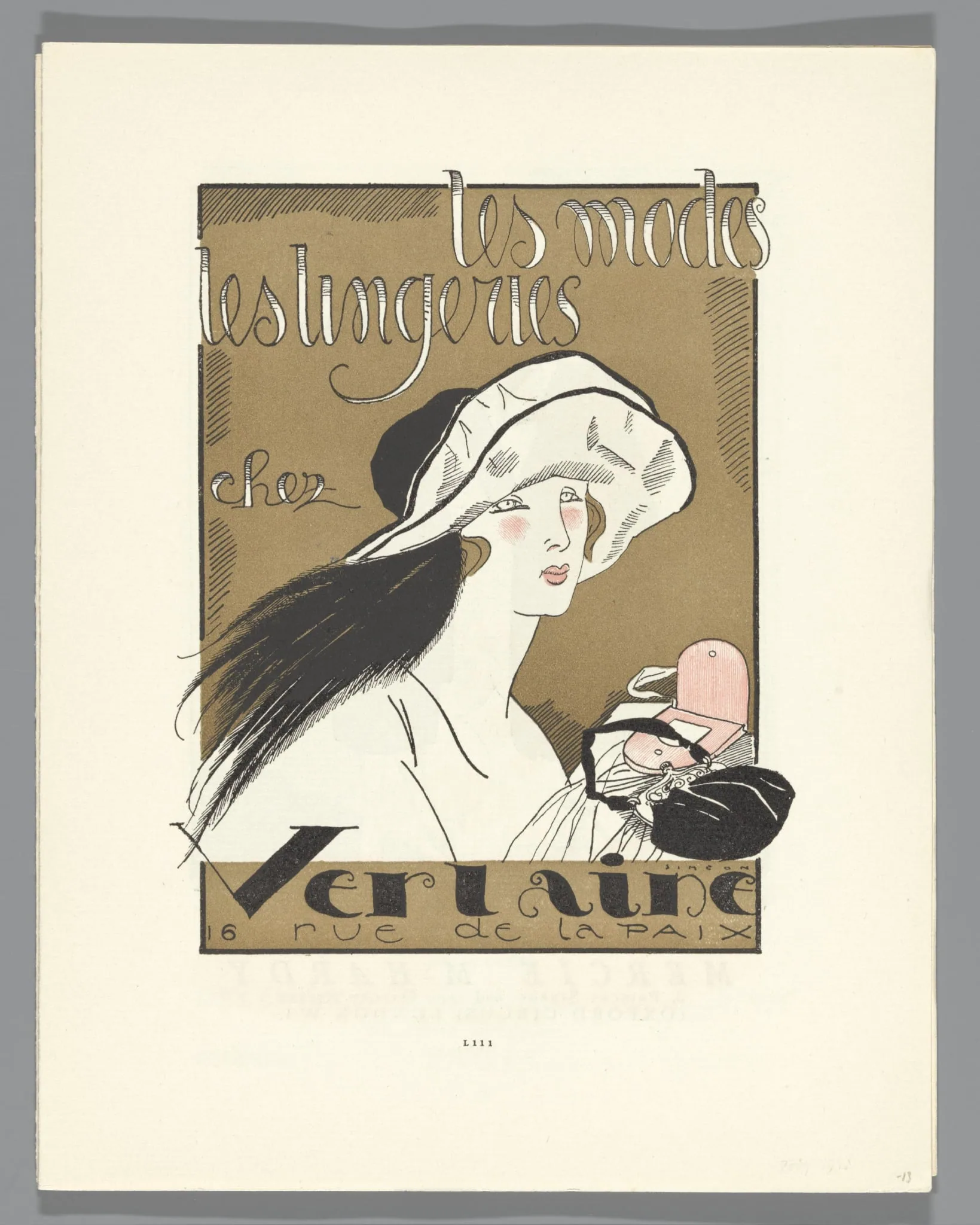
1920 Fernand Siméon Verlaine Gazette du Bon Ton Advertisement
A vertical rectangular composition features a woman viewed from the chest up in profile, facing right. She has dark stylized hair, pale skin with rouged cheeks, and wears a white hat. Her hands hold a pink compact mirror and a black purse. The background is a flat ochre plane, enclosed by varied black border lines. Hand-lettered white script reads "les modes les lingeries" across the top, with "chez" in the middle left. A rectangular ochre box at the base contains "Verlaine" in large stylized black lettering, subtitled "16 rue de la PAIX". The signature "SIMEON" appears in the top right corner of this box. The printed alphanumeric code "L 111" is centered below the main image block. Show-through from the verso reveals reversed printed text, including "M E R C I E M H A R D Y" and "OXFORD CIRCUS LONDON W.1.". Faint markings and reversed numerals bleed through the paper at the lower right. The illustration bears the signature "SIMEON". The advertiser, Verlaine, operated at 16 rue de la Paix in Paris, an address historically associated with luxury retail. The primary image advertises a Parisian boutique, yet the show-through from the verso displays English text and the address "OXFORD CIRCUS LONDON W.1.". The presence of the W.1 postal district, introduced in 1917, establishes the publication as a post-1917 British periodical circulating Parisian fashion to an English-speaking audience. The composition relies on flat planes of color, heavy contour lines, and integrated lettering rather than traditional perspective or shading. The radical cropping of the figure and the asymmetrical balance of the typography suggest established structural markers of Japonisme adapted for commercial use. Surviving as a single leaf extracted from a bound periodical, the object functioned as a commercial advertisement. The physical page provides material evidence of cross-border luxury marketing during the period.
Category: Womenswear
Year: 1920
Rarity Class: B
Paper & Print Condition
The paper exhibits a moderate tone. Colors remain distinct, utilizing a limited palette of ochre, black, white, and pink. Show-through from the verso is prominent, particularly in the lower half, indicating a relatively thin paper stock typical of periodicals. Edges display minor irregularities consistent with extraction. Resolution limits assessment of the precise printing process.
Provenance & Rarity
Publication identification relies on verso text referencing the London postal district "W.1.", situating the leaf within a post-1917 British periodical. The year 1920 is a stylistic and contextual estimate. The physical provenance of this specific copy is undocumented. Class B. The rarity assessment is based on the survival of this specific physical component rather than its original print run. The source medium—a post-1917 British periodical—was mass-produced and widely circulated. However, the survival of this individual, intact leaf is moderate. The inherent fragility of the thin paper stock, combined with the typical disposal rate of commercial print ephemera, limits the availability of isolated sheets in this specific condition.
Rarity & Condition Summary
The physical leaf is intact with clear color registration, though the image area is impacted by inherent text show-through from the verso. Survival of this specific publication element is likely moderate.