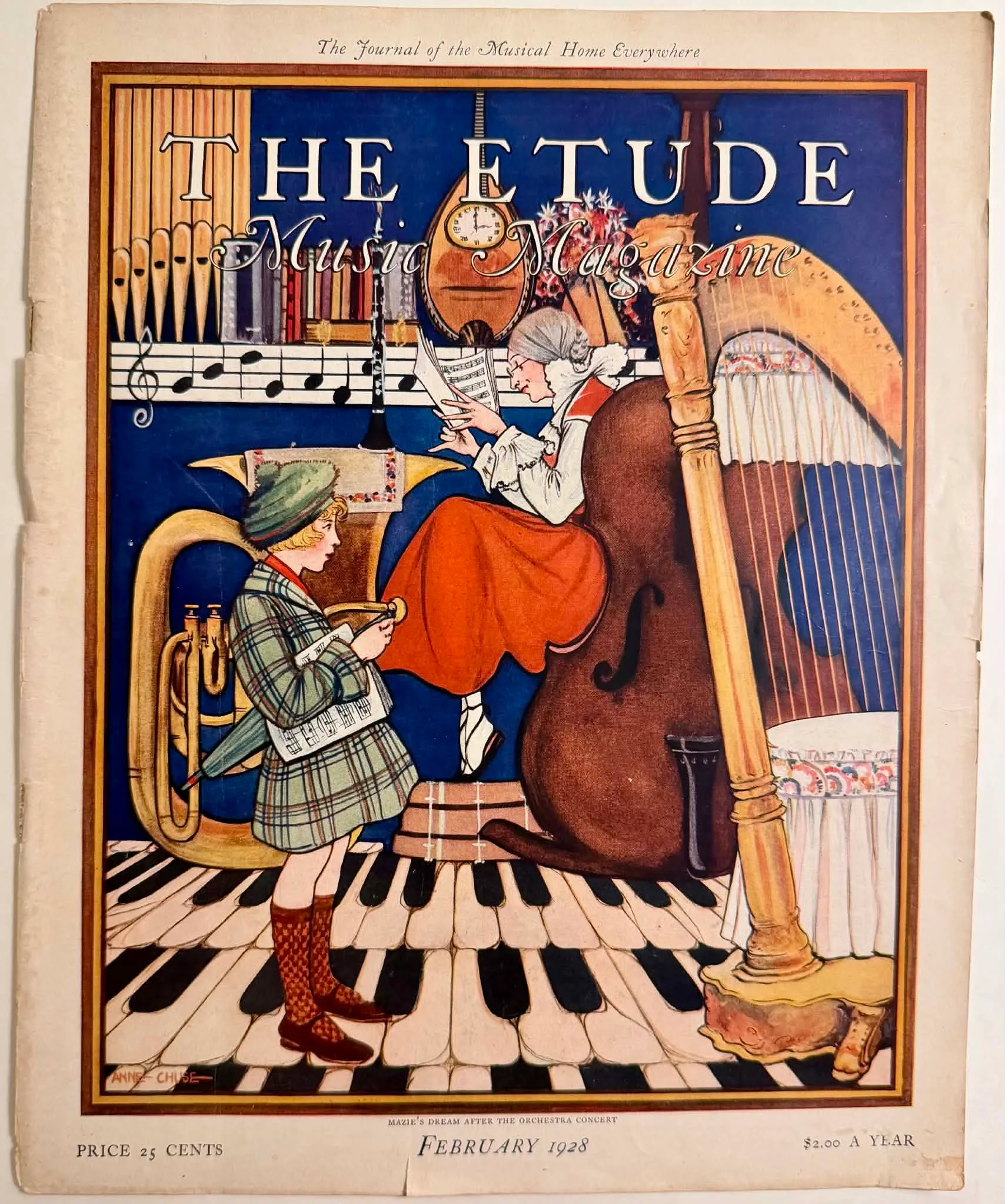
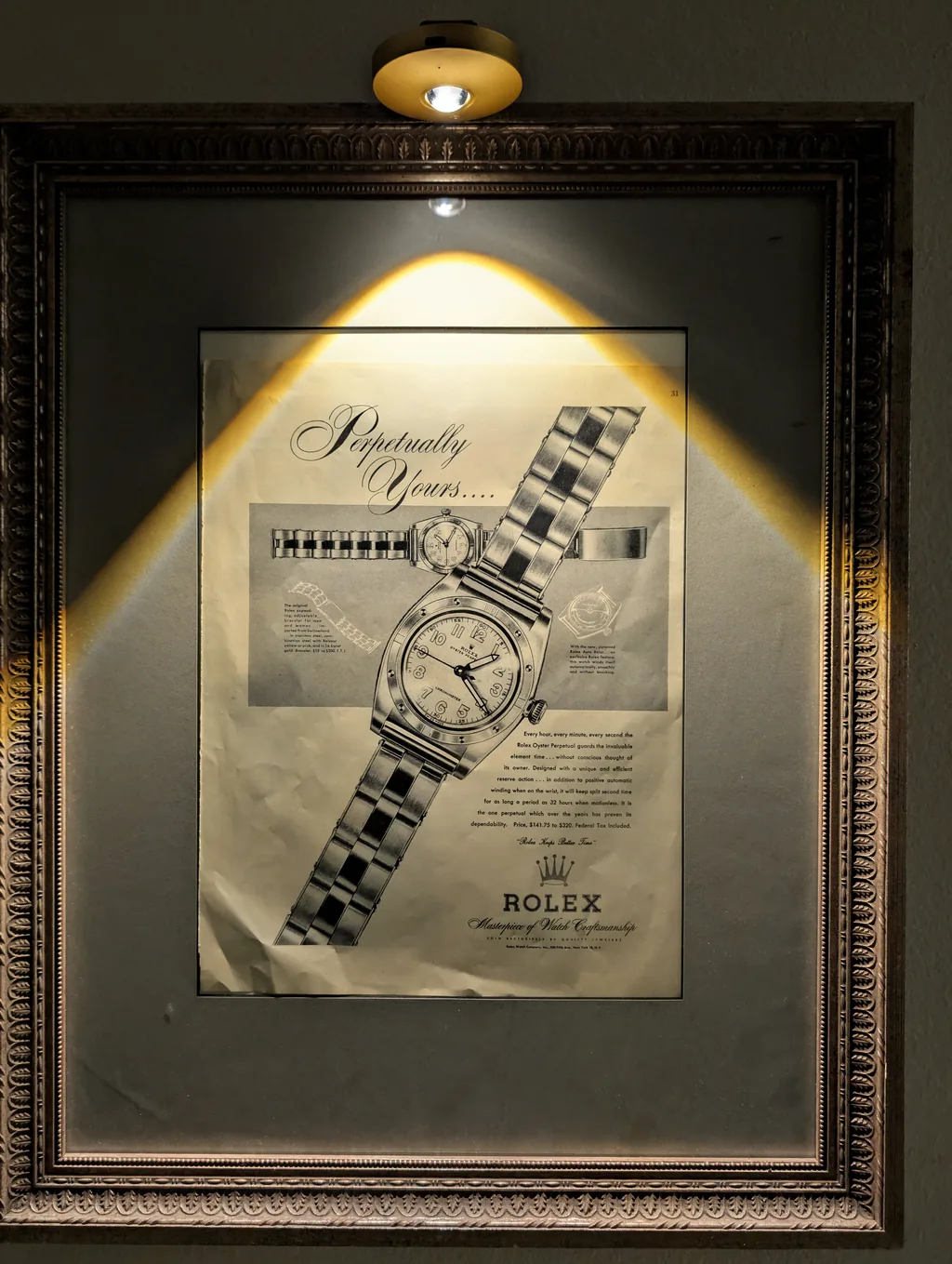
1928 Anne Chuse Mazie's Dream After the Orchestra Concert Etude Magazine Cover Art
The visual evidence presented in this digital surrogate reveals a highly illustrative, mass-market periodical cover dominated by a surreal, dream-like tableau. The central illustration depicts a scene of profound scale distortion, rendering a young girl—presumably the titular "Mazie"—standing upon a floor composed entirely of giant, undulating piano keys. Mazie is dressed in quintessential late-1920s children's winter fashion: a green plaid coat, a matching green tam-o'-shanter with a red pom-pom, a red collared shirt, and patterned knee-high argyle socks paired with brown leather shoes. She clutches a rolled-up green umbrella under her arm while attentively reading a piece of sheet music. Above and behind her, the landscape is populated by impossibly massive musical instruments. An elderl
Category: Pens & Writing
Year: 1928
Rarity Class: B
Paper & Print Condition
Based strictly on rigorous visual examination of the digital proxy, the artifact is printed on typical commercial magazine stock characteristic of the late 1920s, which appears porous and overtly susceptible to natural oxidation and cellular degradation. The extremities show characteristic toning (browning) entirely consistent with the aging of acidic paper over nearly a century. The left binding margin exhibits significant mechanical damage, characterized by multiple rough tears, structural cre
Provenance & Rarity
This artifact originates directly from a mass-circulated monthly publication, The Etude, which was distributed aggressively across the United States. Its initial physical scarcity was entirely non-existent, as it was specifically engineered for widespread, ubiquitous household consumption by the burgeoning middle class. The moderate rarity it possesses today is purely attritional. Magazines of this exact nature were interactive, utilitarian objects—opened, folded, physically placed on piano musi
Rarity & Condition Summary
The artifact is a Class B attritional survivor of late-1920s mass-market publishing. While the central printed image retains bold, saturated hues and remarkably stable color reproduction, the structural integrity of the paper exhibits typical acidic decay, edge toning, and rough mechanical tearing along the left binding edge, consistent with nearly a century of existence.