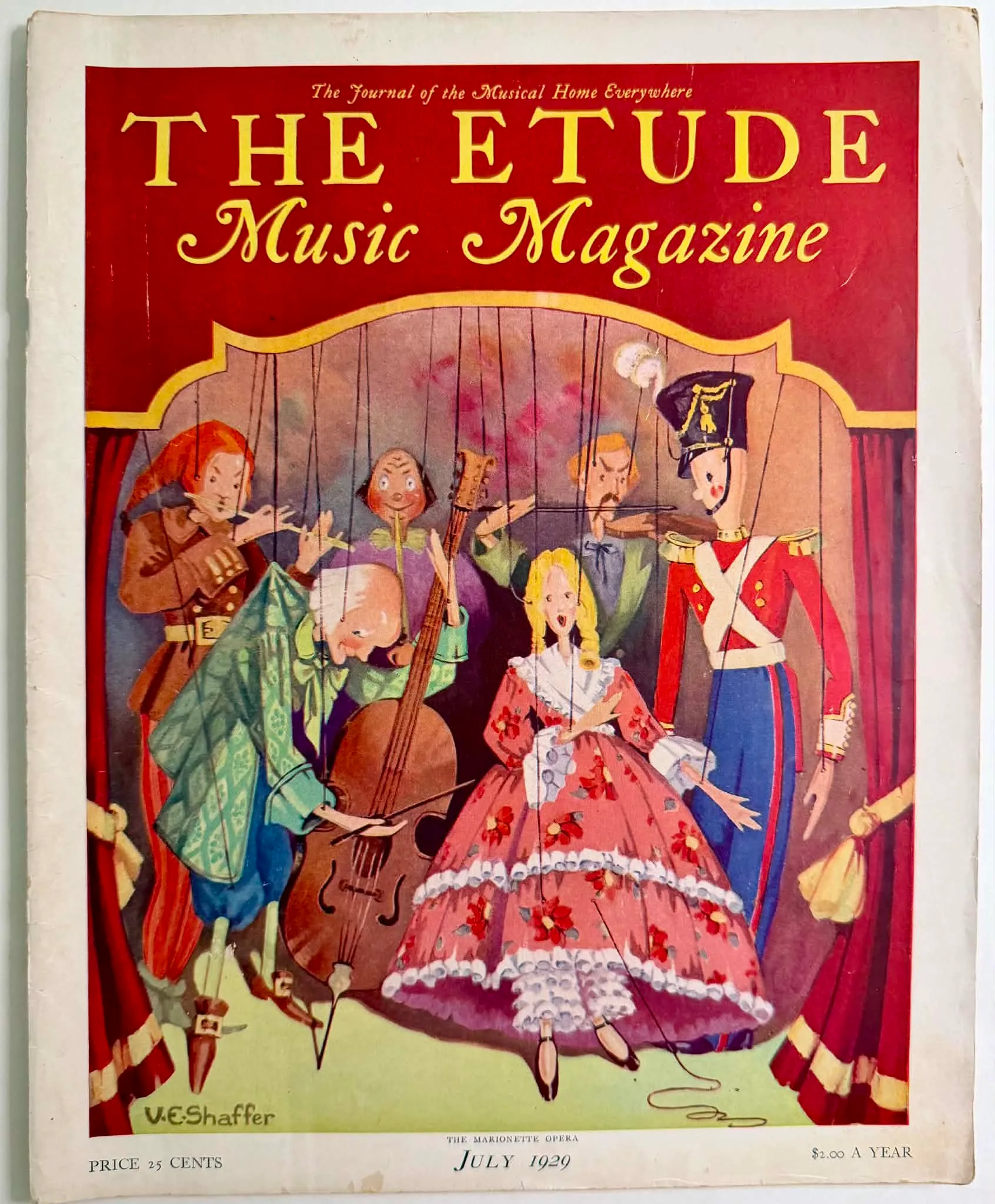
1929 V.E. Shaffer The Marionette Opera Etude Magazine Cover Art
The visual evidence presented in the supplied digital proxy reveals a vibrant, full-colour periodical cover featuring a theatrical illustration framed by a stylized proscenium arch. The composition is dominated by a sharply rendered depiction of five stringed marionette figures actively engaged in a musical performance upon a shallow, green-toned stage. Heavy red theatrical curtains, trimmed with yellow fringe and secured by gold tassels, firmly anchor the left and right margins, establishing the illusion of a stage setting. The central focal point is a female vocalist marionette, rendered with blonde ringlets and an open mouth denoting song. She is attired in an expansive, bell-shaped pink gown adorned with deep red, stylized floral motifs and separated by three distinct horizontal tiers of ruffled white lace. Surrounding her is a specialized ensemble of puppet musicians and performers: to her immediate left, an elderly, stooped cellist with white hair and spectacles plays a brown acoustic cello, dressed in an 18th-century style green frock coat, blue breeches, and buckled shoes; behind him, a figure in a rust-coloured jacket and red-striped trousers plays a transverse flute. To the vocalist's right stands a rigid toy soldier figure in a meticulously detailed uniform comprising a red tunic, white cross-belts, blue trousers with a red side stripe, and a tall black shako hat featuring a white plume. A partially obscured fifth figure in the background plays a violin. Thin, unbroken black lines descend from beyond the upper border of the composition, terminating precisely at the articulated joints, heads, and instruments of the figures, explicitly identifying them as suspended puppets rather than autonomous human actors. The printed text distributed across the artifact serves primary commercial, identifying, and chronological functions. Dominating the upper horizontal quadrant, set against a solid, deep-red rectangular field, is the overarching publication title. The masthead begins with a small, italicized, serif tagline reading, "The Journal of the Musical Home Everywhere". Immediately below, the primary title "THE ETUDE" is rendered in monumental, tracked-out yellow serif typography, commanding significant visual weight. Subordinate to this, the phrase "Music Magazine" is executed in an elegant, sweeping yellow script that provides calligraphic contrast to the rigid block letters above. The lower margin of the artifact, functioning as an informational footer printed on a cream-toned ground, features the title of the specific artwork centrally aligned: "THE MARIONETTE OPERA". Directly beneath this title lies the unequivocal date of publication: "JULY 1929", rendered in a sharply italicized serif font. Price demarcations anchor the lower corners, with "PRICE 25 CENTS" positioned on the left and "$2.00 A YEAR" on the right. Finally, resting securely within the illustrative frame in the lower-left corner of the stage floor, the artist’s signature, "V.E. Shaffer", is hand-lettered in a heavily stylized, rounded sans-serif script. The maker context of this artifact is irrevocably tied to the Theodore Presser Company of Philadelphia, the established and historically documented publisher of The Etude magazine. Founded in 1883, the publication was engineered to serve as a comprehensive educational and cultural resource for music teachers, students, and amateur musicians. By 1929, the magazine had evolved from a strictly pedagogical tool into a broadly appealing lifestyle journal that sought to elevate the cultural standing of the American middle-class home. The visible signature "V.E. Shaffer" attributes the cover artwork to a commissioned commercial illustrator of the era. Within the operational framework of 1920s periodical publishing, illustrators like Shaffer functioned not as autonomous fine artists, but as highly skilled commercial practitioners tasked with generating immediate visual appeal on crowded newsstands. The artwork was specifically engineered to visually encapsulate the themes of musicality, theatricality, and cultured entertainment that the publisher wished to associate with their brand identity. The geographic and audience context places this artifact at the absolute zenith of the American middlebrow cultural expansion, specifically in the late summer of 1929, mere months prior to the catastrophic stock market collapse that would initiate the Great Depression. The intended audience for this publication was explicitly the aspirational middle-class family, a demographic that heavily invested in domestic musical culture, most notably through the ownership of parlour pianos and, increasingly, phonographs and early radio receivers. The Etude positioned itself as the definitive arbiter of respectable musical taste for this demographic, hence the confident proclamation, "The Journal of the Musical Home Everywhere." The choice of a "Marionette Opera" as the cover subject matter directly appeals to an audience that possessed a foundational understanding of classical opera and theatrical traditions, yet desired those high-culture concepts packaged in an accessible, whimsical, and visually engaging format suitable for a family-oriented domestic space. The visual language of the artifact demonstrates a late-1920s commercial synthesis of stylized illustration and early Art Deco geometric simplification. The figures are not rendered with anatomical realism; rather, they are highly stylized caricatures, employing sharp angles, elongated proportions, and flat, unmodulated areas of localized colour. The aesthetic draws heavily upon the visual vocabulary of contemporaneous children's book illustration and theatrical poster design. The compositional strategy deliberately flattens the pictorial space; despite the overlapping figures and the architectural framing of the proscenium arch, there is no atmospheric perspective or deep shadow to suggest true three-dimensional depth. This flattening is a hallmark of modern commercial graphic design of the period. Furthermore, the overt depiction of the puppet strings introduces a sophisticated meta-narrative regarding control, performance, and the mechanics of theatrical production, serving as a clever visual metaphor for the discipline and orchestration required in musical performance—themes highly relevant to the magazine's readership of music students and educators. In terms of function and archival significance, this printed cover operated initially as a protective binding for the fragile sheet music and editorial content contained within, while simultaneously serving as a vibrant point-of-sale advertisement designed to stimulate newsstand purchases and subscriber retention. Plates and covers extracted from such periodicals serve as vital barometers of middle-class cultural consumption. As an archival object housed within a digital museum framework, this specific proxy captures a pristine moment of commercial chromotypography. It preserves the exact intersection of American publishing logistics, mass-market cultural aspiration, and the highly specific, stylized commercial illustration techniques deployed at the very end of the Roaring Twenties, permanently recording the visual and material culture of an era immediately preceding profound global economic transformation.
Category: Music & Entertainment
Year: 1929
Rarity Class: A
Paper & Print Condition
Rigorous macroscopic analysis of the supplied digital proxies, specifically the extreme close-up of the artist's signature, provides definitive, unassailable physical evidence regarding the precise production method. The digital image clearly resolves a distinct, rigidly structured rosette pattern comprising cyan, magenta, yellow, and black (CMYK) halftone dots. This categorically confirms the artifact was produced utilizing a photomechanical four-colour relief printing process, the absolute commercial standard for mass-market magazine covers of the late 1920s. The underlying paper stock exhibits a uniform off-white or light cream tone, characteristic of a moderately sized, wood-pulp-based magazine cover stock that has undergone minor, entirely expected oxidation. Along the extreme left vertical margin, the digital proxy reveals slight visual disruptions and minor structural distress, firmly consistent with the mechanical stress of staple-binding removal or long-term manipulation over a rigid spine. The colour fields, despite being constructed entirely of halftones, register as remarkably vibrant and opaque from a standard viewing distance, suggesting minimal UV degradation. Confidence: Moderate, strictly constrained by the inherent limitations of digital proxy resolution.
Provenance & Rarity
The artifact survives as a remarkably well-preserved example of pre-Depression commercial printing, securing a Class A historical designation. It visually presents robust, un-faded four-colour halftone fields characteristic of 1929 mass media, interrupted only by mild, structurally expected physical wear along the original binding edge.
Rarity & Condition Summary
The artifact survives as a remarkably well-preserved example of pre-Depression commercial printing, securing a Class A historical designation. It visually presents robust, un-faded four-colour halftone fields characteristic of 1929 mass media, interrupted only by mild, structurally expected physical wear along the original binding edge.