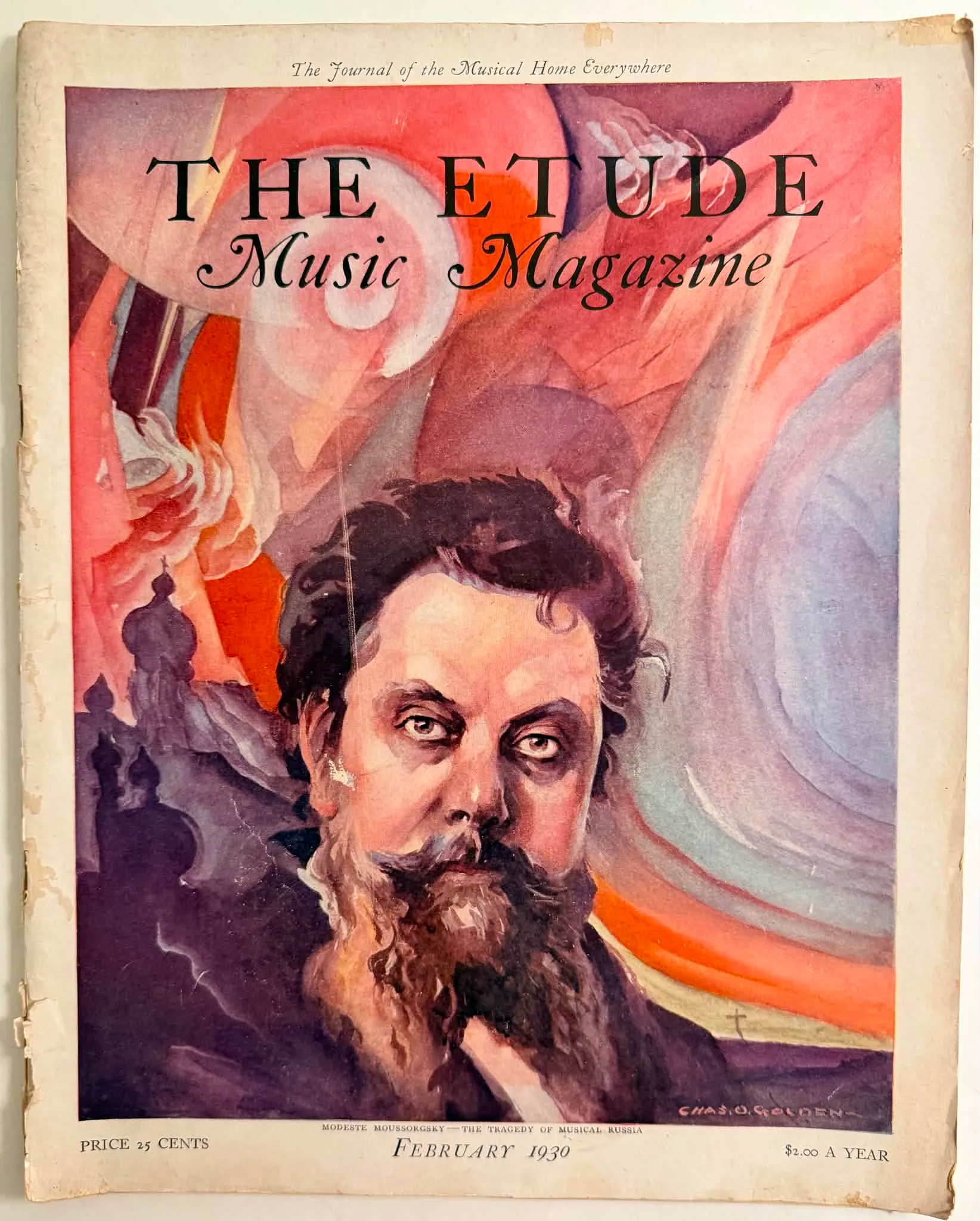
1930 Charles O. Golden Modeste Moussorgsky Etude Magazine Cover Art
The visual evidence presented in this artifact reveals a striking periodical cover dominated by a centrally positioned, intense portrait of a heavily bearded male figure. The subject’s piercing gaze is rendered with thick, expressive strokes, suggesting an original painting executed in gouache or heavy watercolor before being photographically reproduced for print. Behind the static, stoic bust of the figure, the background dissolves into a chaotic, swirling vortex of ethereal pinks, purples, and deep blues. To the lower left, the silhouetted, unmistakable onion domes of traditional Russian Orthodox architecture anchor the composition geographically. Conversely, the lower right features a sparse, desolate horizon line punctuated by a singular, diminutive cross, establishing a landscape of isolation or spiritual finality. An examination of the printed typography provides definitive identification of both the publication and the subject. The masthead prominently declares "THE ETUDE" in a structured, serif typeface, immediately followed by the elegant, flowing script of "Music Magazine." Above the masthead, a smaller, italicized tagline reads, "The Journal of the Musical Home Everywhere." The lower margin contains the critical identifying text: "MODESTE MOUSSORGSKY — THE TRAGEDY OF MUSICAL RUSSIA," flanked by the date "FEBRUARY 1930." Flanking the bottom edges are the commercial indicators: "PRICE 25 CENTS" and "$2.00 A YEAR." In the lower right quadrant, within the illustrated field, a printed artist’s signature is visible, reading "CHAS. O. GOLDEN." The maker context relies on the historical footprint of The Etude, founded by Theodore Presser in 1883. By 1930, the publication was an institution in American music education, serving as a primary conduit for sheet music, pedagogical advice, and musical history for the middle-class public. The visible signature attributes the cover art to Chas. O. Golden, an illustrator who provided commercial artwork for publications during this era. His task was likely to translate the editorial theme—Mussorgsky’s well-documented struggles and brilliant, yet chaotic, musical legacy—into a singular, compelling visual narrative that would stand out on a newsstand or command attention on a parlor piano. Geographically and demographically, this artifact was designed for an American audience, specifically targeting the "Musical Home." The era of publication, February 1930, places this artifact immediately following the 1929 stock market crash. During the early days of the Great Depression, home entertainment, particularly domestic piano playing, remained a vital cultural and social outlet. The magazine served as an accessible luxury, offering not just articles but practical sheet music. Introducing the American public to the complex, turbulent history of a Russian composer required framing it in a dramatic, digestible format—hence the explicit use of the word "Tragedy" to hook the reader. The visual language of this cover relies on distinct, contrasting planes—a sharply defined, imposing foreground portrait set against swirling, non-literal background elements. This deliberate separation of layers not only creates a sense of profound psychological depth but also renders the composition highly adaptable; structurally, the distinct visual tiers are ideal for translation into dynamic 2D animations, allowing the abstract motion of the atmospheric background to oscillate independently behind the static figure of the composer. The colour palette is intensely dramatic, utilizing the cool, sombre tones of Mussorgsky's coat to ground the fiery, agitated colours of his psychological and geographical backdrop. Archivally, this cover is significant as a document of mass-market cultural dissemination. It captures a specific moment when European classical music history was being actively packaged, interpreted, and sold to the American public. It stands as a testament to early 20th-century commercial illustration, demonstrating how visual artists were employed to synthesize complex biographical narratives into single, evocative images designed to elevate the perceived sophistication of the publication and, by extension, its readership.
Category: Music & Entertainment
Year: 1930
Rarity Class: B
Paper & Print Condition
Based strictly on rigorous visual examination of the digital proxy, the artifact is printed on typical commercial magazine stock characteristic of the era, which appears highly porous and overtly susceptible to natural oxidation and cellular degradation. The left binding margin exhibits significant mechanical damage, characterized by multiple rough tears, structural creasing, and total paper loss along the edge, definitively indicating forceful physical removal from the spine of the originally bound publication. The extremities show characteristic toning (browning) entirely consistent with the aging of acidic paper over more than nine decades. The printing process utilizes a commercial halftone screen, visibly evident upon close inspection, to reproduce the continuous tonal shifts of the original illustration. Despite the severe edge wear, the central image registration remains exceedingly sharp, and the organic, heavy pigmentation of the original gouache illustration is successfully transmitted without severe ultraviolet fading. Confidence in this physical assessment is strict and 'Moderate', limited entirely by the inherent parameters of digital surrogate review.
Provenance & Rarity
This artifact originates directly from a mass-circulated monthly publication, The Etude, which was distributed aggressively across the United States. Its initial physical scarcity was entirely non-existent, as it was specifically engineered for widespread, ubiquitous household consumption. The moderate rarity it possesses today is purely attritional. Magazines of this exact nature were interactive, utilitarian objects—opened, folded, physically placed on piano music stands, subjected to environmental light, and ultimately discarded. The survival of the cover art, specifically isolating the visual narrative of Modeste Moussorgsky apart from the textual interior pages, elevates its curatorial status from simple refuse to a curated, significant document of commercial illustration history. It is classified as a Class B artifact; it is not unique, but it is increasingly difficult to locate in unimpaired condition due to the relentless ravages of time on ephemeral, acidic paper goods. Mass-produced consumer publications from the early 1930s, such as The Etude, were printed in exceedingly high volumes utilizing industrial web presses to meet nationwide subscription and localized newsstand demands. Therefore, at the time of its creation, this item was ubiquitous and inherently common. However, due to the inherent chemical fragility of the highly acidic, wood-pulp paper stock utilized during this economically strained era, alongside the strictly utilitarian nature of the magazine (which was routinely discarded after the interior sheet music was played or the issue became dated), survival rates for intact, structurally sound covers are relatively low. The preservation of this specific cover, while not historically singular or definitively unique, represents a moderately scarce surviving example of early Depression-era cultural ephemera. Its attrition rate elevates it to Class B.
Rarity & Condition Summary
The artifact is a Class B attritional survivor of 1930s mass publishing. While the central printed image remains bold and the colour reproduction is stable, the structural integrity of the paper is heavily compromised along the left binding edge, exhibiting typical acidic decay and handling damage consistent with nearly a century of existence.