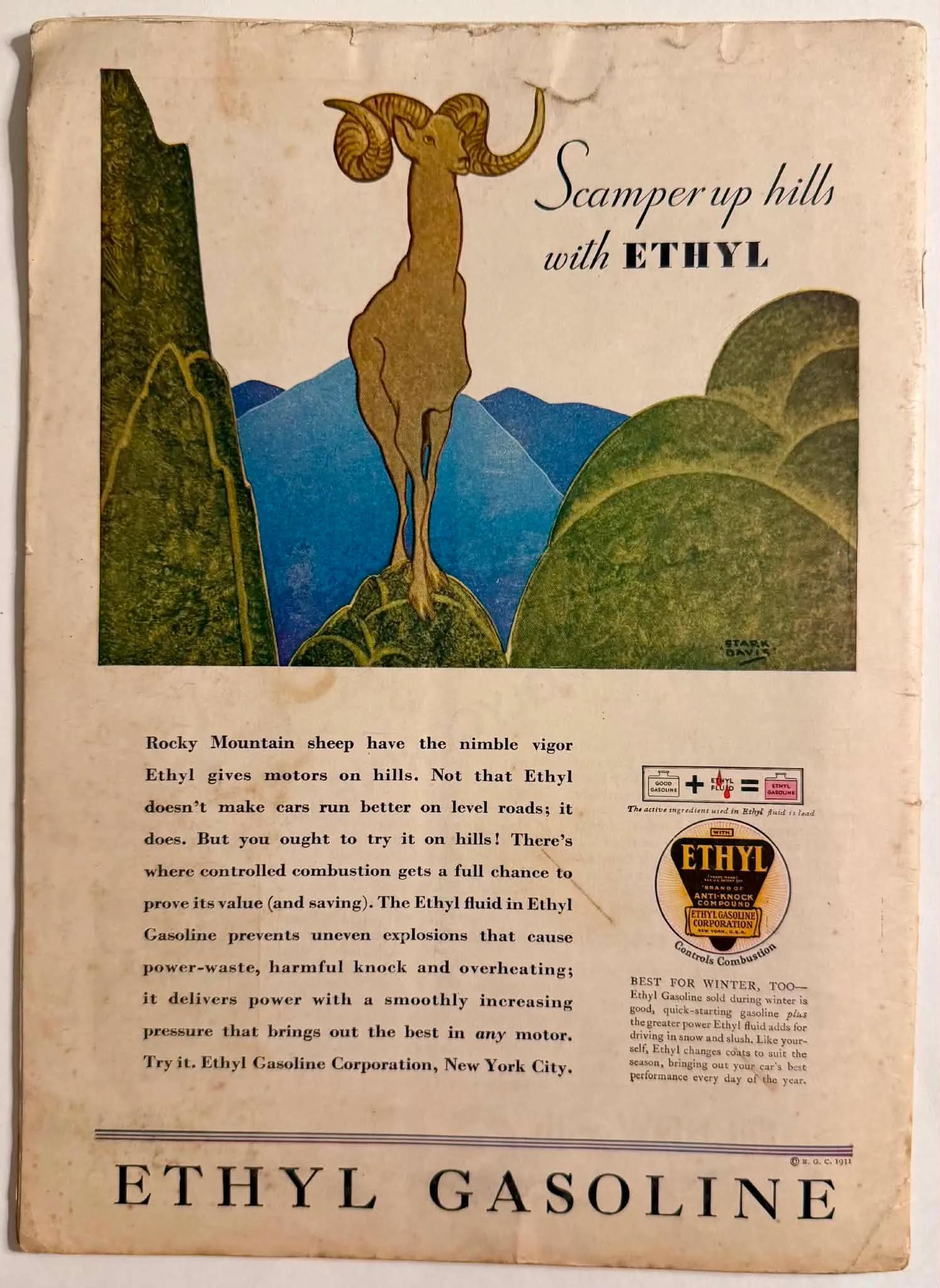
1931 Stark Davis Ethyl Gasoline "Scamper Up Hills" Bighorn Sheep Advertising Plate
The digital proxy provided for curatorial assessment reveals a vertically oriented, full-page commercial illustration dominated by a highly stylized depiction of a North American Rocky Mountain bighorn sheep. The central animal figure is positioned prominently in the upper half of the composition, rendered in a warm, textured umber tone. The anatomical proportions of the sheep are deliberately exaggerated, featuring an exceptionally elongated, sinuous neck that emphasizes verticality and elegance over strict biological realism. The animal's head is shown in profile, crowned with intricately detailed, spiraling horns that exhibit deep, rhythmic ridges, conveying a sense of immense natural strength and agility. The sheep stands poised upon a stylized foreground of fragmented, crystalline roc
Category: Automotive Parts
Year: 1931
Rarity Class: A
Paper & Print Condition
The digital proxy provides clear macro-photographic evidence of the physical printing methodology. Across the color fields—specifically visible within the brown tones of the sheep's neck and the dark green ink of the artist's signature—a distinct, mechanical halftone dot rosette pattern is resolvable. This definitively identifies the process as standard four-color (CMYK) photomechanical rotary relief printing, ubiquitous in high-volume magazine production of the era. The registration of these pl
Provenance & Rarity
Original printed advertisement mechanically extracted from a mass-circulation American consumer periodical (likely a major weekly or monthly publication such as The Saturday Evening Post or Collier's, pending downstream documentary confirmation of precise dimensions). Its historical rarity is fundamentally categorized as accessible but increasingly fragile. Due to the inherent acidity of early 20th-century wood pulp paper, these unbound artifacts are subject to rapid deterioration if not archive
Rarity & Condition Summary
The artifact is a well-preserved, mass-market periodical extract demonstrating classic 1930s four-color halftone printing on lightly aged, standard paper stock. Its historical scarcity is classified as Class A, representing a widespread but increasingly fragile category of automotive ephemera that survives here with strong visual integrity and crisp chromatic execution.