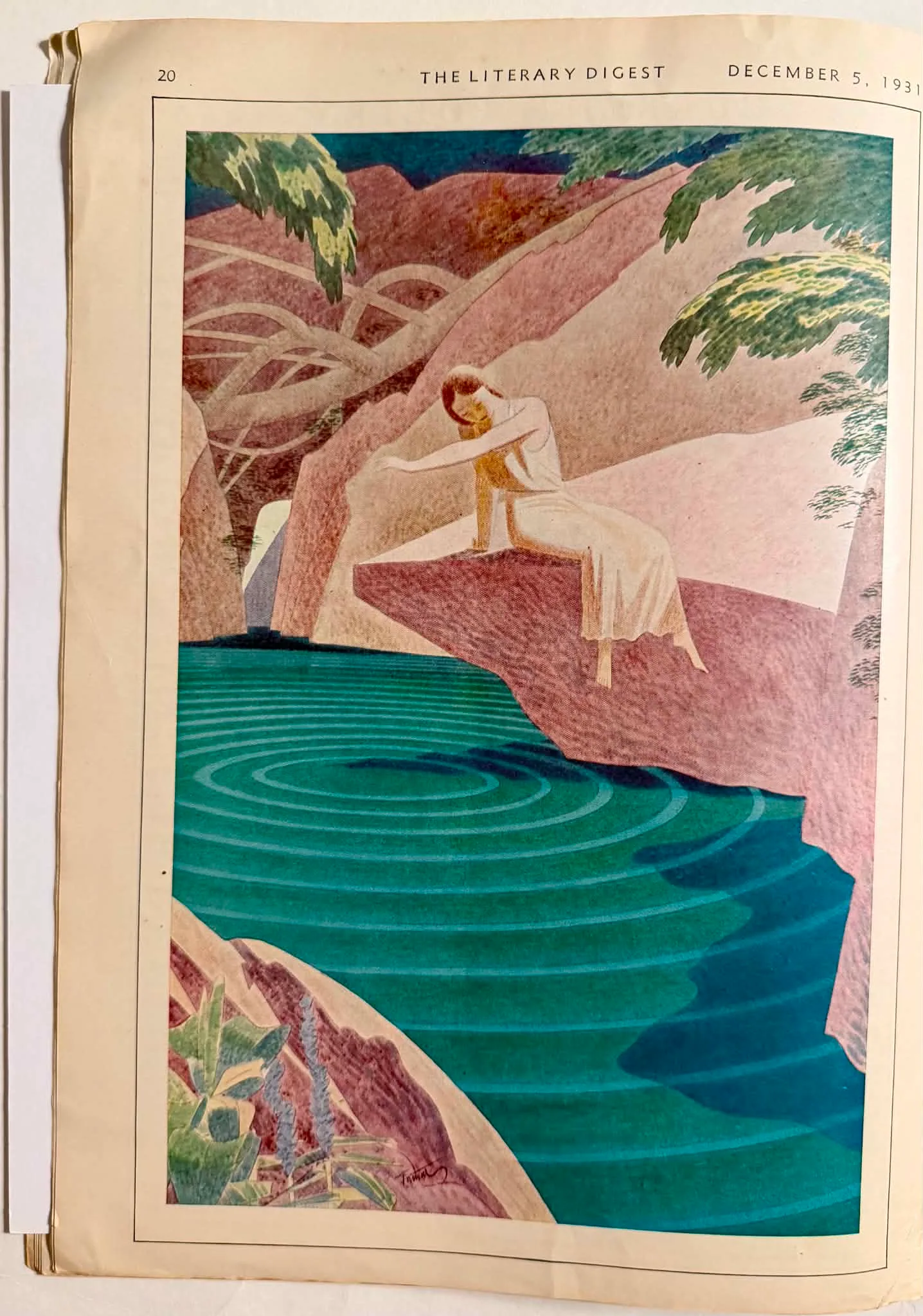
1931 Tamas for Fisher Bodies "Growth of an Idea" Art Deco Illustration Plate
The visual evidence presented in the primary digital proxy reveals a vertically oriented, full-page commercial illustration dominated by a deeply serene, highly stylized allegorical scene. The composition is anchored by a solitary female figure seated upon a jagged, cantilevered outcropping of salmon-pink and muted mauve rock. She is rendered with elegant, elongated proportions, dressed in a flowing, sleeveless white classical gown that drapes fluidly over her form, exposing her pale arms and bare feet. Her auburn hair is styled close to her head in a manner evocative of early 1930s fashion, yet her attire and pose lean heavily into classical antiquity. She leans forward, extending her right arm gracefully toward a vibrant, deep teal pool of water below. The water is depicted not with natu
Category: Pens & Writing
Year: 1931
Rarity Class: A
Paper & Print Condition
The provided digital proxy yields exceptionally clear macro-photographic evidence of the physical printing methodology. Across the color fields—most demonstrably within the muted pink and mauve tones of the stylized rocks and the deep teal ink establishing the geometric water ripples—a distinct, mechanical halftone dot rosette pattern is easily resolvable. This definitively identifies the production process as standard four-color (CMYK) photomechanical rotary relief printing, a method ubiquitous
Provenance & Rarity
Original printed advertisement mechanically extracted from a mass-circulation American consumer periodical, specifically The Literary Digest, dated December 5, 1931, pages 20 and 21. The historical rarity of this piece is fundamentally categorized as highly accessible yet increasingly fragile. Because early 20th-century standard magazine wood pulp paper is inherently highly acidic, these unbound artifacts are subject to rapid, irreversible deterioration (embrittlement and severe yellowing) if no
Rarity & Condition Summary
The artifact survives as a well-preserved, mass-market periodical extract spread demonstrating classic 1930s four-color halftone printing executed on lightly aged, standard commercial paper stock. Its historical scarcity is strictly classified as Class A, representing a widespread but increasingly fragile category of automotive marketing ephemera that endures here with exceptional visual integrity, stark geometric clarity, and crisp chromatic execution across both illustrative and typographic pl