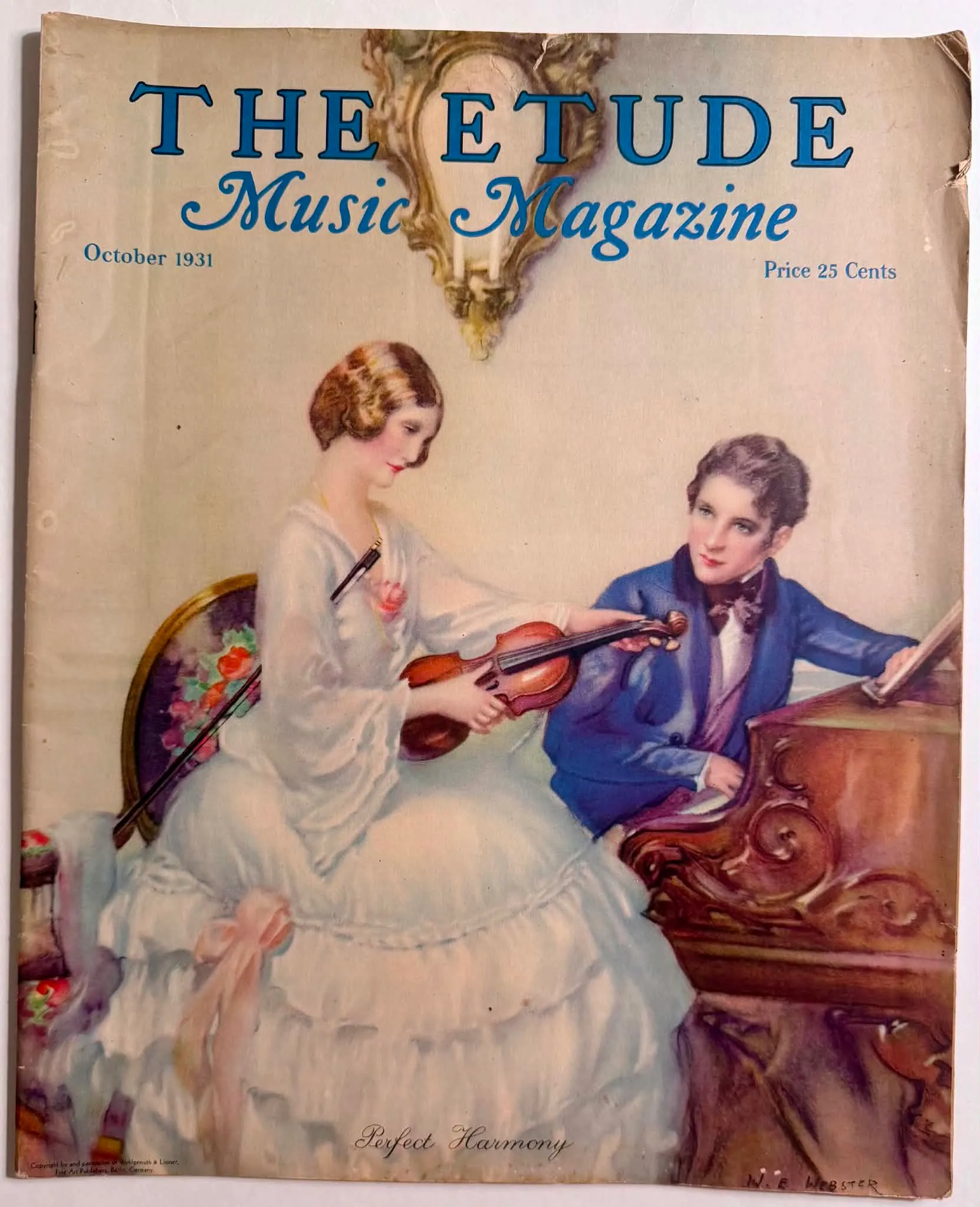
1931 W.E. Webster Perfect Harmony Etude Magazine Cover Art
The visual evidence presented within the supplied digital proxies reveals a full-colour periodical cover characterized by a highly idealized, romanticized domestic tableau. The compositional space is dominated by two figures situated within a softly rendered interior setting. On the left, a young female figure is seated upon an ornately carved, dark-wood chair featuring a vibrant floral tapestry or needlepoint backrest. She is depicted in strict profile facing right, holding a finely rendered acoustic violin across her lap, her left hand lightly fingering the neck while her right hand rests near the bridge, though she is not actively bowing the instrument. She is attired in a voluminous, heavily ruffled white gown indicative of late 19th-century or Romantic-era fashion, accented by a broad
Category: Electronics
Year: 1931
Rarity Class: A
Paper & Print Condition
Rigorous macroscopic examination of the supplied digital proxies reveals definitive physical evidence of the artifact's material reality. The underlying paper stock presents a warm, mottled off-white to beige tone, consistent with moderately acidic, wood-pulp-based magazine cover stock of the 1930s experiencing expected oxidation and age-related darkening. Localized instances of brown spotting (foxing) are clearly visible, particularly around the "Perfect Harmony" title text, indicating localize
Provenance & Rarity
Original front cover wrapper of The Etude Music Magazine, Vol. XLIX, No. 10, issued precisely in October 1931. The historical rarity of this precise artifact is defined by the intersection of its original mass-market distribution and the aggressive physical attrition typical of interwar ephemera. The Etude, operating under the robust infrastructure of the Theodore Presser Company, possessed an immense national subscriber base; thus, this object was ubiquitous upon its immediate publication in 19
Rarity & Condition Summary
This artifact secures a Class A rarity designation as a vital, surviving fragment of 1931 mass-market publishing. Despite visible edge distress and localized foxing inherent to its acidic paper matrix, it remarkably retains vibrant ink fidelity, specifically preserving a crucial transatlantic copyright marker essential to print history.