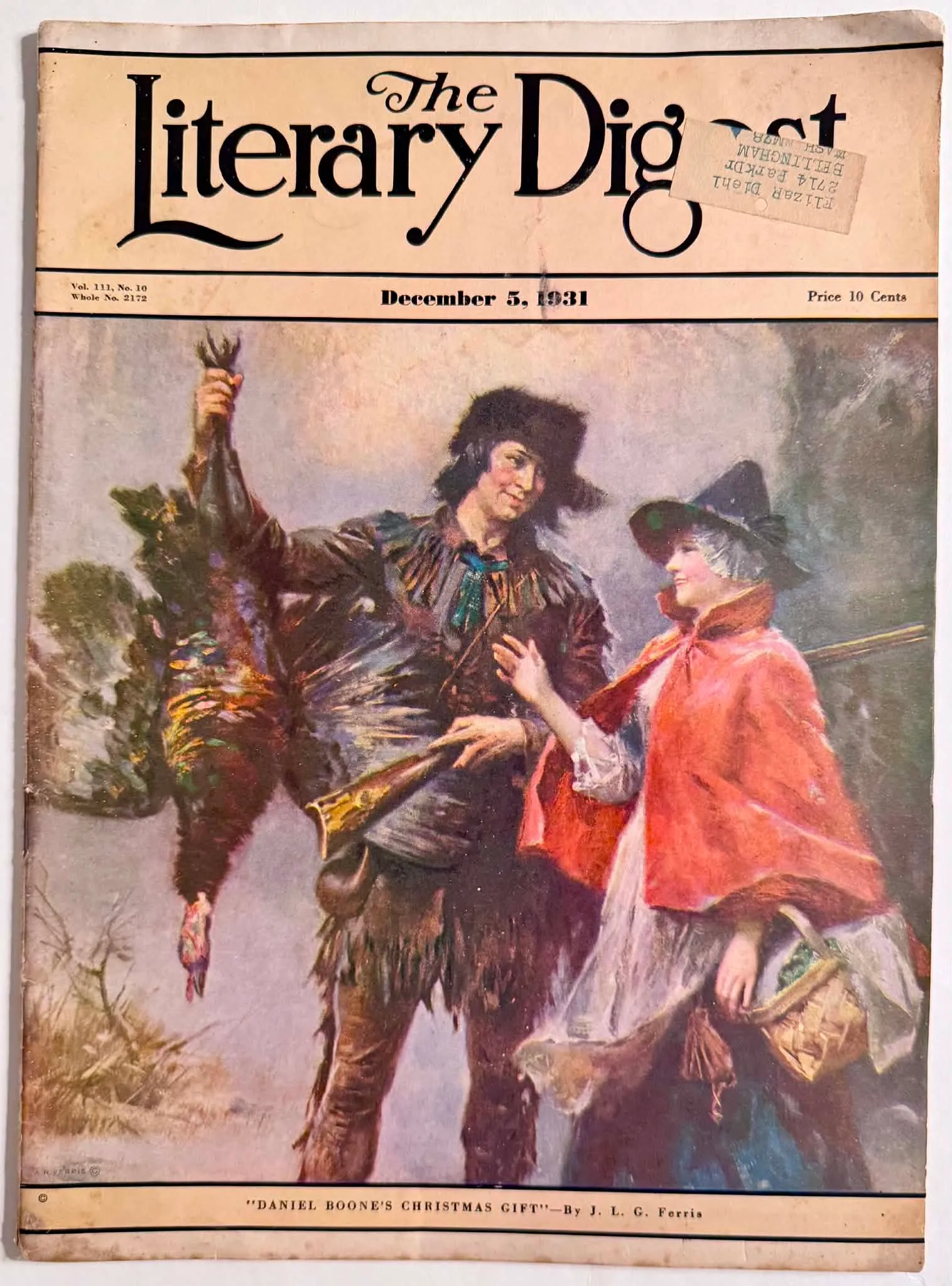
1931 The Literary Digest "Daniel Boone's Christmas Gift" Cover Art by J.L.G. Ferris
The visual evidence presented in the supplied digital proxy reveals the front cover of a historical American news magazine, The Literary Digest, explicitly dated December 5, 1931. The vertical composition is anchored at the top by the prominent, ornate black serif masthead typography reading "The Literary Digest," which spans the upper width of the page. An original, typed subscriber mailing label is affixed directly over the right side of the masthead, physically interrupting the graphic design. Below the masthead sits a structured dateline banner displaying the volume and issue numbers ("Vol. 111, No. 10, Whole No. 2172"), the publication date ("December 5, 1931"), and the cover price ("Price 10 Cents"). The central pictorial field features a vibrant, full-color illustration of an idealized American frontier winter scene. A male figure, identified contextually as the legendary frontiersman Daniel Boone, stands centrally, dressed in a fringed leather hunting shirt, buckskin trousers, and a fur coonskin cap. He smiles amiably while holding a large, dead wild turkey aloft by its legs in his right hand, cradling a long flintlock rifle in his left arm, with a powder horn slung at his hip. To his right, a female figure dressed in a white gown, a vibrant red hooded cloak, and a conical black hat reaches out gracefully toward the bird, holding a woven wooden basket in her left hand. The background consists of a muted, atmospheric snowy landscape featuring bare branches and overcast winter skies, rendered in soft, painterly brushstrokes. The printed text and physical additions occupying the artifact provide specific identification, structural designation, and unique provenance cues essential for precise archival cataloguing. The primary masthead utilizes an expressive, high-contrast serif font characteristic of early twentieth-century periodical design, demanding immediate visual authority on the newsstand. The secondary header lines are set in clean, uniform letterspaced serif typefaces that establish a strict, organized hierarchical grid. In the lower-right quadrant of the illustration, a small, partially obscured signature reads "J. L. G. FERRIS ©", indicating the artist and asserting a formal copyright claim over the image. Along the stark bottom margin, centered beneath a thick black framing line, the specific attribution text reads: "DANIEL BOONE'S CHRISTMAS GIFT"—By J. L. G. Ferris. Most uniquely, the physically adhered mailing label in the upper right provides a highly specific historical footprint; it is mechanically printed with the subscriber's name and address: "Elizar Diehl / 2714 ParkDr / BELLINGHAM WASH", alongside a faded routing or tracking code. The paper substrate itself exhibits visible horizontal ribbed texture lines across the surface, an intrinsic characteristic of standard pulp-based periodical paper stock manufactured during the interwar era. The maker context relies intrinsically on the printed credits framing the illustration, the embedded signature within the artwork, and the overarching publication history of the periodical. The illustration is explicitly credited to J. L. G. Ferris (Jean Leon Gerome Ferris), a prominent American painter celebrated for his extensive, highly romanticized series of historical paintings depicting idealized scenes from early American history. The presence of the copyright symbol next to his signature strongly suggests that the magazine licensed an existing, copyrighted painting for seasonal use, rather than commissioning a bespoke illustration specifically for this issue. The layout, typographic assembly, and mass distribution were executed under the editorial direction of The Literary Digest, a highly influential general-interest weekly news magazine published by Funk & Wagnalls in New York. The magazine was renowned for wrapping its dense, text-heavy interior—which meticulously synthesized news and political opinions from various global newspapers—with striking, high-quality, full-color art reproductions on its covers. Downstream documentary verification is required to firmly establish the specific licensing agreement between Ferris's estate or syndicator and Funk & Wagnalls for this December 1931 publication. The geographic and audience context is firmly situated within the United States during the devastating depths of the Great Depression in late 1931. As a widely distributed weekly news magazine, The Literary Digest served a broad, literate, and civically engaged American readership that relied heavily on printed periodicals for current events, political analysis, and cultural commentary. The presence of the original subscriber mailing label explicitly locates this specific physical copy in Bellingham, Washington, dramatically demonstrating the vast, transcontinental reach of the New York-based publication. The selection of a nostalgic, frontier-themed Christmas painting in December 1931 reflects a calculated editorial strategy. During a period of profound national economic strain, widespread unemployment, and profound uncertainty, the publication provided its audience with comforting imagery of American resilience, pioneer self-sufficiency, and traditional holiday providence. By presenting Daniel Boone—a venerated, almost mythological icon of American westward expansion and rugged individualism—securing a Christmas feast from the wilderness, the magazine catered to an audience eager for historical reassurance and idealized national mythology amidst socioeconomic turbulence. The visual language of the cover employs a conventional early twentieth-century American historical realism strategy that effectively balances academic painting techniques with accessible, romanticized illustrative storytelling. The composition is highly theatrical, utilizing a shallow foreground stage where the brightly illuminated figures interact directly with the bounty of the untamed frontier. Ferris’s style relies on careful, recognizable costuming—the fringed buckskins, the iconic coonskin cap, the colonial-era red cloak—to instantly communicate the historical setting to a lay audience without requiring profound historical literacy. The warm, selective color palette, dominated by the vibrant, saturated red of the woman's cloak and the rich, iridescent browns, greens, and bronzes of the wild turkey's plumage, contrasts sharply against the cool, muted winter background. This deliberate color strategy draws the viewer's eye immediately to the interaction between the figures and the narrative focus of the "gift." The overall aesthetic communicates a sanitized, highly romanticized vision of the American frontier, emphasizing natural abundance, cheerfulness, and pioneer spirit rather than the harsh, brutal realities of colonial survival. This visual strategy was the standard for mass-market periodicals of the era, which often prioritized patriotic uplift and narrative clarity over strict, unvarnished historical accuracy. In terms of function and archival significance, this printed artifact operated originally as the disposable outer wrapper and primary promotional front of a mass-market weekly news magazine, purposefully designed to capture consumer attention and instantly signal seasonal relevance. Despite its inherently ephemeral intended lifespan as weekly consumer detritus, this surviving cover possesses significant archival value as a pristine primary document reflecting American cultural mythology, interwar graphic design conventions, and the commercial publishing practices of 1931. Furthermore, the rare retention of the original subscriber mailing label fundamentally elevates the artifact from a generic mass-produced object to a highly specific historical relic with a traceable, individualized geographic journey to the Pacific Northwest. It captures a specific, fleeting historical moment when mass media utilized the American frontier mythos to foster national unity and psychological comfort during the Great Depression. Preserved within a strictly digital museum framework, the artifact offers researchers an unvarnished visual and typographic record of print culture, safeguarding the material memory of the era against the inevitable physical degradation of its original, highly acidic pulp substrate.
Category: Film & Entertainment
Year: 1931
Rarity Class: S
Paper & Print Condition
The digital proxy reveals a warm, tan-toned paper substrate exhibiting distinct, visible horizontal ribbed texture lines across its surface, completely consistent with the natural aging of highly acidic, pulp-based newsprint from the early 1930s. Minor edge wear, slight discoloration around the margins, and gentle handling creases are visually evident, directly reflecting its functional use as an outer periodical wrapper distributed through the postal system. The physically affixed mailing label in the upper right presents a slightly different paper texture, adhered over the printed graphics. The printed typography remains sharp, with deep black ink transfer across the masthead and lower text zones. The central painting displays clear, vibrant, color-tinted halftone photographic reproduction typical of high-volume magazine presses of the era. Confidence: Moderate. A physical, tactile inspection under magnification is required to definitively determine the exact paper weight, intrinsic acidity levels, and the precise printing plate mechanics utilized for the color separations. Minimum distinguishable color separations resolvable in the supplied image are 4 (black, cyan, magenta, yellow process).
Provenance & Rarity
Original printed front cover of The Literary Digest, Vol. 111, No. 10, Whole No. 2172, published December 5, 1931 (digital proxy review based on photographic captures). Historical Rarity: The historical rarity is deeply significant due to the inherently ephemeral nature of early 1930s consumer news weeklies. Published during the severe economic nadir of the Great Depression, this item was a disposable commodity meant for a single read and quick disposal. The survival of a complete cover featuring a cohesive visual document of American historical myth-making presents a notable archival scarcity. Crucially, the explicit physical presence of the original subscriber mailing label ("Elizar Diehl / BELLINGHAM WASH") establishes a highly documented, individualized provenance that substantially enhances the artifact's institutional value. It transforms a mass-produced cover into a specific geographic artifact of the interwar American postal distribution system and consumer readership. Class S (Rare 1930s News Magazine Cover with Original Ephemeral Additions). The historical rarity of this artifact is unequivocally established by its survival as an intact weekly news magazine cover from the early 1930s, elevated significantly by the retention of its original subscriber mailing label. General-interest news weeklies published during the Great Depression were printed in massive runs on inexpensive pulp paper strictly for immediate consumption. The attrition rate of such mass-market ephemera is exceptionally high. Surviving individual covers from late 1931 featuring highly recognizable historical art (J.L.G. Ferris's Daniel Boone)—and explicitly preserving the physical evidence of its localized delivery to a specific subscriber in Bellingham, Washington—exhibit an acute archival scarcity, elevating their institutional, geographic, and historical value.
Rarity & Condition Summary
This artifact survives as a highly scarce, well-preserved news magazine cover from December 1931. It exhibits stable pulp paper toning, minor expected edge wear, and pristine typography, elevated profoundly in historical significance by the presence of its original subscriber mailing label, firmly placing it in a high tier of curatorial interest for interwar ephemera.