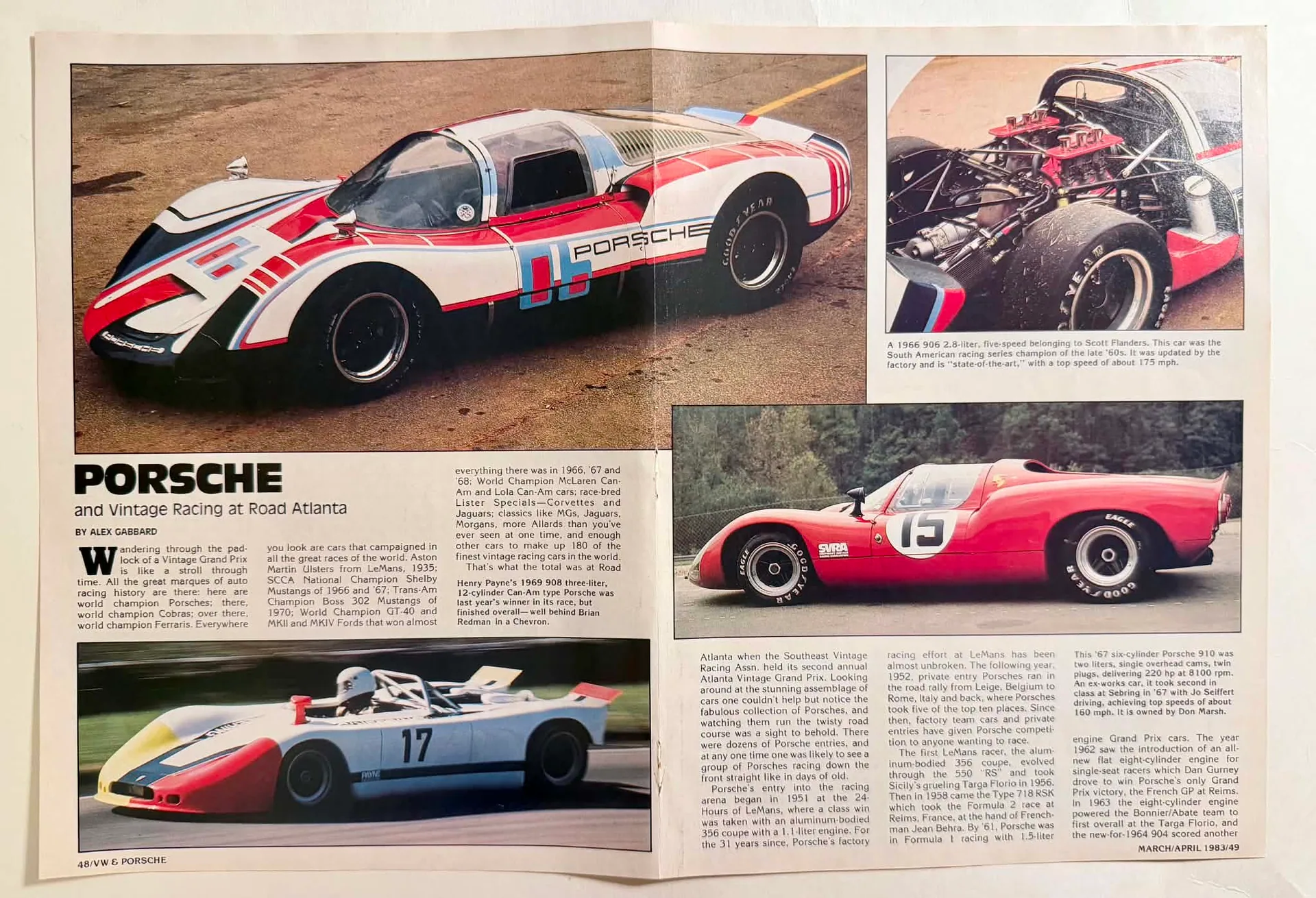
1983 Alex Gabbard "Porsche and Vintage Racing at Road Atlanta" Magazine Spread
The visual evidence presented in the supplied digital proxy reveals a horizontally oriented, two-page printed magazine spread featuring four full-colour photographic reproductions meticulously integrated into a structured, grid-based editorial layout. The left-hand page is dominated by a large, dramatically angled photograph of a white, red, and blue Porsche racing car bearing the number 15 and prominent "PORSCHE" side script, captured in a static profile resting on an asphalt surface. Below this, a smaller, dynamic action photograph depicts a white and red Porsche, numbered 17 and marked with a "PAYNE" decal, actively navigating a track corner with a driver wearing a white helmet visible in the open cockpit. The right-hand page is anchored in the top-right quadrant by a detailed mechanical photograph of an exposed rear engine bay, highlighting a complex tubular spaceframe, striking red intake manifolds equipped with polished velocity stacks, and massive Goodyear Eagle racing tires. Centrally positioned on the right page is a strict profile photograph of a solid red Porsche, also bearing the number 15 and an explicitly visible "SVRA" (Southeast Vintage Racing Association) decal positioned behind the front wheel arch. The accompanying editorial text is arranged in rigorous, justified columns—three on the lower left, one central column bridging the gap across the fold, and two on the lower right—set against the standard off-white paper substrate. A distinct, permanent vertical fold line squarely bisects the entire visual composition, providing undeniable structural confirmation of its physical origin as a dual-page spread manually extracted from a saddle-stitched or perfect-bound periodical. The printed text occupying the negative space of the artifact provides indispensable conceptual rationale, specific structural designations, and vital bibliographic cues essential for precise archival cataloguing. The prominent, heavy sans-serif master headline "PORSCHE and Vintage Racing at Road Atlanta" anchors the mid-left section, immediately followed by the formal attribution byline "BY ALEX GABBARD". The absolute bottom-left margin establishes the publication's identity and pagination, reading explicitly "48/VW & PORSCHE". Symmetrically mirrored, the absolute bottom-right margin reads "MARCH/APRIL 1983/49". Explicit, detailed captions accompany the photography; notably, the top-right engine bay image is designated: "A 1966 906 2.8-liter, five-speed belonging to Scott Flanders. This car was the South American racing series champion of the late '60s. It was updated by the factory and is 'state-of-the-art,' with a top speed of about 175 mph." The dense body text discusses the "second annual Atlanta Vintage Grand Prix" held by the "Southeast Vintage Racing Assn." and references specific, highly significant historical models including Henry Payne's "1969 908 three-liter, 12-cylinder Can-Am type Porsche", early aluminum-bodied 356 coupes, the legendary 550 "RS", the Type 718 RSK, and a "'67 six-cylinder Porsche 910" achieving top speeds of about 160 mph at Sebring. The maker context relies intrinsically upon the explicitly printed periodical data and the prominent byline, which securely and undeniably attributes the journalistic prose—and highly likely the accompanying track-side event photography—to Alex Gabbard, operating during the 1983 calendar year. The layout design and artistic technique deployed throughout the spread are highly indicative of professional, late-20th-century specialized automotive journalism. The creator utilizes a stringent, rational grid system to successfully balance dense typographical historical information with high-impact, full-colour photographic reproductions. The visual hierarchy is established not through speculative or artistic illustration, but through authentic, objective photojournalism, prioritizing mechanical accuracy and empirical track-side reality. The integration of formal, highly legible serif body copy against the massive, authoritative, and unyielding sans-serif master title reflects the strict editorial standards of the era. The creator operates not as a fictional storyteller, but as an active documentarian and meticulous historian, recording a pivotal transitional moment in automotive culture with absolute clinical precision. The geographic and audience context is firmly and undeniably situated within the deeply passionate North American automotive enthusiast subculture of the early 1980s. The explicitly printed magazine title "VW & PORSCHE" identifies a highly targeted, niche publication catering exclusively to owners, modifiers, and ardent devotees of German engineering. The conceptual subject matter—documenting the second annual Atlanta Vintage Grand Prix at the iconic Road Atlanta circuit—captures with surgical precision the specific cultural zeitgeist of 1983. During this specific era, purpose-built 1960s European endurance racing prototypes, such as the Porsche 906, 908, and 910 depicted herein, were transitioning from obsolete, uncompetitive discarded race cars into highly coveted, actively campaigned historic artifacts. The publication inherently assumed a high degree of technical and historical literacy from its readership, addressing an elite audience intimately familiar with factory racing lineage, homologation specials, and the nascent evolution of the Southeast Vintage Racing Association (SVRA) as a formal, regulatory organizing body for historic motorsport in the United States. The visual language of the artifact serves as a quintessential, masterfully executed representation of 1980s commercial automotive photojournalism, relying heavily and deliberately upon raw mechanical exposure and dynamic, unmanipulated composition. The photography strictly rejects stylized, interpretive illustration in favor of literal, physical documentation. The top-right image of the exposed 906 engine bay is highly characteristic of the era's specialized technical reporting, utilizing a high-angle perspective to deliberately emphasize the brutal, functional complexity of the tubular chassis, the dual distributors, and the aggressive red velocity stacks. Conversely, the strict profile shot of the red number 15 vehicle grounds the machine, explicitly showcasing the aerodynamic, low-slung, "long-tail" or sleek silhouette mandated by rigorous 1960s aerodynamic theory. The action shot of the number 17 Porsche utilizes a slight camera panning technique to impart a visceral, authentic sense of speed and momentum, blurring the background asphalt slightly while maintaining the driver and machine in relative focus. The typographic treatment projects an aura of serious, unyielding academic and historical legitimacy, devoid of frivolous ornamentation. In terms of function and archival significance, this printed editorial spread operated as a highly sophisticated educational and informational mechanism: it served simultaneously as thrilling, immediate event coverage for the magazine's dedicated readership and as a vital, enduring historical primer on elite European racing provenance. It expertly bridges the cultural gap between legendary mid-century factory endurance racing and the modern grassroots preservation efforts highly prized by the 1980s collector culture. The fundamental archival significance of this physical object within the operational framework of a digital museum lies in its immaculate preservation of pre-digital automotive journalism. Before the overwhelming ubiquity of digital photography, instant digital publishing, and internet-based motorsport archives, conceptual and historical communication was achieved exclusively via precisely assembled analog layouts published in physical print media. This artifact stands as a verified, primary historical record of that now-obsolete analog workflow, capturing with absolute fidelity the technical reality of the vehicles and the specific cultural obsession with historic motorsport that indelibly defined the enthusiast community in 1983.
Category: Cars
Year: 1983
Rarity Class: B
Paper & Print Condition
The digital proxy unequivocally reveals a standard, medium-weight coated commercial magazine paper stock, exhibiting a slight, highly uniform off-white or subtle cream oxidation that is entirely typical of mid-to-late 20th-century wood-pulp paper aging mechanisms. The print quality securely displays the characteristic, formal structural markers of CMYK offset lithography; the dense serif text remains razor-sharp and highly legible at current resolution limits, while the four photographic reproductions successfully maintain distinct colour separations and adequate tonal contrast, despite the inherent technological limitations of 1980s mass-market commercial magazine printing. Colour saturation remains remarkably stable, particularly visible within the vibrant primary reds and striking blues of the vehicle liveries and intake manifolds, with absolutely no severe visible evidence of destructive UV fading or atmospheric light-bleaching. A distinct, permanent, and unavoidable vertical crease squarely bisects the visual composition, definitively confirming its origin as an extracted, physical page from a saddle-stitched or perfect-bound periodical. There are no prominent signs of invasive moisture damage, fungal foxing, or severe marginal tearing.
Provenance & Rarity
Original printed two-page magazine editorial spread, carefully and deliberately extracted from the March/April 1983 issue of "VW & PORSCHE" magazine, spanning pages 48 and 49 (explicitly and indisputably verified via the printed marginalia located in the absolute lower corners). The Historical Rarity of this specific artifact is formally classified as Class B (Specialized Editorial Ephemera). Although the global automotive publishing industry printed and distributed immense commercial volumes of periodicals during the 1980s, the specific, unblemished survival of this highly specialized editorial spread—miraculously free from the heavy physical wear, chemical oil staining, or severe environmental degradation typically associated with the active workshops or garages where such enthusiast magazines were invariably kept and consumed—is a highly significant archival event. It perfectly captures a highly specific intersection of motorsport history, documenting the exact, physical vehicles actively campaigned in the nascent, foundational years of organized vintage racing in North America. Its rarity on the preservation market is exponentially compounded by its definitive status as a verified, unaltered primary historical record of the Southeast Vintage Racing Association (SVRA) operating in 1983.
Rarity & Condition Summary
This artifact successfully survives as a remarkably well-preserved editorial extract originating from a dedicated automotive enthusiast publication, placing it confidently in a notable, verifiable tier of historical scarcity for motorsport ephemera. Visually, the print exhibits highly stable colour saturation, razor-sharp typography, and clear photographic reproduction despite the inevitable, visible centerfold crease, though absolute confirmation of the physical substrate and offset printing process strictly requires subsequent material, tactile examination in a laboratory setting.