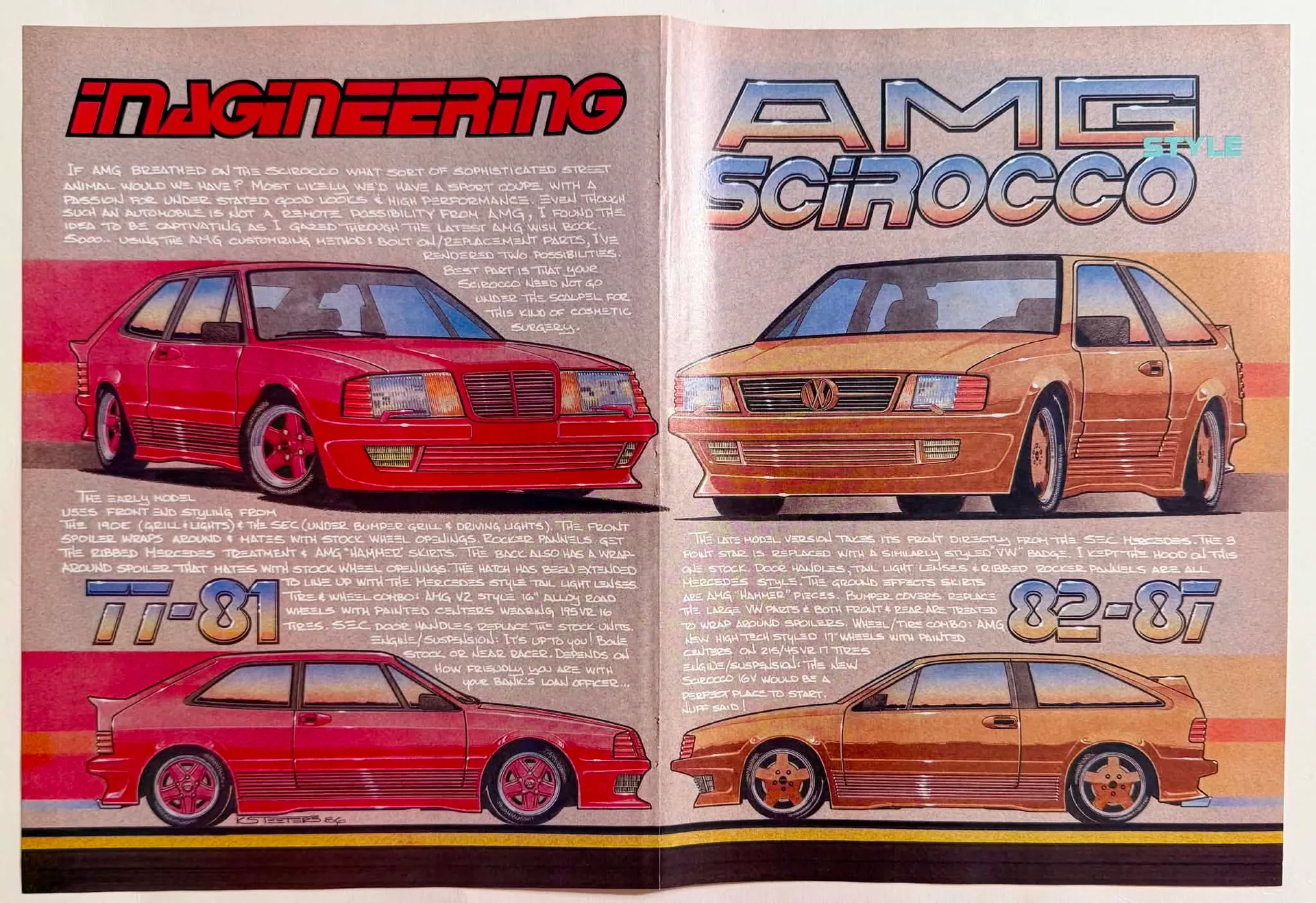
1986 K.S. Teeters "Imagineering: AMG Style Scirocco" Automotive Concept Illustration Spread
The visual evidence presented in the supplied digital proxy reveals a complete two-page magazine spread featuring highly detailed, hand-rendered conceptual automotive illustrations. The composition is horizontally anchored by a vibrant, multi-banded gradient background transitioning from a deep, saturated maroon at the upper edge through striking crimson, vivid orange, and resolving into a pale, dusty yellow at the lower horizon line. This striated backdrop spans both pages seamlessly, interrupted only by the structural center gutter of the publication. On the left leaf, two distinct angles of a brilliant red, modified first-generation Volkswagen Scirocco are depicted: a dominant front three-quarter perspective positioned centrally, and a strict, unforeshortened side profile anchored near the bottom margin. The right leaf mirrors this compositional structure, presenting a bronze or copper-toned second-generation Volkswagen Scirocco, again utilizing the commanding front three-quarter view above a highly precise side profile. Both vehicles exhibit extensive, heavily stylized aerodynamic body modifications, featuring deep front air dams with integrated auxiliary lighting, aggressively ribbed side rocker panels, and dramatically extended rear spoiler assemblies that fundamentally alter the factory silhouettes. The vehicles are grounded by rendered drop shadows, emphasizing a low, aggressive stance typical of specialized tarmac-oriented tuning. The printed text and marks dominating the upper registers of the spread provide both immediate thematic identification and structural dating cues. The left page is crowned by the title "IMAGINEERING," rendered in a heavy, overlapping, italicized sans-serif typeface, heavily outlined in black and filled with a solid, unvariegated red. Conversely, the right page features the immense title "AMG STYLE SCIROCCO," which utilizes a highly complex, airbrushed "chrome" or "sunset" gradient effect—transitioning from a reflective pale blue at the crest to a warm orange at the baseline, encased in a dual-line red and black border. Copious blocks of hand-lettered, capitalized architectural-style text flank the vehicle illustrations, acting as detailed design briefs. The left page identifies its subject via a stylized graphic reading "77-81", while the right page utilizes an identical graphic style to denote "82-87", effectively categorizing the two generations of the Scirocco chassis. A critical curatorial mark is located beneath the red side-profile illustration on the lower left page: a distinct, cursive hand-lettered signature reading "KS TEETERS 86", which firmly establishes both authorship and the execution date of the original artwork. The text exhaustively details the hypothetical integration of Mercedes-Benz elements, specifically referencing "190E", "SEC", and "AMG 'HAMMER' SKIRTS", alongside highly specific tire and wheel combinations like "195 VR 16" and "215/45 VR 17". The maker context is intrinsically bound to the explicit signature and the highly specialized rendering techniques observed. The signature "KS TEETERS 86" attributes the creation of these illustrations to K.S. Teeters, executed in the year 1986. The visual evidence strongly indicates the utilization of professional industrial design methodologies of the mid-1980s, primarily the masterful application of design markers (such as Chartpak or Copic) combined with precise airbrushing for the gradient skies, typographic effects, and the smooth, specular highlights on the automotive bodywork. The meticulous attention to mechanical components, such as the directional rendering of the alloy wheel spokes, the precise delineation of the fluted headlight glass, and the accurate perspective of the Mercedes-style grilles, demonstrates a creator with formal training in automotive or industrial rendering. The hand-lettered descriptive text, executed with drafting precision, further reinforces this professional pedigree, echoing the presentation boards utilized within automotive design studios before the absolute ascendance of digital rendering platforms. The geographic and audience context is firmly situated within the fervent, highly specialized automotive enthusiast subculture of the mid-1980s, specifically catering to the Euro-tuning scene. The English language text, combined with the specific cultural reverence for the German tuning house AMG (Aufrecht, Melcher and Großaspach) and the contemporary "Hammer" (the legendary AMG-modified W124 E-Class introduced around 1986), suggests publication in a North American or British automotive periodical dedicated to aftermarket modifications. The target audience consisted of dedicated automotive hobbyists and professional fabricators who were actively seeking to elevate the aesthetic and performance cachet of accessible, mass-produced sports compacts (the VW Scirocco) by grafting on the elite, high-status visual language of ultra-luxury German tuning syndicates. This spread speaks directly to an aspirational demographic, providing a detailed, hypothetical blueprint for radical, boundary-crossing cosmetic surgery that would command intense respect within the period's car show arenas. The visual language of the artifact is a masterclass in the definitive aesthetic currents of 1980s commercial graphic design and automotive styling. The sweeping, aerodynamic, monochromatic body kits (where bumpers and trim are painted to precisely match the body color, eradicating the standard factory black plastics) perfectly encapsulate the era's obsession with aerodynamic efficiency and visual fluidity. The presence of deeply dished, color-matched five-spoke alloy wheels—a direct homage to authentic AMG road wheels—serves as a critical visual anchor for the period. Furthermore, the typography itself, particularly the sunset-gradient "chrome" effect applied to the "AMG SCIROCCO" header, is a hallmark of the decade's airbrush-dominated visual culture, instantly evoking the synthetic, high-tech optimism prevalent in 1980s media. The entire composition, devoid of naturalistic backgrounds and heavily reliant on rigid, stylized horizontal bands of color, operates on a purely graphic, almost cybernetic level, emphasizing the machine over any organic context. In terms of function and archival significance, this printed spread operated as an engine of inspiration and editorial entertainment—a literal exercise in "Imagineering"—designed to provoke thought and inspire physical emulation among its readership. It was not a factual report of an existing vehicle, but a speculative design thesis. As a preserved digital artifact within the Record Institute, it holds immense significance as a pristine capsule of a highly specific, ephemeral moment in automotive customization history. It documents the exact point where elite, unattainable luxury tuning aesthetics trickled down to the enthusiast mainstream, captured through a now-obsolete, highly skilled manual rendering tradition. The physical preservation of such an intact, multi-page spread is vital, as magazines of this nature were fundamentally utilitarian, often subjected to intense physical wear, dismemberment for wall posters, or casual disposal.
Category: Cars
Year: 1986
Rarity Class: A
Paper & Print Condition
The digital proxy reveals an artifact printed via standard commercial web-offset lithography, typical of high-volume periodical production. The colour behaviour remains highly dynamic; the reds, oranges, and deep maroons of the background gradients exhibit robust saturation without visible chemical fading or severe UV degradation. A microscopic halftone rosette pattern is inferable, though smoothed by the digital reproduction scale. The paper tone suggests a standard, lightweight coated magazine stock, maintaining structural integrity despite the prominent, vertical center gutter fold which inherently breaks the image plane—a definitive hallmark of bound publication extraction.
Provenance & Rarity
Original printed editorial spread extracted from an enthusiast automotive magazine (digital proxy review). The historical rarity of this document is intrinsically linked to the ephemeral lifecycle of 1980s automotive journalism. Publications dedicated to the aftermarket tuning sector were rarely archived by institutional libraries and were typically consumed and discarded by their specialized readership. This specific artifact, preserving an intricate conceptual vision that bridges the gap between accessible hatchbacks and elite luxury tuning, represents a fragile survivor of a highly specific cultural moment, elevating its necessity within the digital archival framework. Class A (Specialized Niche Publication Extract). The historical rarity of this piece is established by its status as a specialized, fully intact two-page editorial spread originating from a niche enthusiast automotive publication. While these periodicals were mass-produced in the mid-1980s, their inherent nature as disposable, monthly utilitarian media ensures a high attrition rate. Enthusiasts frequently excised specific illustrations for garage or workshop display, rendering immaculate, unclipped, and unseparated continuous spreads exceedingly scarce in a pristine archival state today.
Rarity & Condition Summary
The artifact survives as a well-preserved, continuous two-page editorial extract capturing a highly specific and influential automotive tuning subculture. Visually, the commercial web-offset print exhibits incredibly strong colour retention and sharp typographic boundaries, contextualized by the standard, unavoidable center gutter fold inherent to bound periodical distribution.