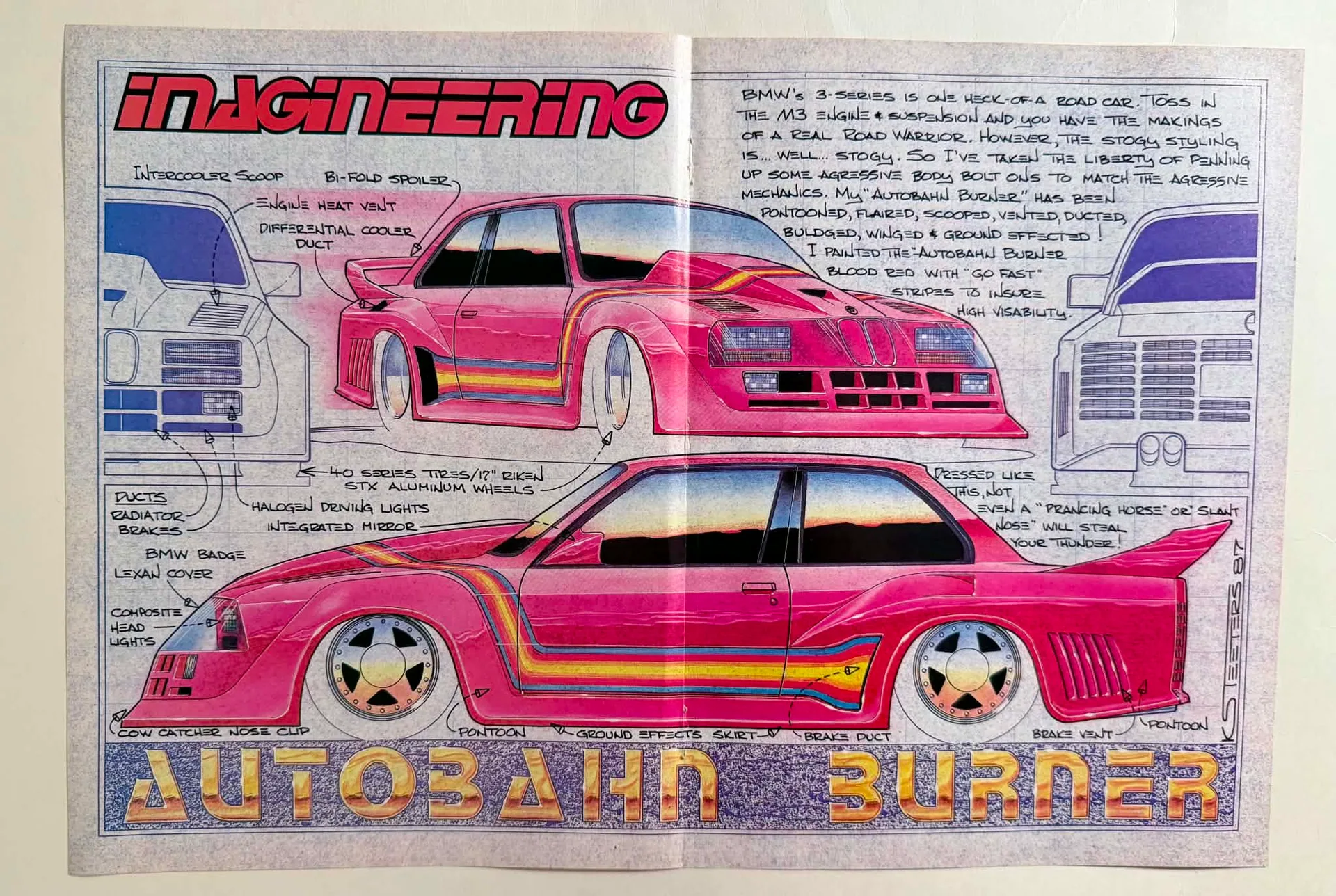
1987 K.S. TEETERS BMW 3-Series "Autobahn Burner" Imagineering Concept Spread
The visual evidence presented in the supplied digital proxy reveals a highly detailed, horizontally oriented two-page printed magazine spread featuring an array of hand-rendered automotive illustrations arranged dynamically across a light blue background that rigorously imitates architectural drafting grid paper. The overarching composition is dominated by highly stylized, speculative renderings of a modified coupe vehicle, explicitly referencing the architectural chassis of the mass-market BMW 3-Series. The right-hand page features a front-three-quarter perspective of the vehicle rendered in a striking, vibrant shade of pinkish-red (described by the artist as "blood red"), accented with sweeping, multi-coloured racing stripes in yellow, orange, and blue along its flanks and hood. Below this, spanning the lower half of the composition, is a strict, low-angle profile view of the same vehicle, showcasing its extreme aerodynamic modifications. The left-hand page is anchored by meticulous, uncoloured blue line drawings depicting the vehicle's front and rear fascias, exposing the underlying skeletal engineering and venting structures. The primary master title "IMAGINEERING" anchors the top-left quadrant in a bold, stylized, red sans-serif typeface, while the overarching concept title "AUTOBAHN BURNER" spans the entire lower margin in a massive, split-fountain chrome typographic effect. A distinct, permanent vertical fold line squarely bisects the image down the center, providing undeniable structural confirmation of its physical origin as a dual-page spread manually extracted from a bound periodical. The printed text and hand-drawn annotations occupying the negative space of the artifact provide indispensable conceptual rationale, specific structural designations, and vital bibliographic cues essential for precise archival cataloguing. A prominent text block in the upper right quadrant explicitly states the creator's intent: "BMW'S 3-SERIES IS ONE HECK-OF-A ROAD CAR. TOSS IN THE M3 ENGINE & SUSPENSION AND YOU HAVE THE MAKINGS OF A REAL ROAD WARRIOR. HOWEVER, THE STOGY STYLING IS... WELL... STOGY. SO I'VE TAKEN THE LIBERTY OF PENNING UP SOME AGRESSIVE BODY BOLT ONS TO MATCH THE AGRESSIVE MECHANICS. MY 'AUTOBAHN BURNER' HAS BEEN PONTOONED, FLAIRED, SCOOPED, VENTED, DUCTED, BULDGED, WINGED & GROUND EFFECTED! I PAINTED THE 'AUTOBAHN BURNER' BLOOD RED WITH 'GO FAST' STRIPES TO INSURE HIGH VISABILITY." (Curatorial note: The idiosyncratic misspellings of "aggressive," "flared," "bulged," and "visibility" are faithfully preserved in the original text). Specific structural callouts point to a "COW CATCHER NOSE CLIP," "COMPOSITE HEAD LIGHTS," "LEXAN COVER," "INTERCOOLER SCOOP," "BI-FOLD SPOILER," and "40 SERIES TIRES/17" RIKEN STX ALUMINUM WHEELS." A highly evocative annotation near the rear wing declares: "DRESSED LIKE THIS, NOT EVEN A 'PRANCING HORSE' OR 'SLANT NOSE' WILL STEAL YOUR THUNDER!" A highly distinct, hand-drawn signature is oriented vertically along the absolute lower right border, reading "K.S. TEETERS 87", establishing a firm chronological marker and direct creator attribution. The maker context relies intrinsically upon the embedded vertical signature "K.S. TEETERS 87", which firmly and undeniably attributes the primary visual execution, stylistic rendering, and conceptual engineering to the commercial artist K.S. TEETERS, operating during the 1987 calendar year. The artistic technique deployed throughout the spread is highly indicative of professional, late-20th-century industrial design and specialized automotive commercial rendering practices. K.S. TEETERS utilizes fastidious, rigid ink linework combined with vibrant, meticulously blended marker gradients to simulate the highly reflective, curved surfaces of automotive gloss paint and environmental lighting. The inclusion of stark white, opaque highlights—likely applied via gouache or white ink—masterfully enhances the illusion of specular reflection. The integration of a strict architectural grid as the background, paired with uniformly structured, all-caps hand-lettering, consciously mimics strict architectural drafting standards. The creator operates not merely as a passive draftsman recording an existing reality, but as an active, highly speculative conceptual designer, audaciously proposing the radical transformation of a conservative luxury vehicle into an aggressive, uncompromised performance machine. The geographic and audience context is firmly and undeniably situated within the deeply passionate North American and European automotive enthusiast subcultures of the late 1980s. The conceptual subject matter—transforming the attainable, mass-produced BMW 3-Series into a widebody "Autobahn Burner"—captures with surgical precision the specific cultural zeitgeist of 1987. During this era, the BMW 3-Series was heavily associated with upward mobility and "yuppie" culture; however, the introduction of the motorsport-derived M3 ignited a fervent desire for aggressive, track-ready aesthetics among dedicated tuning enthusiasts. K.S. TEETERS' concept directly panders to this audience's desperate desire to adapt extreme, widebody styling cues to their everyday vehicles. Furthermore, the explicit textual references to a "Prancing Horse" (the globally recognized moniker for Ferrari) and a "Slant Nose" (the iconic, highly coveted factory modification for the Porsche 930 Turbo) demonstrate that the publication assumed a high degree of technical and cultural literacy from its readership. The target audience was intimately familiar with the hierarchy of elite European sports cars and aspired to challenge that hierarchy through extreme, grassroots aftermarket modification. The visual language of the artifact serves as a quintessential, masterfully executed representation of 1980s commercial automotive illustration, relying heavily and deliberately upon dramatic, sweeping gradient shading and geometrically exaggerated aerodynamic forms. The window glazing rendered on the vehicle features a highly distinctive, stylized, high-contrast flat sunset reflection—an absolute stylistic hallmark of 1980s commercial marker art. This specific technique, retroactively associated with the nascent synthwave or retrowave aesthetic, was consciously utilized by industrial illustrators to impart a visceral, immediate sense of environment and sleekness without the laborious necessity of rendering a complex, distracting background. The master title "AUTOBAHN BURNER" employs a classic split-fountain chrome effect, a typographic technique heavily associated with 1980s airbrush aesthetics, heavy metal album art, and commercial graphic design, which instantly and accurately dates the visual sensibilities of the piece. The strict architectural background grid provides essential spatial anchoring for the vehicles while simultaneously creating a palpable aura of technical legitimacy and engineered reality for these wildly speculative designs. In terms of function and archival significance, this printed editorial spread operated as a highly sophisticated hybrid mechanism: it served simultaneously as thrilling speculative entertainment for the magazine's dedicated readership and as an influential cultural taste-maker for the effervescent aftermarket tuning community. It expertly bridges the ideological gap between conservative factory engineering and the radical, boundary-pushing customization prized by 1980s car culture, offering exhilarating "what-if" scenarios that visualized the ultimate enthusiast dream of ascending the automotive social ladder through meticulous vehicle modification. The fundamental archival significance of this physical object within the operational framework of a digital museum lies in its immaculate preservation of pre-digital industrial rendering techniques. Before the overwhelming ubiquity of 3D CAD modeling, photorealistic digital rendering software, and internet-based artist portfolios, conceptual communication was achieved exclusively via precisely executed analog marker illustrations published in physical print media. This artifact stands as a verified, primary historical record of that now-obsolete artistic workflow, capturing with absolute fidelity the technical virtuosity of the commercial illustrator as well as the aggressive, widebody cultural obsession that indelibly defined automotive tuning in the late 1980s. The visual evidence presented in the supplied digital proxy reveals a highly detailed, horizontally oriented two-page printed magazine spread featuring an array of hand-rendered automotive illustrations arranged dynamically across a light blue background that rigorously imitates architectural drafting grid paper. The overarching composition is dominated by highly stylized, speculative renderings of a modified coupe vehicle, explicitly referencing the architectural chassis of the mass-market BMW 3-Series. The right-hand page features a front-three-quarter perspective of the vehicle rendered in a striking, vibrant shade of pinkish-red (described by the artist as "blood red"), accented with sweeping, multi-coloured racing stripes in yellow, orange, and blue along its flanks and hood. Below this, spanning the lower half of the composition, is a strict, low-angle profile view of the same vehicle, showcasing its extreme aerodynamic modifications. The left-hand page is anchored by meticulous, uncoloured blue line drawings depicting the vehicle's front and rear fascias, exposing the underlying skeletal engineering and venting structures. The primary master title "IMAGINEERING" anchors the top-left quadrant in a bold, stylized, red sans-serif typeface, while the overarching concept title "AUTOBAHN BURNER" spans the entire lower margin in a massive, split-fountain chrome typographic effect. A distinct, permanent vertical fold line squarely bisects the image down the center, providing undeniable structural confirmation of its physical origin as a dual-page spread manually extracted from a bound periodical. The printed text and hand- drawn annotations occupying the negative space of the artifact provide indispensable conceptual rationale, specific structural designations, and vital bibliographic cues essential for precise archival cataloguing. A prominent text block in the upper right quadrant explicitly states the creator's intent: "BMW'S 3-SERIES IS ONE HECK-OF- A ROAD CAR. TOSS IN THE M3 ENGINE & SUSPENSION AND YOU HAVE THE MAKINGS OF A REAL ROAD WARRIOR. HOWEVER, THE STOGY STYLING IS... WELL... STOGY. SO I'VE TAKEN THE LIBERTY OF PENNING UP SOME AGRESSIVE BODY BOLT ONS TO MATCH THE AGRESSIVE MECHANICS. MY 'AUTOBAHN BURNER' HAS BEEN PONTOONED, FLAIRED, SCOOPED, VENTED, DUCTED, BULDGED, WINGED & GROUND EFFECTED! I PAINTED THE 'AUTOBAHN BURNER' BLOOD RED WITH 'GO FAST' STRIPES TO INSURE HIGH VISABILITY." (Curatorial note: The idiosyncratic misspellings of "aggressive," "flared," "bulged," and "visibility" are faithfully preserved in the original text). Specific structural callouts point to a "COW CATCHER NOSE CLIP," "COMPOSITE HEAD LIGHTS," "LEXAN COVER," "INTERCOOLER SCOOP," "BI-FOLD SPOILER," and "40 SERIES TIRES/17" RIKEN STX ALUMINUM WHEELS." A highly evocative annotation near the rear wing declares: "DRESSED LIKE THIS, NOT EVEN A 'PRANCING HORSE' OR 'SLANT NOSE' WILL STEAL YOUR THUNDER!" A highly distinct, hand- drawn signature is oriented vertically along the absolute lower right border, reading "K.S. TEETERS 87", establishing a firm chronological marker and direct creator attribution. The maker context relies intrinsically upon the embedded vertical signature "K.S. TEETERS 87", which firmly and undeniably attributes the primary visual execution, stylistic rendering, and conceptual engineering to the commercial artist K.S. TEETERS, operating during the 1987 calendar year. The artistic technique deployed throughout the spread is highly indicative of professional, late-20th-century industrial design and specialized automotive commercial rendering practices. K.S. TEETERS utilizes fastidious, rigid ink linework combined with vibrant, meticulously blended marker gradients to simulate the highly reflective, curved surfaces of automotive gloss paint and environmental lighting. The inclusion of stark white, opaque highlights—likely applied via gouache or white ink—masterfully enhances the illusion of specular reflection. The integration of a strict architectural grid as the background, paired with uniformly structured, all-caps hand-lettering, consciously mimics strict architectural drafting standards. The creator operates not merely as a passive draftsman recording an existing reality, but as an active, highly speculative conceptual designer, audaciously proposing the radical transformation of a conservative luxury vehicle into an aggressive, uncompromised performance machine. The geographic and audience context is firmly and undeniably situated within the deeply passionate North American and European automotive enthusiast subcultures of the late 1980s. The conceptual subject matter—transforming the attainable, mass-produced BMW 3-Series into a widebody "Autobahn Burner"—captures with surgical precision the specific cultural zeitgeist of 1987. During this era, the BMW 3-Series was heavily associated with upward mobility and "yuppie" culture; however, the introduction of the motorsport-derived M3 ignited a fervent desire for aggressive, track-ready aesthetics among dedicated tuning enthusiasts. K.S. TEETERS' concept directly panders to this audience's desperate desire to adapt extreme, widebody styling cues to their everyday vehicles. Furthermore, the explicit textual references to a "Prancing Horse" (the globally recognized moniker for Ferrari) and a "Slant Nose" (the iconic, highly coveted factory modification for the Porsche 930 Turbo) demonstrate that the publication assumed a high degree of technical and cultural literacy from its readership. The target audience was intimately familiar with the hierarchy of elite European sports cars and aspired to challenge that hierarchy through extreme, grassroots aftermarket modification. The visual language of the artifact serves as a quintessential, masterfully executed representation of 1980s commercial automotive illustration, relying heavily and deliberately upon dramatic, sweeping gradient shading and geometrically exaggerated aerodynamic forms. The window glazing rendered on the vehicle features a highly distinctive, stylized, high- contrast flat sunset reflection—an absolute stylistic hallmark of 1980s commercial marker art. This specific technique, retroactively associated with the nascent synthwave or retrowave aesthetic, was consciously utilized by industrial illustrators to impart a visceral, immediate sense of environment and sleekness without the laborious necessity of rendering a complex, distracting background. The master title "AUTOBAHN BURNER" employs a classic split-fountain chrome effect, a typographic technique heavily associated with 1980s airbrush aesthetics, heavy metal album art, and commercial graphic design, which instantly and accurately dates the visual sensibilities of the piece. The strict architectural background grid provides essential spatial anchoring for the vehicles while simultaneously creating a palpable aura of technical legitimacy and engineered reality for these wildly speculative designs. In terms of function and archival significance, this printed editorial spread operated as a highly sophisticated hybrid mechanism: it served simultaneously as thrilling speculative entertainment for the magazine's dedicated readership and as an influential cultural taste- maker for the effervescent aftermarket tuning community. It expertly bridges the ideological gap between conservative factory engineering and the radical, boundary-pushing customization prized by 1980s car culture, offering exhilarating "what-if" scenarios that visualized the ultimate enthusiast dream of ascending the automotive social ladder through meticulous vehicle modification. The fundamental archival significance of this physical object within the operational framework of a digital museum lies in its immaculate preservation of pre- digital industrial rendering techniques. Before the overwhelming ubiquity of 3D CAD modeling, photorealistic digital rendering software, and internet-based artist portfolios, conceptual communication was achieved exclusively via precisely executed analog marker illustrations published in physical print media. This artifact stands as a verified, primary historical record of that now-obsolete artistic workflow, capturing with absolute fidelity the technical virtuosity of the commercial illustrator as well as the aggressive, widebody cultural obsession that indelibly defined automotive tuning in the late 1980s.
Category: Cars
Year: 1987
Rarity Class: A
Paper & Print Condition
The digital proxy unequivocally reveals a distinct and permanent vertical fold squarely bisecting the visual composition, structurally confirming the artifact's indisputable origin as a dual-page spread manually extracted from a saddle-stitched or perfect-bound enthusiast periodical. The underlying surface texture heavily implies a standard, medium-weight coated commercial magazine stock, typical of late-twentieth-century mass-market automotive publications. The print quality exhibits the formal and recognizable characteristics of CMYK offset lithography, although individual microscopic halftone rosettes are only marginally resolvable under the currently provided digital resolution limitation. Colour saturation remains remarkably vibrant and chemically stable, particularly within the striking primary colour marker gradients and the stylized chrome typography, strongly suggesting minimal UV degradation or atmospheric light-fading over the preceding decades. There is absolutely no visual evidence of foxing, invasive moisture-related damage, or significant structural margin tears, although minor, handling-related micro-creasing is faintly perceptible along the central bind line axis. Due to the inherent and inescapable constraints of analyzing a remote digital proxy, a physical tactile assessment determining exact paper brittleness or the precise microscopic ink weight remains strictly impossible.
Provenance & Rarity
Original printed two-page magazine spread, carefully extracted from an unidentified English-language automotive enthusiast periodical (visual estimate based entirely upon textual language, idiomatic expressions, and thematic content referencing North American tuning culture). The Historical Rarity of this specific artifact is formally classified as Class A (Scarce Editorial Ephemera). Although the global automotive publishing industry of the late 1980s printed and distributed extremely high commercial volumes of periodicals, the specific and unaltered survival of this conceptual "Autobahn Burner" spread—remaining totally intact as a complete two-page unit, absolutely unclipped by enthusiastic readers, and miraculously free from the heavy physical wear, chemical oil staining, or severe environmental degradations typically associated with the workshops or garages where such magazines were invariably kept—is a remarkably rare and significant archival event. The artifact captures a highly specific intersection of custom automotive culture, speculative commercial art, and the absolute zenith of analog technical illustration, occupying a fleeting moment before the inevitable advent of the 3D digital rendering revolution. Its rarity on the preservation market is exponentially compounded by its singular status as a free-thinking editorial showcase, perfectly integrated into mainstream enthusiast content, elevating the page to the rank of an invaluable cultural document mapping the stylistic aspirations of the modifier subculture of the late decade.
Rarity & Condition Summary
The artifact survives as a remarkably well-preserved editorial extract originating from a dedicated enthusiast publication, placing it confidently in a significant tier of historical scarcity for automotive ephemera. Visually, the print exhibits vibrant, stable colour saturation and distinct, precise linework despite the inevitable, visible centerfold crease; however, absolute confirmation of the physical substrate and offset printing process strictly requires subsequent material physical examination in a laboratory setting.