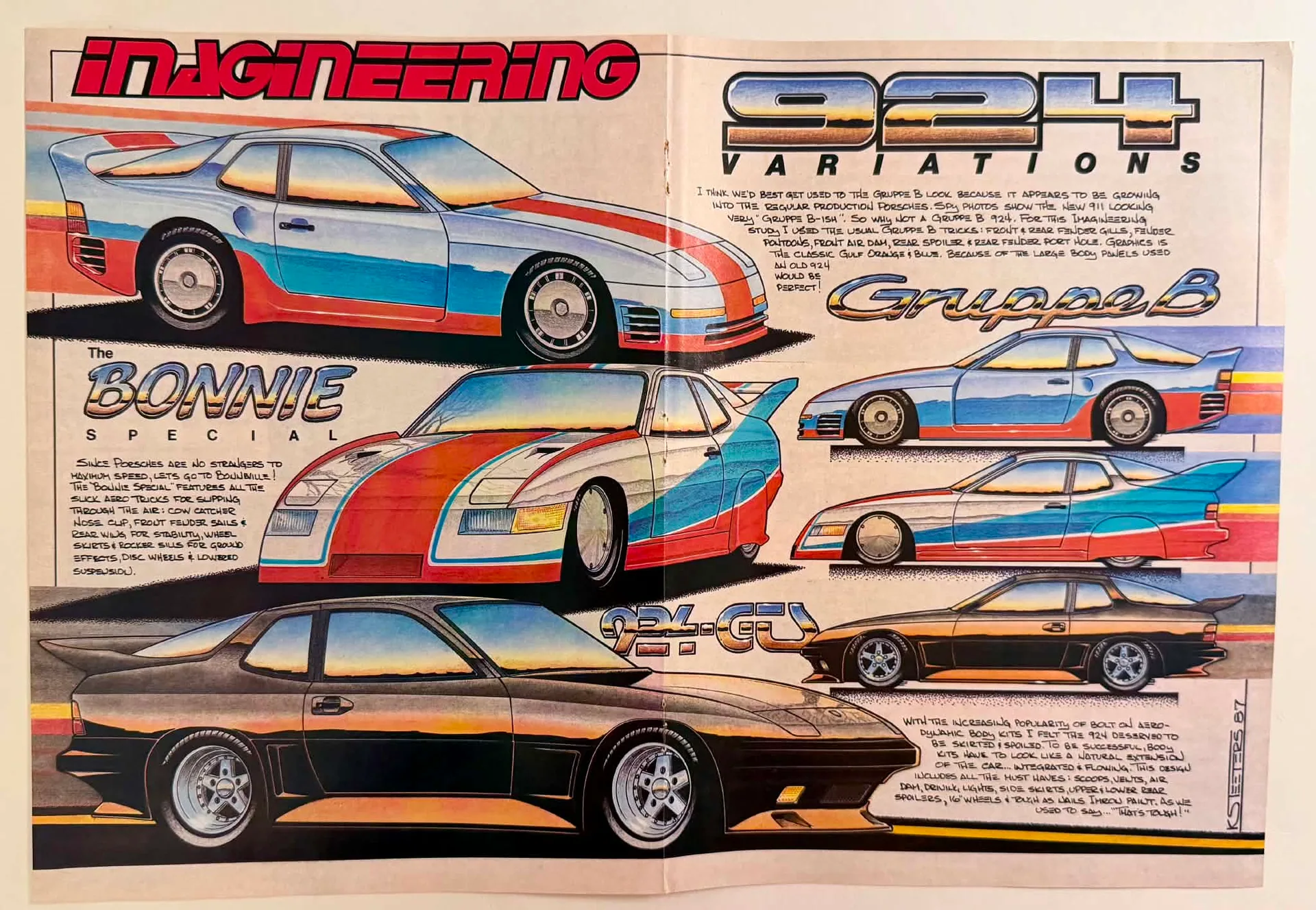
1987 K.S. TEETERS Porsche 924 "Imagineering" Concept Spread
The digital proxy presents a two-page printed magazine spread featuring four distinct automotive illustrations arranged dynamically across a light background. The composition is dominated by highly stylized renderings of modified coupe vehicles, specifically referencing the Porsche 924 chassis. The topmost illustration depicts a profile view of a vehicle bearing a blue, white, and orange livery (evoking the iconic Gulf racing scheme), positioned above a smaller, rear-three-quarter view of the same vehicle. Below this, a vehicle labeled "The BONNIE SPECIAL" is shown in a three-quarter frontal perspective, rendered in stark white with broad red and blue graphical bands, featuring extreme aerodynamic modifications including solid disc wheels and a pronounced front aero-shield. At the bottom of the spread, a sleek, dark-toned vehicle labeled "924-GTJ" is depicted in profile with deep black and sunset-reflective window glazing, accompanied by a smaller rear-perspective inset. The overarching title "IMAGINEERING" anchors the top left in a stylized, bold, red sans-serif typeface, while heavily hand-lettered text blocks accompany each vehicle concept. A distinct vertical fold line bifurcates the image centrally, confirming its origin as a bound periodical spread. The artifact is heavily annotated with hand-rendered, architectural-style lettering providing conceptual context for each vehicle. The primary title reads "IMAGINEERING" with a subtitle "924 VARIATIONS". The text block adjacent to the top vehicle explicitly references "Gruppe B" aesthetics, noting, "I think we'd best get used to the Gruppe B look... So why not a Gruppe B 924." It details modifications such as "fender pontoons, front air dam, rear spoiler" and mentions "the classic Gulf Orange & Blue." The mid-page block titled "The BONNIE SPECIAL" references "maximum speed, lets go to Bonneville!" and lists "slick aero tricks... cow catcher nose clip, front fender sails & rear wing for stability." The bottom section, "924-GTJ," discusses the "increasing popularity of bolt on aero-dynamic body kits," describing the design as an "integrated & flowing" extension of the car, mentioning "16 inch wheels & 'tough as nails' Imron paint." Notably, a distinct signature is oriented vertically along the bottom right edge, reading "K STEETERS 87", establishing a firm chronological marker and creator attribution. The maker context relies intrinsically on the vertical signature "K STEETERS 87", which strongly attributes the primary visual execution and conceptual design to an illustrator named K. Steeters, operating in the year 1987. The artistic technique displayed—characterized by precise linework, vibrant marker or airbrush gradients (particularly visible in the sunset reflections on the vehicle glass), and structural hand-lettering—is highly indicative of professional industrial design or automotive rendering practices of the late 20th century. The overarching conceptual framework, "Imagineering" (a term famously trademarked by Disney but utilized here in a general conceptual brainstorming context), suggests this spread functioned as an editorial feature within an automotive enthusiast publication. The creator acts not merely as a draftsman, but as a conceptual designer proposing hypothetical modifications to existing production chassis. Absolute verification of the specific publication requires cross-referencing this page against physical archival holdings of 1987 automotive periodicals. The geographic and audience context is firmly situated within the North American or European automotive enthusiast subculture of the late 1980s. The explicit reference to "Bonneville" geographically anchors one of the concepts to the Bonneville Salt Flats in Utah, USA, a legendary site for land speed record racing. Conversely, the term "Gruppe B" references Group B rally racing, a wildly popular and lightly regulated era of FIA rallying in Europe that was notoriously canceled in 1986, just prior to this illustration's 1987 date. The mention of "Imron paint," a highly durable polyurethane enamel popular in aviation and high-end automotive applications during that era, further contextualizes the technical literacy expected of the audience. This audience consisted of dedicated automotive hobbyists and modifiers—individuals who consumed print media for aspirational design inspiration and technical daydreaming regarding accessible chassis like the Porsche 924. The visual language of the artifact is a quintessential representation of 1980s automotive illustration, heavily reliant on dramatic gradient shading and exaggerated aerodynamic forms. The window glazing on the "924-GTJ" and the top "Gruppe B" vehicle features a distinctive high-contrast sunset reflection—a stylistic hallmark of 1980s commercial art, often associated with the nascent synthwave or retrowave aesthetic, used to impart a sense of speed, sleekness, and futuristic environment without rendering a complete background. The vehicles themselves sport extreme geometric modifications: boxy fender flares, slatted vents, deep front air dams, and solid aero-disc wheels. The hand-drawn typography, with its rigid, all-caps structure, mimics architectural drafting standards, lending an air of technical legitimacy to the speculative designs. The layout is chaotic yet balanced, typical of enthusiast magazine layouts aiming to pack maximum visual stimulation into a limited physical spread. In terms of function and archival significance, this printed spread functioned as speculative entertainment and design inspiration for automotive enthusiasts. It bridges the gap between factory engineering and grassroots customization, offering a hypothetical scenario for a production car nearing the end of its lifecycle. Archival significance within a digital museum framework lies in its preservation of pre-digital industrial rendering techniques. Before the ubiquity of 3D CAD modeling and digital rendering software, conceptual automotive design was communicated via precisely executed analog marker and airbrush illustrations. This artifact stands as a verifiable record of that workflow, capturing both the technical skill of the illustrator and the specific cultural zeitgeist of 1980s automotive tuning.
Category: Cars
Year: 1987
Rarity Class: A
Paper & Print Condition
The digital proxy reveals a distinct vertical fold bisecting the composition, structurally confirming the artifact's origin as a dual-page spread extracted from a saddle-stitched or perfect-bound periodical. The surface texture implies a standard, medium-weight coated commercial magazine stock, typical of late 20th-century automotive publications. The print quality exhibits characteristic CMYK offset lithography, though individual halftone rosettes are only marginally resolvable at the provided digital resolution. Colour saturation remains remarkably vibrant, particularly within the gradient fields of the window reflections and the orange graphics, suggesting minimal UV degradation or light-fading over time. There is no visible evidence of foxing, moisture damage, or significant margin tears, though minor micro-creasing is perceptible along the central bind line. Due to the nature of analyzing a digital proxy, physical tactile assessment of paper brittleness or precise ink weight is impossible.
Provenance & Rarity
Original two-page magazine spread extracted from an unidentified English-language automotive enthusiast periodical (visual estimate). The Historical Rarity of this artifact is classified as Class A (Scarce Editorial Ephemera). While automotive magazines of the late 1980s were produced in high commercial volumes, the specific survival of this conceptual "Imagineering" spread—intact, unclipped by enthusiasts, and free from the heavy physical wear typically associated with workshop or garage environments where such magazines were commonly kept—is notably scarce. The artifact captures a highly specific intersection of custom automotive culture and analog illustration just prior to the digital rendering revolution. Its rarity is compounded by its status as an editorial concept rather than a factory
Rarity & Condition Summary
The artifact survives as a well-preserved editorial extract from an enthusiast publication, placing it in a significant tier of historical scarcity for automotive ephemera. Visually, the print exhibits vibrant colour saturation and distinct linework despite the visible centerfold crease; however, absolute confirmation of the substrate and printing process requires physical examination.