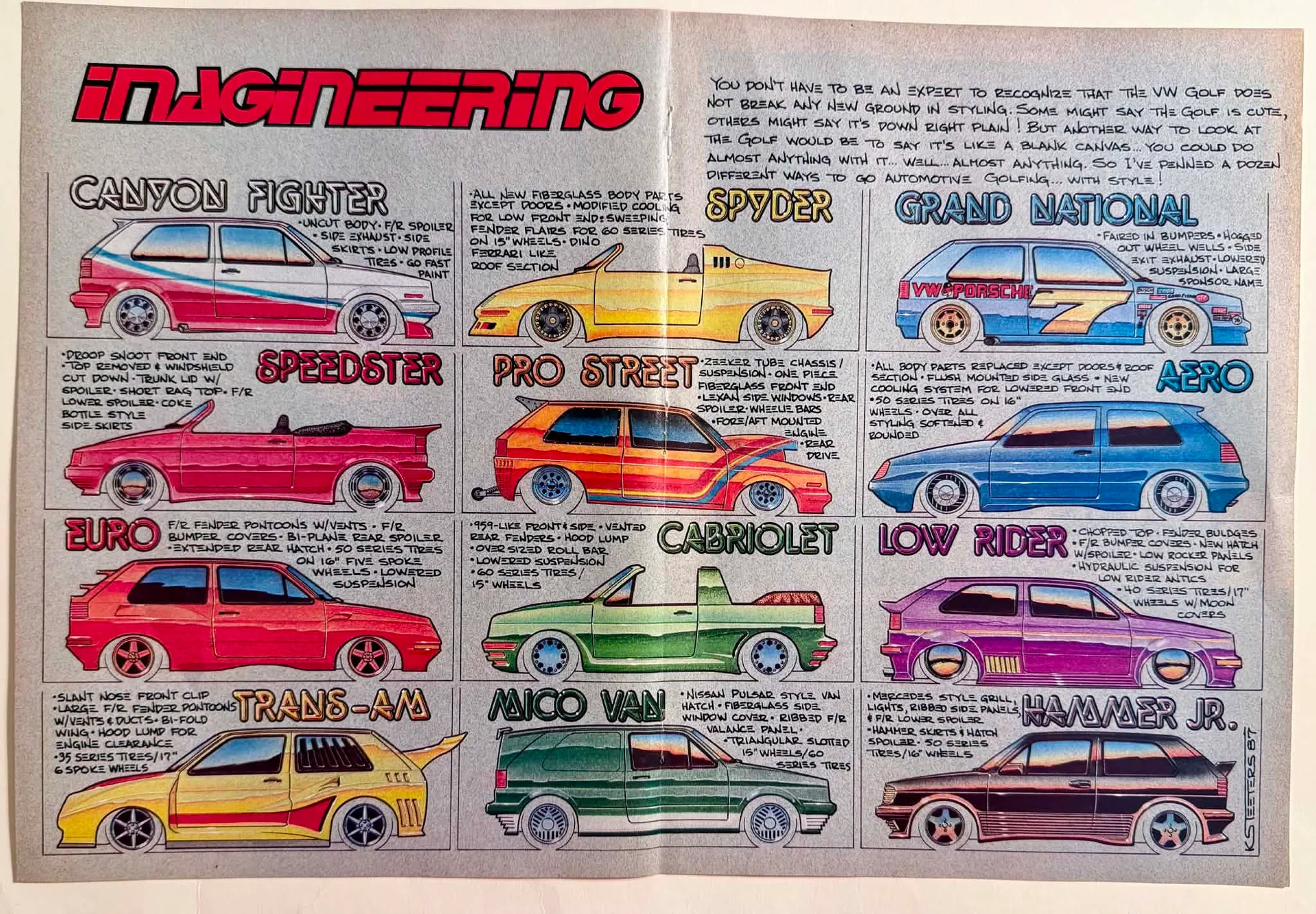
1987 K.S. Teeters "Imagineering: Automotive Golfing" Volkswagen Golf Concept Illustration Spread
The visual evidence presented in the supplied digital proxy reveals a complete, highly detailed two-page magazine spread featuring an exhaustive grid of conceptual automotive illustrations. The composition is structured as a masterclass in comparative design, presenting twelve distinct, hand-rendered side-profile variations of the first-generation Volkswagen Golf (also known as the Rabbit in North American markets). These twelve vehicles are meticulously arranged in three vertical columns of four across the spread, unified by a simulated light grey, slightly textured background tone that isolates the vehicles and emphasizes their vivid color palettes. Each vehicle is rendered in a strict, unforeshortened orthographic side profile, facing right, grounded by an identical, subtle drop shadow that establishes a consistent baseline and scale across the entire visual matrix. The meticulous uniformity of the base vehicle's wheelbase and core greenhouse dimensions serves as a rigid canvas upon which increasingly radical aerodynamic, structural, and stylistic modifications are applied. The illustrations are executed with a vibrant, high-contrast marker technique, characterized by the hallmark 1980s application of stark horizon-line reflections—specifically, a stylized sunset gradient of dark blue transitioning sharply into bright orange—rendered consistently across every side window, windshield, and polished wheel surface. This recurring reflection motif not only visually unifies the diverse grid of concepts but also firmly roots the artifact within the definitive aesthetic language of late-20th-century commercial industrial rendering. The printed text and structural marks dominating the artifact provide precise thematic identification and critical archival dating cues. Spanning the upper register of the left page is the massive, stylized title "IMAGINEERING," rendered in a heavy, overlapping, bold sans-serif typeface, thickly outlined in black and filled with a solid, unvariegated primary red. Adjacent to this on the right page is a block of hand-lettered introductory text explaining the premise: "You don't have to be an expert to recognize that the VW Golf does not break any new ground in styling... But another way to look at the Golf would be to say it's like a blank canvas... So I've penned a dozen different ways to go automotive golfing... with style!" Each of the twelve concepts is accompanied by a uniquely styled, hand-lettered title and a bulleted list of highly specific modifications. The left column features the "CANYON FIGHTER" (white/blue/red graphics), "SPEEDSTER" (pinkish-red, droop snoot), "EURO" (red, fender pontoons), and "TRANS-AM" (yellow, slant nose, massive wing). The center column displays the "SPYDER" (yellow, Ferrari-like roof), "PRO STREET" (orange/red gradient, wheelie bars), "CABRIOLET" (green, pickup style), and "MICO VAN" (dark green, Nissan Pulsar style hatch). The right column details the "GRAND NATIONAL" (blue/light blue racing livery), "AERO" (monochromatic blue, flush glass), "LOW RIDER" (purple, chopped top), and "HAMMER JR." (black/grey, Mercedes AMG styling). A critical curatorial mark is situated in the lower right corner beneath the "Hammer Jr." illustration: a distinct, black, hand-lettered signature reading "KS TEETERS 87", definitively establishing both the authorship and the execution date of the artwork. The maker context is intrinsically bound to the explicit signature and the highly specialized analog rendering techniques observed throughout the twelve panels. The signature "KS TEETERS 87" unequivocally attributes the creation of these illustrations to K.S. Teeters, with execution certified in the year 1987. The visual evidence strongly indicates the masterful utilization of professional industrial design methodologies standard to the 1980s. This primarily involves the expert application of alcohol-based design markers (such as Chartpak, Prismacolor, or Copic) to lay down smooth, broad fields of vibrant color, combined with highly precise airbrushing or opaque white pencil work to achieve the sharp specular highlights and complex horizon reflections on the glass and chrome surfaces. The architectural precision of the hand-lettered descriptive text blocks, executed with drafting-board accuracy, further reinforces this professional pedigree. The ability to conceptualize and execute twelve radically different stylistic interpretations of a single vehicle chassis while maintaining perfect perspective and proportion demonstrates a creator with formal, advanced training in automotive design rendering, likely utilizing specialized ellipse templates and french curves typical of pre-digital studio environments. The geographic and audience context is firmly situated within the fervent, rapidly evolving automotive enthusiast subculture of the late 1980s, specifically catering to the burgeoning water-cooled Volkswagen tuning scene. The English-language text, combined with the specific cultural references to "Trans-Am" racing, "Pro Street" drag racing, "Low Rider" aesthetics, and European tuning houses (AMG "Hammer"), suggests publication in a North American automotive periodical dedicated to aftermarket modifications and sport compacts. During this era, the Volkswagen Golf was transitioning from a purely utilitarian economy hatchback into a highly respected platform for extreme personalization, mirroring the cultural shift from air-cooled Beetles to modern, water-cooled chassis. The target audience consisted of dedicated automotive hobbyists, professional fabricators, and body shop artisans who were actively seeking inspiration to elevate the visual cachet and perceived performance of mass-produced vehicles. This spread speaks directly to that highly aspirational demographic, providing a detailed, hypothetical blueprint—a literal "dozen different ways"—to execute radical, boundary-crossing cosmetic surgery that would command intense respect within the period's car show arenas and street tuning hierarchies. The visual language of the artifact constitutes an exhaustive masterclass in the definitive aesthetic currents of 1980s commercial graphic design and automotive styling trends. The sheer variety of modifications presented encapsulates the eclectic, boundary-pushing nature of the decade's car culture. Concepts like the "Aero" demonstrate the era's obsession with aerodynamic efficiency, flush-mounted glass, and monochromatic color schemes. The "Hammer Jr." explicitly highlights the cross-pollination of elite luxury styling (Mercedes AMG ribbed cladding) onto economy platforms. The "Pro Street" and "Trans-Am" concepts reflect the pervasive influence of professional motorsports on street-legal customization, featuring exaggerated widebody kits, massive rear wings, and exposed mechanical elements. Furthermore, the rendering style itself—particularly the rigid, un-naturalistic sunset reflections applied uniformly to every window, regardless of the vehicle's body color—is a hallmark of the decade's airbrush-dominated visual culture, instantly evoking the synthetic, high-tech optimism prevalent in 1980s media. The composition operates on a purely graphic, almost cybernetic level, emphasizing the mechanical possibilities of the machine over any organic or realistic environmental context. In terms of function and archival significance, this printed two-page spread operated primarily as an engine of intense inspiration and sophisticated editorial entertainment—a literal, explicit exercise in "Imagineering." It was designed to provoke thought, spark debate, and inspire physical, sheet-metal emulation among its specialized readership. It was not a factual report of existing, fabricated vehicles, but rather a speculative design thesis showcasing the absolute limits of the Golf platform. As a preserved digital artifact within the Record Institute, it holds immense significance as a pristine, highly concentrated time capsule of a specific, ephemeral moment in automotive customization history. It documents the exact visual vocabulary of 1980s tuning culture, captured through a highly skilled, now-obsolete analog manual rendering tradition. The physical preservation of such an intact, multi-page spread featuring twelve complete concept illustrations is vital, as magazines of this utilitarian nature were frequently subjected to intense physical wear, dismemberment for workshop reference, or casual disposal.
Category: Cars
Year: 1987
Rarity Class: A
Paper & Print Condition
The digital proxy reveals an artifact printed via standard commercial web-offset lithography, entirely consistent with high-volume enthusiast periodical production of the late 1980s. The colour behaviour remains highly dynamic and robust; the expansive spectrum of reds, yellows, purples, and deep greens across the twelve vehicle concepts exhibits strong saturation without any visible chemical fading or severe UV degradation. A microscopic halftone rosette pattern is inferable across the gradient fields, although this is inherently smoothed by the digital reproduction scale. The paper tone suggests a standard, lightweight coated magazine stock. The spread maintains its structural integrity despite the prominent, inevitable vertical center gutter fold which disrupts the central vehicles—a definitive hallmark confirming its extraction from a bound publication.
Provenance & Rarity
Original printed editorial spread extracted from an enthusiast automotive magazine (digital proxy review). The historical rarity of this document is intrinsically linked to the ephemeral lifecycle of 1980s automotive journalism. Publications dedicated to the aftermarket tuning sector were purely utilitarian and rarely archived by academic or institutional libraries; they were typically consumed, utilized as reference, and discarded by their specialized readership. This specific artifact, preserving an intricate conceptual vision that explores a dozen radical variations on a single chassis, represents a highly fragile survivor of a very specific cultural moment, elevating its absolute necessity and curatorial value within the strict digital archival framework of the Institute. Class A. The historical rarity of this piece is established by its verified status as a fully intact, consecutive two-page editorial spread originating from a niche enthusiast automotive publication. While such utilitarian periodicals were mass-produced in the late 1980s, their inherent nature as disposable workshop reference material guarantees an exceptionally high attrition rate. Enthusiasts frequently excised specific illustrations—such as these individual car profiles—for garage display or fabrication reference, rendering complete, unclipped, and unseparated continuous spreads featuring the entire matrix of twelve concepts exceedingly scarce in a pristine archival state today.
Rarity & Condition Summary
The artifact survives as a remarkably well-preserved, continuous two-page editorial extract capturing a highly specific and influential 1980s automotive tuning subculture in exhaustive detail. Visually, the commercial web-offset print exhibits incredibly strong colour retention and sharp typographic boundaries, contextualized by the standard, unavoidable center gutter fold inherent to bound periodical distribution of the period.