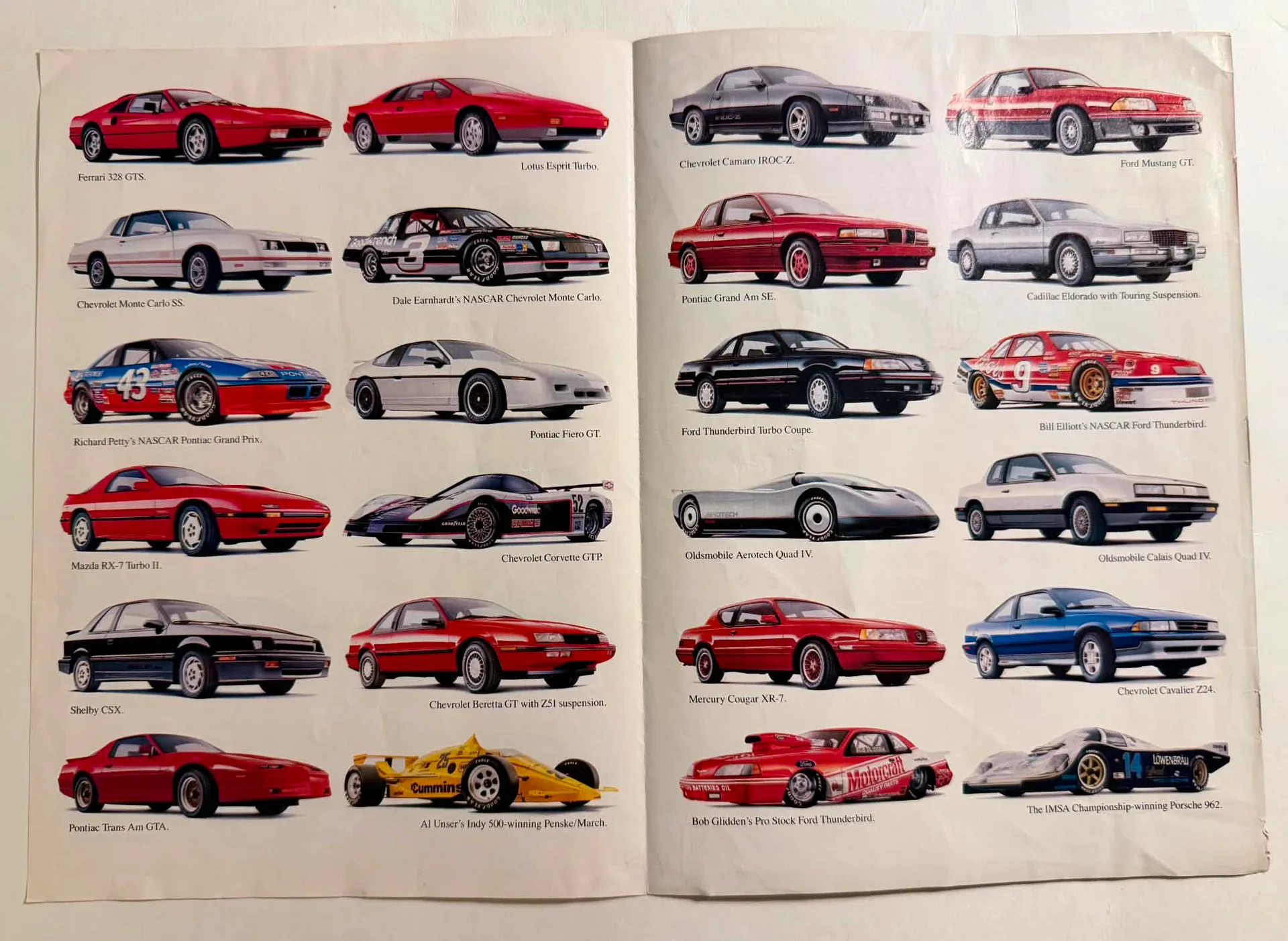
c. 1988 Automotive Performance Grid Showcase Spread
The visual evidence presented in the supplied digital proxy reveals a highly detailed, horizontally oriented printed magazine spread or multi-page fold-out, characterized by an array of high-performance automobiles arranged in a meticulous, highly uniform grid against a stark white or off-white background. These vehicles encompass an extraordinary cross-section of late-1980s automotive engineering, spanning top-tier production sports cars (such as the Ferrari Testarossa and Aston Martin Vantage), luxury performance coupes (including the Lincoln Mark VII LSC and Cadillac Allanté), and a multitude of purpose-built, championship-winning race cars. Each vehicle is rendered in either a dynamic front-three-quarter perspective or a strict profile view, anchored firmly to the visual space by a harsh, precise drop shadow positioned directly beneath the chassis. This rigorous layout projects an aura of encyclopedic rigidity, treating each vehicle as an isolated, highly prized industrial specimen. The spread consciously lacks a singular central focal point, compelling the viewer's eye to wander systematically across the matrix to absorb the dense visual data of each mechanical masterpiece. The printed text occupying the negative space of the artifact is legible, highly structured, and provides crucial identification cues vital for precise archival cataloguing. Positioned directly beneath each vehicle is a crisp, serif-typeface caption that meticulously identifies the specific model, its special trim configuration, or its prestigious motorsport pedigree. Visible textual designations include historically significant markers such as "Dale Earnhardt's NASCAR Chevrolet Monte Carlo," "Richard Petty's NASCAR Pontiac Grand Prix," "Formula One Lotus-Honda," "The IMSA Championship-winning Porsche 962," and the "Oldsmobile Aerotech Quad IV." This deliberate juxtaposition of championship-winning machines across multiple elite racing disciplines (NASCAR, Indy 500, IMSA, F1, Pro Stock) alongside showroom-available production performance cars strongly implies that this is a heavily corporate-sponsored promotional poster or centerpiece insert. Notably, while an overarching master headline is absent from the visible composition, the prominent and repetitive display of the word "EAGLE" on the sidewalls of nearly all the featured racing tires strongly suggests that this artifact is a highly calculated promotional piece orchestrated by the Goodyear Tire & Rubber Company to visually assert its absolute dominance in both elite motorsport and high-performance street applications. The maker context is not explicitly denoted within the visible boundaries of the image; there are no credited publishers, photographers, or art directors immediately apparent. However, the visual execution of the piece is highly representative of the absolute zenith of late-1980s commercial art direction and analog image compositing. The consistent lighting, uniform shadow treatment, highly regulated perspectives, and flawless colour balance dictate that this composition is not the result of a single, monumental physical photoshoot. Instead, it is the product of masterful darkroom retouching, meticulous photo-montage, and advanced pre-digital compositing techniques. The creator has taken diverse official press photographs, originally captured under vastly different environmental and lighting conditions, and subjected them to an extremely strict standardization process to fit seamlessly into this clinical grid layout. The creator operates here not merely as a graphic designer, but as a rigorous visual taxonomist, organizing industrial power into a unified, harmonious matrix. The geographic and audience context of this artifact is firmly and undeniably rooted within the fervent, highly commercialized North American automotive culture of the late 1980s. The inclusion of specific, dateable vehicles—such as the 1988 Chevrolet Beretta GTU, the 1987 Oldsmobile Aerotech concept, and the Chevrolet Cavalier Z24—provides a highly accurate chronological anchor of circa 1988. The target audience for this spread encompassed a broad spectrum of automotive enthusiasts, dedicated motorsport fans, and aspirational buyers of performance vehicles. During this specific era, there existed a powerful, culturally entrenched, and heavily marketed symbiotic relationship between the glorious achievements of motorsport and the retail availability of showroom performance cars—a philosophy famously distilled into the industry adage, "win on Sunday, sell on Monday." This showcase spread precisely and surgically caters to the consumer's desperate desire for speed, technological prestige, and cutting-edge mechanical engineering. The visual language of the artifact deliberately employs an extremely rational and objective grid system, a modernist typographical and layout technique utilized extensively in late-twentieth-century commercial design. By completely eliminating all environmental context, background scenery, and spatial distractions (such as racetracks or dealership floors), the creator forces the viewer's undivided attention onto the pure industrial design, the aerodynamic sculpting, and the graphic, visceral impact of the racing liveries. This specific method of presentation is strongly evocative of scientific specimen displays found in entomology or botany, effectively distilling the inherent violence, speed, and noise of these machines into a clean, clinically precise, and highly collectible visual catalogue. In terms of function and archival significance, this printed ephemera operated as the ultimate visual encyclopedia of automotive performance for its specific calendar year. Whether functioning originally as a pull-out poster within a dedicated motorsport magazine, a highly prized center spread in an automotive annual, or a sophisticated advertorial insert commissioned by a tire manufacturer, it perfectly and comprehensively encapsulates the cultural zeitgeist of 1988 motoring. In the contemporary era, where digital imagery is ubiquitous and vehicle specifications are instantly retrievable, the fundamental archival significance of this physical object lies in its preservation of immensely time-consuming and expensive pre-digital image curation and layout techniques. It stands not only as an object of high visual and nostalgic value but as a critical, unyielding record of commercial culture, vividly documenting the pinnacle achievements of the automotive industry and the sophisticated marketing aesthetics of the late 1980s.
Category: Cars
Year: 1988
Rarity Class: B
Paper & Print Condition
The digital proxy unequivocally reveals a standard, commercial magazine or poster-grade coated paper stock. The background substrate exhibits an extremely slight, highly uniform off-white oxidation, entirely typical of the natural aging mechanisms of late-twentieth-century wood-pulp paper, devoid of any destructive fungal foxing or invasive moisture damage. The print quality securely displays the superlative, formal structural markers of high-end CMYK offset lithography. Despite the incredibly complex masking and silhouetting required to isolate the vehicles against a stark white background using analog techniques, the outlines of all vehicles remain razor-sharp, with no visible registration errors at the provided resolution limit. The colour saturation maintains an astonishing vitality; the vibrant primary reds of the Ferrari and NASCAR entries, alongside the cold, clinical metallic hues of the Porsche and Oldsmobile models, show absolutely no visual evidence of destructive UV fading or atmospheric light-bleaching. Minor marginal shadowing and vertical binding creases are visible, confirming its origin as a physical extraction from a large bound publication or a folded promotional poster insert.
Provenance & Rarity
Original printed pages meticulously extracted from an unnamed, large-format English-language automotive publication, centerfold poster, or highly probable corporate-sponsored (e.g., Goodyear, based on specific vehicle selection and brand exposure) promotional fold-out (visual estimate based entirely upon typographical structure, visual consistency, and textual language). The Historical Rarity of this specific artifact is formally classified as Class B (Specialized Ephemera). During the 1980s, while automotive magazines and posters were ubiquitous consumer goods, a spread containing this extreme density of information—amalgamating dozens of top-tier vehicles from completely disparate racing series and rival manufacturers under a single, unified visual aesthetic—represented a massive investment in copyright coordination and analog image manipulation. Its rarity lies in its pristine survival as an immaculate "time capsule"; it has not only escaped common physical destruction but serves as an indisputable, unaltered primary historical record documenting the absolute zenith of global motorsport (from F1 to NASCAR, IndyCar to IMSA) and mass-production performance in the year 1988 through an encyclopedic presentation.
Rarity & Condition Summary
This artifact successfully survives as a remarkably well-preserved, multi-page visual taxonomy originating from a high-production-value automotive publication or corporate portfolio, placing it confidently in a notable tier of historical scarcity for commercial ephemera. Visually, the print exhibits highly stable, vibrant colour saturation and flawless analog masking and typography techniques despite the inevitable, visible centerfold and binding creases; however, absolute confirmation of the physical paper substrate, exact publication source, and offset printing process strictly requires subsequent material examination in a controlled laboratory setting.