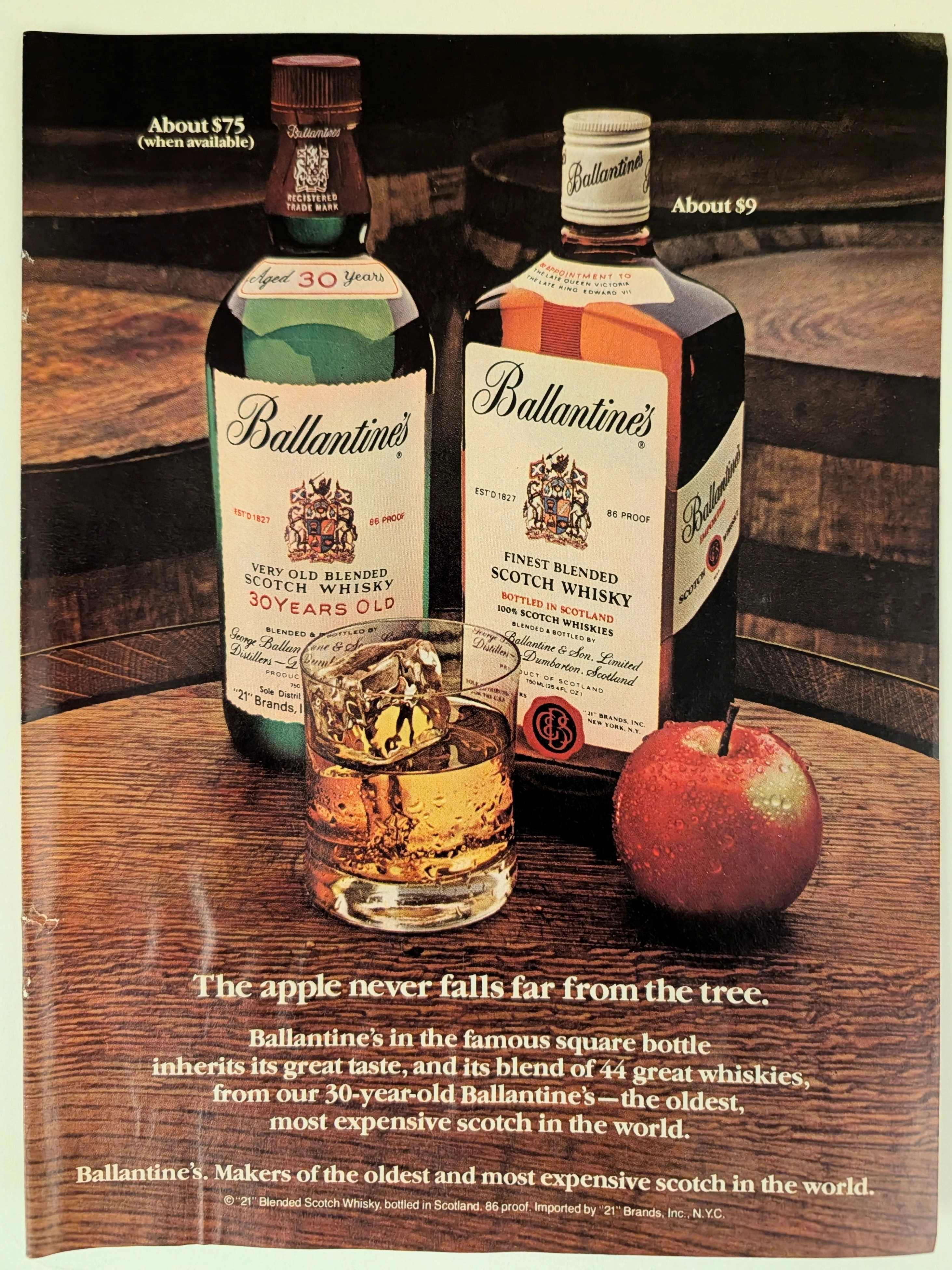
1970 Ballantine's Scotch Heritage. A study in prestige marketing, linking the rare 30-year-old blend to the everyday "Finest" square bottle.
1970 Ballantine's 30-Year-Old & Finest Blended Scotch Whisky Vintage Advertisement In the landscape of mid-20th-century spirits marketing, Ballantine’s (established in 1827) positioned itself as a guardian of consistency and age-stated excellence. This specific campaign, titled "The apple never falls far from the tree," is a masterclass in brand architecture. At the time of publication, the Ballantine’s 30-Year-Old was a rarity, priced at approximately $75—an extraordinary sum for the era, equivalent to several hundred dollars today. The advertisement serves a dual purpose. First, it establishes Ballantine’s as a leader in the high-end "prestige" market. Second, it uses that prestige to validate the consumer's choice of the $9 "Finest Blended" square bottle. The copy explicitly states that the younger blend "inherits its great taste" from the 30-year-old counterpart, suggesting that the DNA of the world’s most expensive scotch resides within every bottle. The visual composition—featuring the warm glow of a dram, a fresh apple to symbolize the proverb, and the rugged texture of oak aging barrels—evokes a sense of pastoral tradition and craftsmanship. Imported by "21" Brands, Inc. in New York, this ad captures a moment when Scotch whisky began to lean heavily into its "aged" credentials to differentiate itself in an increasingly competitive global market.
Category: Alcohol
Year: 1970
Rarity Class: A
Paper & Print Condition
Substrate Analysis: Printed on a medium-weight, clay-coated mechanical wood-pulp paper. The high-gloss coating was engineered for superior "ink holdout," crucial for reproducing the viscous, amber translucency of the whisky. Printing Methodology: Four-color offset lithography (CMYK). Micro-examination reveals a precise halftone rosette pattern. The ink density is intentionally high in the "K" (black) channel to create a dramatic chiaroscuro background, contrasting with the high-chroma magenta and yellow tones in the liquid and the red apple. Preservation State: Excellent structural integrity. Displays characteristic "oxidative browning" (patina) along the left-hand margin due to lignin content in 1970s magazine stock. Minor stress creases at the lower corner and feathered edges consistent with manual archival extraction from a bound volume.
Provenance & Rarity
Provenance: This artifact originates from a premium North American publication circa 1970, specifically targeting high-net-worth demographics. It was commissioned to support the distribution network of "21" Brands, Inc., N.Y.C., the exclusive United States importer for Ballantine's at the time. The physical margins indicate meticulous extraction from a bound, high-society lifestyle or business periodical. Rarity & Archival Value: Classified as Collector’s Grade Ephemera. While mid-century print advertising was produced en masse, surviving specimens featuring ultra-aged spirits in such high-fidelity color registries are increasingly scarce. The artifact’s primary historical value lies in its documentation of the $75 retail price for the 30-Year-Old expression—an invaluable data point for economic historians studying luxury market inflation and the globalization of the Scotch whisky industry.
Rarity & Condition Summary
Collector’s Grade Ephemera (Uncommon). The artifact is in excellent archival condition, retaining high-fidelity CMYK color registry. It exhibits minor organic degradation (oxidative patina) and edge-wear typical of careful extraction from a 1970s bound periodical. Highly valued for its visual integrity and its economic documentation of the $75 luxury price point.