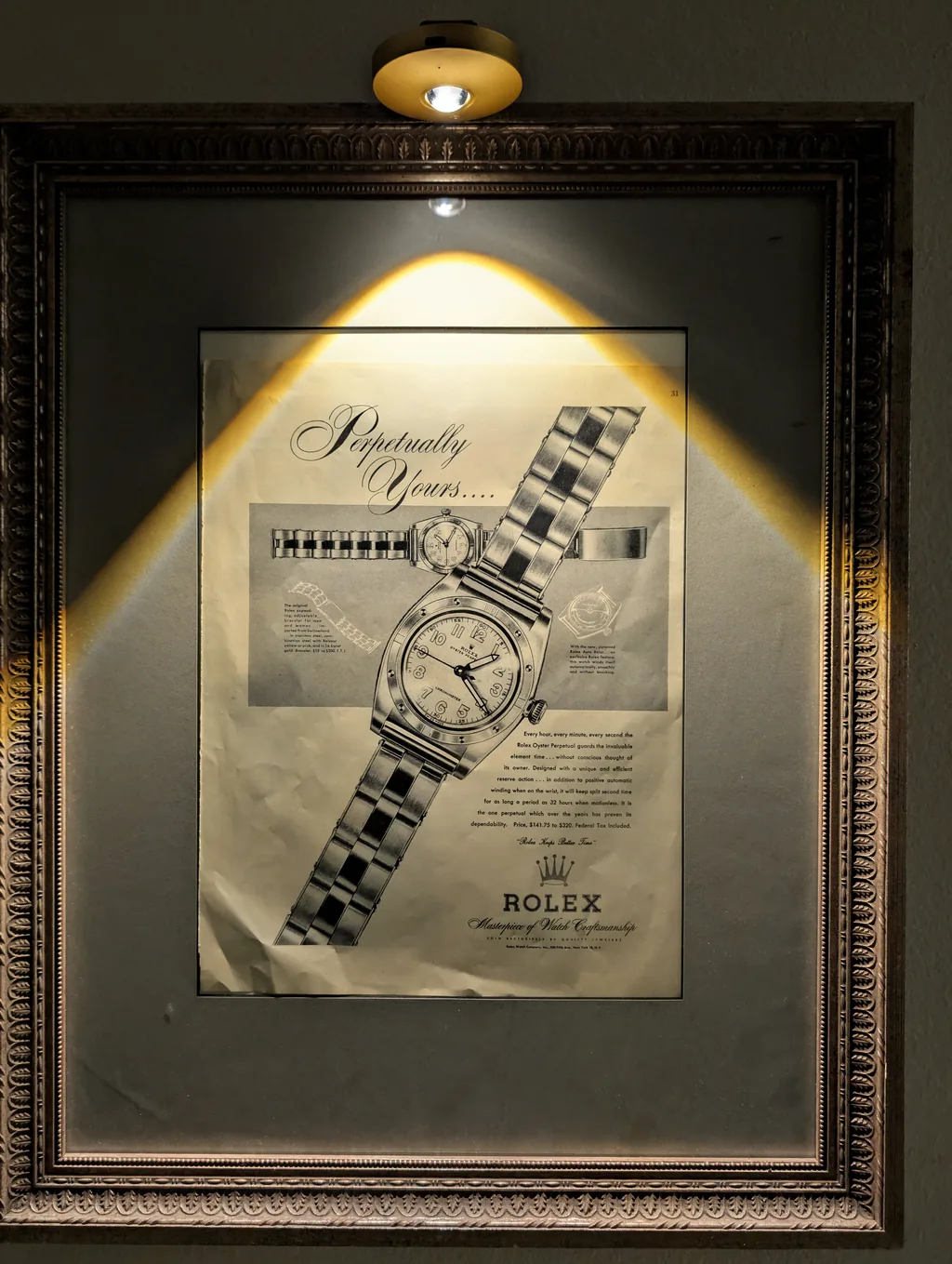
" THE CHRONICLE OF THE CORPORATE IMPRINT & THE PARALLEL CYCLE "
1. THE MICROSCOPIC ANCHOR OF TIME
-The date and corporate name serve as an indisputable primary historical source. From this collection, we witness a timeline deeply intertwined with global contexts: The 1933 Camel imprint anchors us in the Great Depression; the 1943 Seven-Up imprint reflects the WWII era where private brands dedicated ad space to War Bonds; and the early 80s imprints highlight the booming era of global capitalism.
2. THE UNSUNG HEROES & ARTISTIC INTEGRITY
-Beyond corporate copyrights, fine print serves as the ultimate record of "Creators." In the analog era, these layouts were collaborations among masters. The presence of credits like Fashions by Yves St. Laurent (the legendary French designer who revolutionized 20th-century women's fashion) guarantees the highest artistic pedigree.

3. THE LOST ART OF ANALOG REGISTRATION
-Under a master’s loupe, these texts reveal the magic of Offset Lithography. Long before digital graphics, this 4pt text required elite metal plates. When pressed into the paper, genuine ink creates a razor-sharp edge with physical depth. Preserving film grain texture while keeping micro-text legible is a 20th-century printing feat that modern counterfeits simply turn into blurry pixels.

4. THE PARALLEL CYCLE: BAND TEES & EPHEMERAL PAGES
-Analyzing the market mechanics reveals the "Exact Same Cycle" operating within the global high-end Vintage Band T-Shirt market. Six-figure band tees (e.g., 80s-90s Nirvana or Pink Floyd) rely exclusively on the microscopic Fine Print (Copyright Line) beneath the graphic to authenticate the era and licensing. Counterfeiters can fake the main graphic, but they cannot replicate authentic fine print bleeding into aged fabric fibers.
The analog pages, cut and preserved individually by The Record, follow this exact same unyielding logic. Every single page is a Piece-by-Piece Historical Artifact, fully authenticated by its micro-typographical DNA.

5. THE ECONOMICS OF ACIDIC DECAY
-The catalyst driving the exponential future value of these prints is their unavoidable fragility. Vintage paper is heavily comprised of acidic wood pulp. Over decades, this inherent acidity relentlessly consumes the material from within, resulting in severe foxing and structural embrittlement.
Just as vintage shirts suffer from irreversible "Dry Rot," our analog pages are actively being destroyed by their own acidic composition every single second. This creates an absolute economic equation: The global supply of authentic analog pages is drastically decreasing and can never be replenished. Consequently, the value of the surviving, properly curated pieces skyrockets in direct opposition to the shrinking supply.
***For the complete archival analysis and microscopic details, visit the Journal section on our website or access the full dossier here:
https://therecord.institute/journal/the-tiny-text-that-authenticates-history-why-fine-print-in-magazine-advertisements-matters-more-than-you-think"