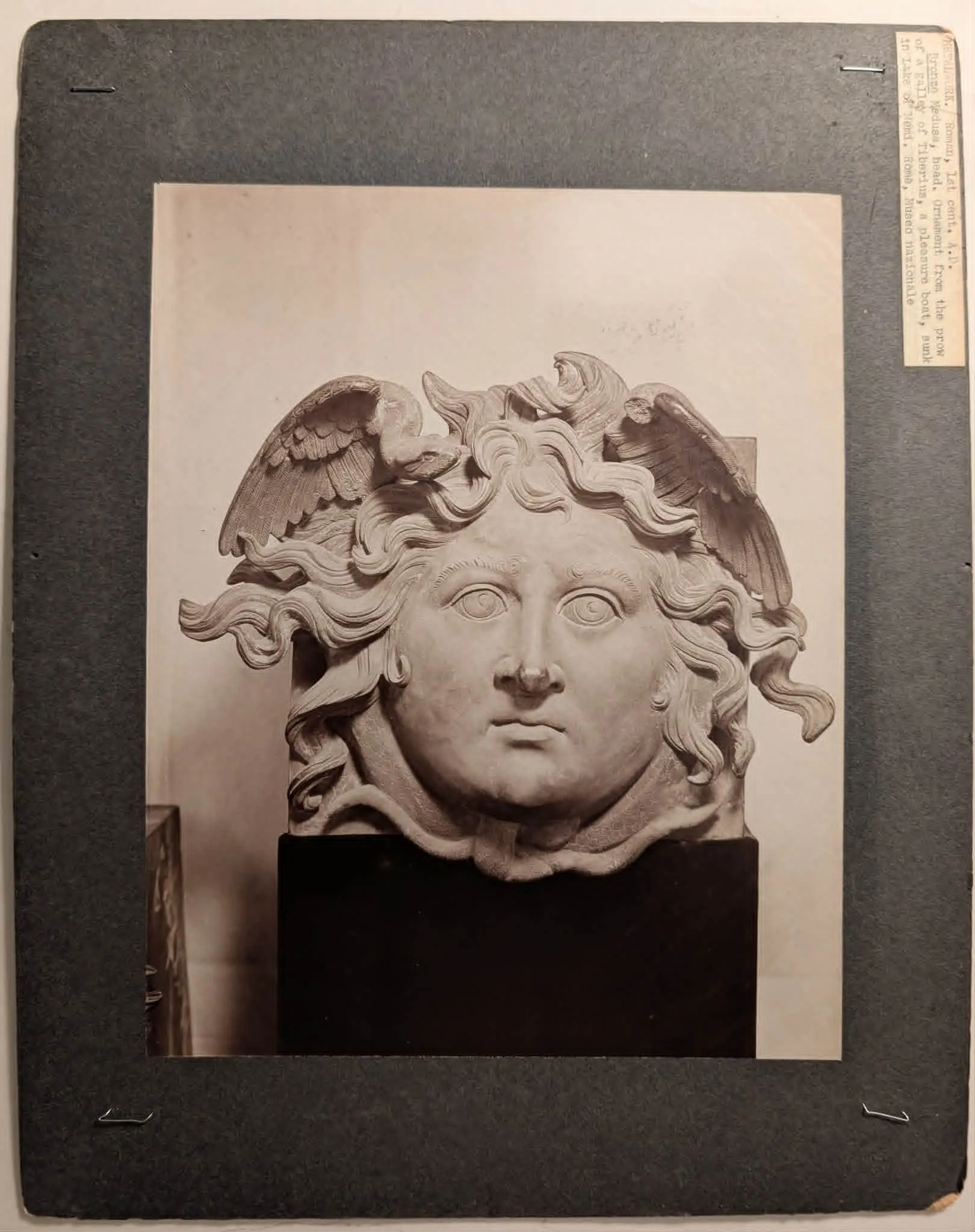
c. 1930s Seattle Public Library: Roman Bronze Medusa Head Archival Photograph
The subject of this profound vintage photographic print is a magnificent bronze Medusa head, a 1st-century A.D. architectural masterwork recovered from the fabled Lake Nemi ships. These immense pleasure galleys, often associated with the notorious Emperor Caligula, were marvels of ancient Roman engineering and luxury. As indicated by the meticulously typewritten institutional labels, this specific bronze functioned as an apotropaic emblem—designed to ward off evil—mounted prominently on the ship's prow or steering oars. The silver gelatin print masterfully captures the deep patination, the sharp rendering of the Gorgon’s serpentine locks, and the haunting hollows of her eyes. What elevates this photograph to a Class S archival artifact is its immense historical weight as a pre-war visual d
Category: Real Estate
Year: 1930
Rarity Class: S
Paper & Print Condition
The silver gelatin print is securely affixed to a heavyweight, dark-grey institutional mounting board. The photograph itself retains exceptional tonal depth and sharp focal clarity, expertly illustrating the intricate textures and light play on the bronze artifact. The physical condition vividly reflects its authentic historical provenance as a working library reference: the mounting board exhibits minor edge wear, slight softening at the corners, and subtle surface abrasions consistent with dec
Provenance & Rarity
This Class S archival photograph holds an unassailable institutional provenance, having originally been held within the prestigious reference collections of the Seattle Public Library. It was formally deaccessioned, as evidenced by the official "DISCARDED" stamp on the reverse. Its supreme rarity is derived from its status as a vital pre-war visual record of the legendary Nemi ship bronzes—many of which were tragically destroyed by fire during World War II—surviving in pristine condition alongsi
Rarity & Condition Summary
Rarity Class: Class S Summary: This photograph transcends mere reproduction; it is a primary historical document bridging classical archaeology and institutional history. The flawless preservation of its cataloging ephemera and its role in documenting a legendary artifact prior to the devastating 1944 Nemi museum fire make it a supreme, museum-grade collectible of irreplaceable archival value.