The Time Traveller’s Dossier: 1980 Imperial Treasury Golden Reliquary Vintage Advertisement — The Weight of Divine Right
The History
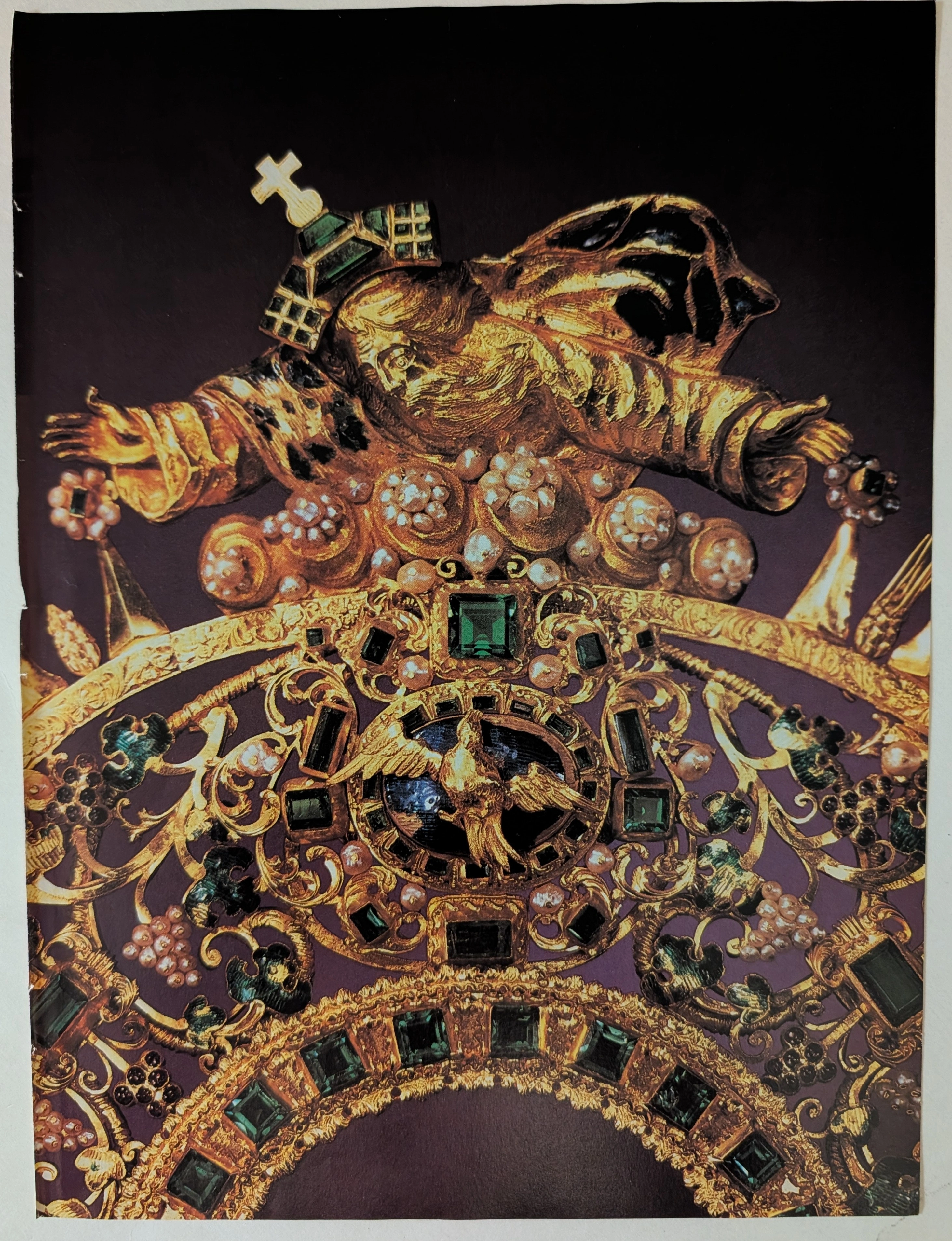
To understand the profound weight of this printed artifact, one must first dismantle the layers of history it represents—both the history of the object depicted and the history of the era in which it was printed. The subject of this macro-photographic reproduction is a superlative example of medieval or early Renaissance ecclesiastical goldsmithing, bearing the hallmarks of the masterworks traditionally housed in the Imperial Treasury (Kaiserliche Schatzkammer) of Vienna or similar royal European vaults.
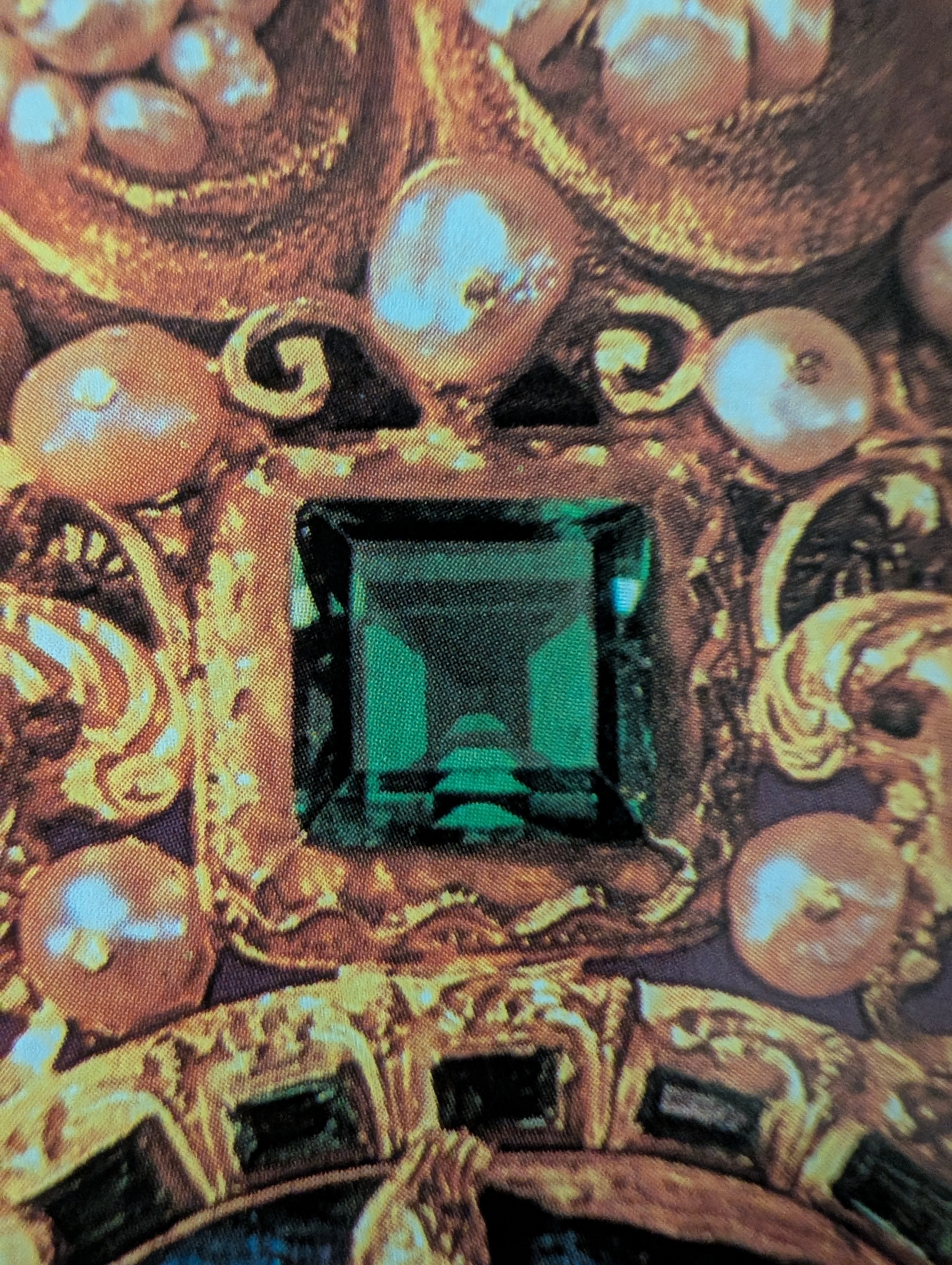
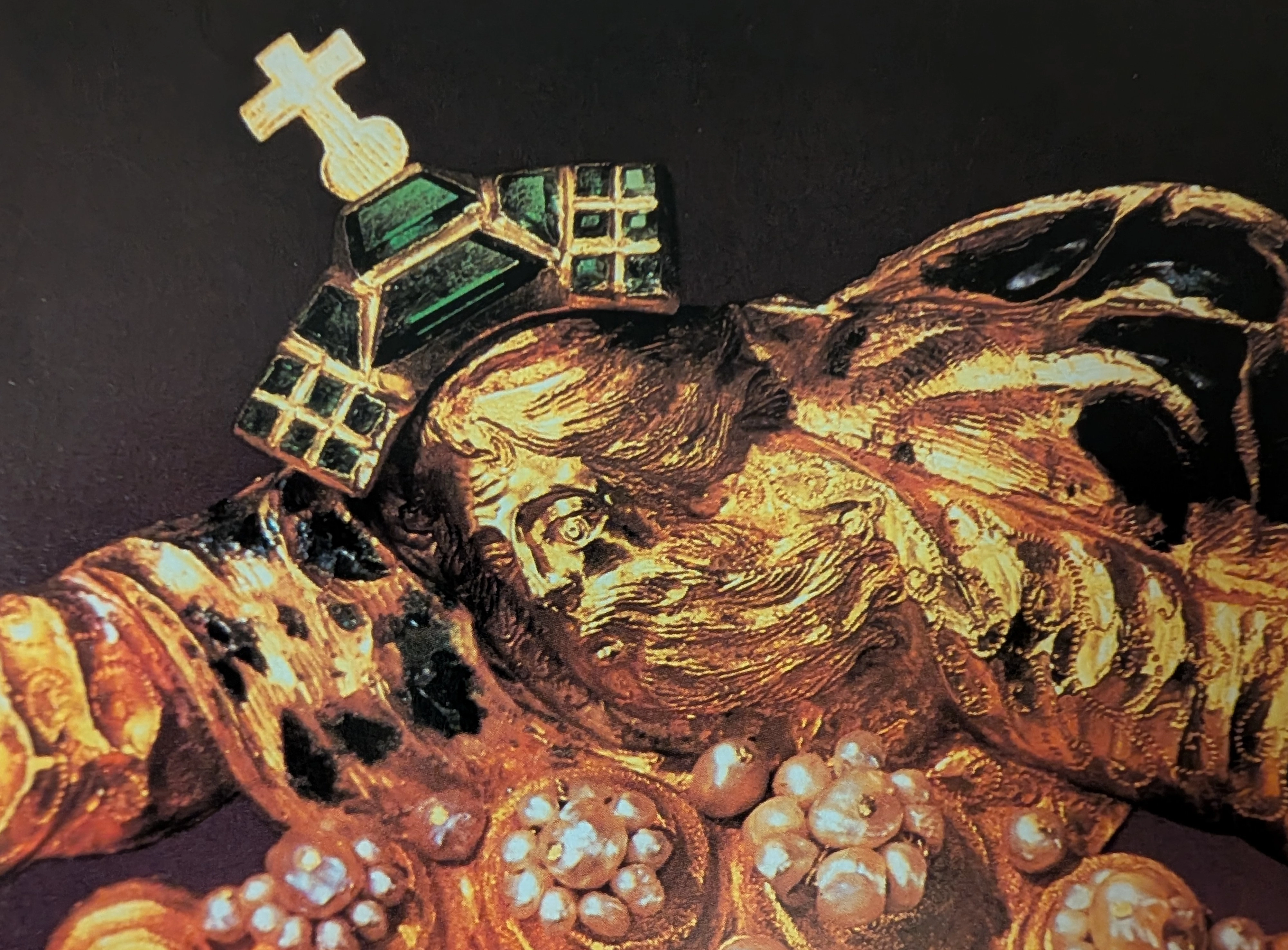
The imagery is saturated with the visual vocabulary of the Holy Roman Empire and absolute monarchical authority. At the apex of the composition sits a highly ornamented golden figure, heavily draped in robes composed of repoussé gold, crowned with a cruciform diadem. This is not merely a decorative figure; it is a representation of a saint, an emperor, or perhaps a localized manifestation of divine right itself. In medieval semiotics, material wealth was inextricably linked to spiritual and temporal power. Gold was not just currency; it was the physical manifestation of divine light on earth. The inclusion of the magnificent, step-cut emeralds serves a dual purpose: emeralds were historically associated with eternal spring, resurrection, and enduring power, while their immense cost signaled undisputed sovereign wealth. The lustrous pearls that frame the central motif symbolize purity, virtue, and the kingdom of heaven.
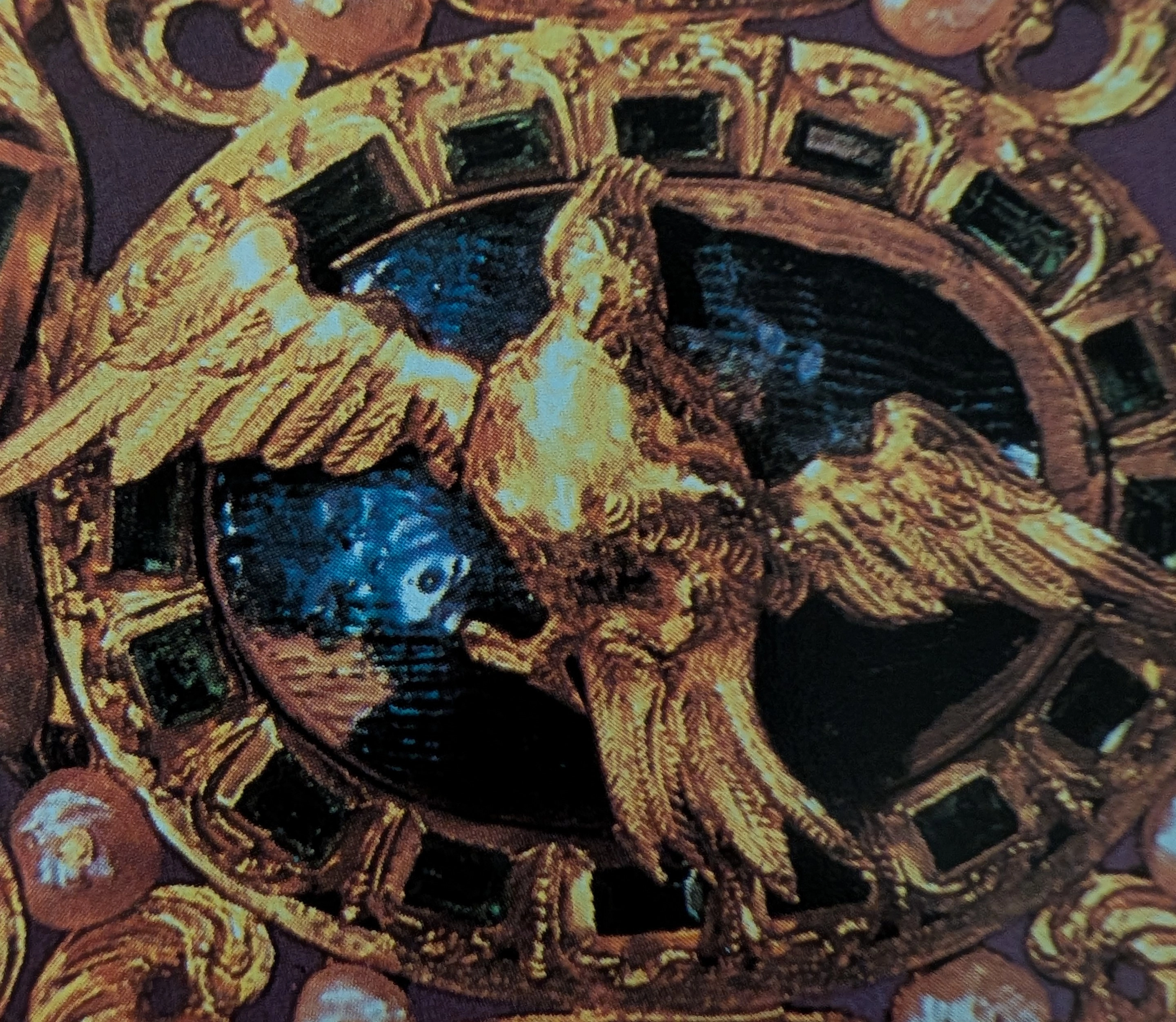
Furthermore, the central enamel medallion, depicting a meticulously detailed golden eagle against a vibrant, celestial blue background, acts as the definitive seal of imperial lineage. The eagle, a direct descendent of the Roman Aquila, was the ultimate symbol of supreme power, adopted by successive empires to legitimize their rule.
Fast forward to the late 1970s and early 1980s, the era in which this print was struck. During this period, prestigious national museums, auction houses, and luxury conglomerates began shifting their public relations strategies. There was a concerted movement to democratize access to high culture, bringing the secluded treasures of royal vaults to the global public through high-fidelity printed materials, exhibition catalogs, and specialized magazine placements. This 1980 Imperial Treasury Golden Reliquary vintage advertisement serves as a vital cultural bridge. It translated the intimidating, untouchable majesty of medieval reliquaries into a two-dimensional format accessible to the contemporary public, scholars, and collectors. The campaign's overarching background likely rested on a psychological desire to project permanence, unparalleled craftsmanship, and undisputed authority—qualities that high-end institutions continually seek to associate with their own modern, corporate identities. In an era increasingly dominated by mass production, presenting a unique, handcrafted relic of incalculable value was a profound statement of enduring institutional power.
The Paper
An archival analysis of this specific print reveals the fascinating, highly technical intersection of late 20th-century offset lithography and specialized analog macro-photography. The extreme close-ups provided in the visual data expose a distinct, tightly clustered CMYK (Cyan, Magenta, Yellow, and Key/Black) halftone pattern.
Unlike modern, ultra-high-resolution digital printing—where ink is sprayed in microscopic, randomized droplets to create a continuous tone—this print relies on the precise, mechanical, and geometric overlapping of halftone dots to deceive the human eye into perceiving depth, contour, and continuous color. The mastery of the pre-press separation is evident here. To replicate the intense, reflective glare of polished gold and the deep, refractive interior of a faceted emerald using only four base colors requires an exceptional understanding of ink density and dot gain. The printer had to carefully balance the yellow and magenta plates to achieve the warm, authentic glow of the medieval gold, while heavily relying on the cyan and key plates to construct the deep, almost abyssal darkness of the background and the precise shadows within the filigree.
The paper substrate itself is of significant archival interest. It appears to be a heavy-stock, coated gloss or silk variant, likely weighing between 130gsm and 170gsm, typical of premium exhibition catalogs, high-end auction brochures, or inserts in luxury periodicals of the early 1980s. This specific clay or synthetic polymer coating has served a vital protective function over the decades. It has effectively sealed the ink beneath a microscopic layer of gloss, protecting the delicate halftone dots from severe environmental degradation, atmospheric moisture, and minor abrasive damage.
Crucially, there is a noticeable absence of heavy lignin oxidation. Lignin, a natural polymer found in wood pulp, is the primary culprit behind the yellowing and embrittlement of cheaper newsprint and low-grade magazine paper over time. The high-quality, likely acid-free or heavily buffered pulp used in this print has allowed the rich, dark purplish-black background to remain exceptionally deep and highly saturated, preserving the intended visual drama of the original photograph. The way ambient light currently interacts with the printed surface—reflecting off the glossy ink while simultaneously catching the subtle, microscopic textures of the paper fibers beneath—adds a tactile, physical dimension to the visual experience that cannot be replicated on a digital screen.
The Rarity
In the specialized realm of paper ephemera and institutional archiving, this piece occupies a highly rarefied niche. While mid-century automotive advertisements, consumer goods catalogs, and fashion spreads were printed in the millions and are relatively abundant in the collector's market, high-fidelity fine art and artifact prints from specialized institutional campaigns were produced in significantly lower volumes.
Exhibition posters, auction house preview materials, and specialized museum advertisements were inherently transient objects. They were designed to promote a specific, time-bound event. Once the exhibition closed or the auction hammer fell, the vast majority of these promotional materials were unceremoniously discarded by both the institutions and the public. Therefore, the survival of a print from this era that retains such pristine structural integrity—free from the deep creases, edge tears, foxing (fungal spotting), or the severe UV-induced color fading typically associated with paper from the 1980s—is a statistical anomaly.
The collector value of this piece is driven not merely by a sense of vintage nostalgia, but by its dual nature as both a triumph of analog photographic technology and a legitimate curatorial document. As museums and archives increasingly digitize their collections, physical prints that document the exact curatorial lens of the late 20th century are becoming prized historical records in their own right. Market perception heavily favors prints that offer this level of macro-detail, allowing the viewer to study the raw craftsmanship of the original historical artifact—such as the exact internal inclusions and step-faceting of the central emerald, or the natural, organic imperfections in the surrounding pearls—exclusively through the authentic, period-correct lens of vintage printing technology.
Visual Impact
The art direction and photographic composition of this piece represent a masterclass in visual hierarchy and the application of photographic chiaroscuro. By isolating the immensely detailed, golden reliquary against a profound, seemingly infinite dark background, the photographer and layout artist have forcefully directed the viewer’s eye, stripping away all contextual distractions and demanding total focus on the textures of the metal and the luster of the jewels.
This required specialized equipment, likely a medium or large-format analog camera utilizing a macro lens, paired with an intensely controlled studio lighting setup. The extreme shallowness of the depth of field is a deliberate artistic choice. The focal plane is razor-thin, rendering the leading edges of the goldwork, the surface of the pearls, and the face of the enameled eagle in aggressive, hyper-realistic sharpness, while allowing the deeper recesses of the artifact to soften and melt away into the shadows. This optical effect mimics the way the human eye focuses on a dazzling object, creating an intimate, almost voyeuristic viewing experience.
The color theory employed relies on striking, elemental contrasts. The warm, radiant, almost aggressive tones of the ancient gold and the soft, creamy white of the pearls are violently yet beautifully juxtaposed with the cold, geometric, crystalline precision of the deep green emeralds and the stark, celestial blue of the enamel background. The emotional tone conveyed by this visual strategy is one of deep reverence, quiet awe, and intimidating luxury. It is an image designed not just to be looked at, but to be studied—demanding that the viewer pause and contemplate the intersection of human artistry, material wealth, and divine ambition.
Exhibition Halls
The Archive Continues
Continue the Exploration
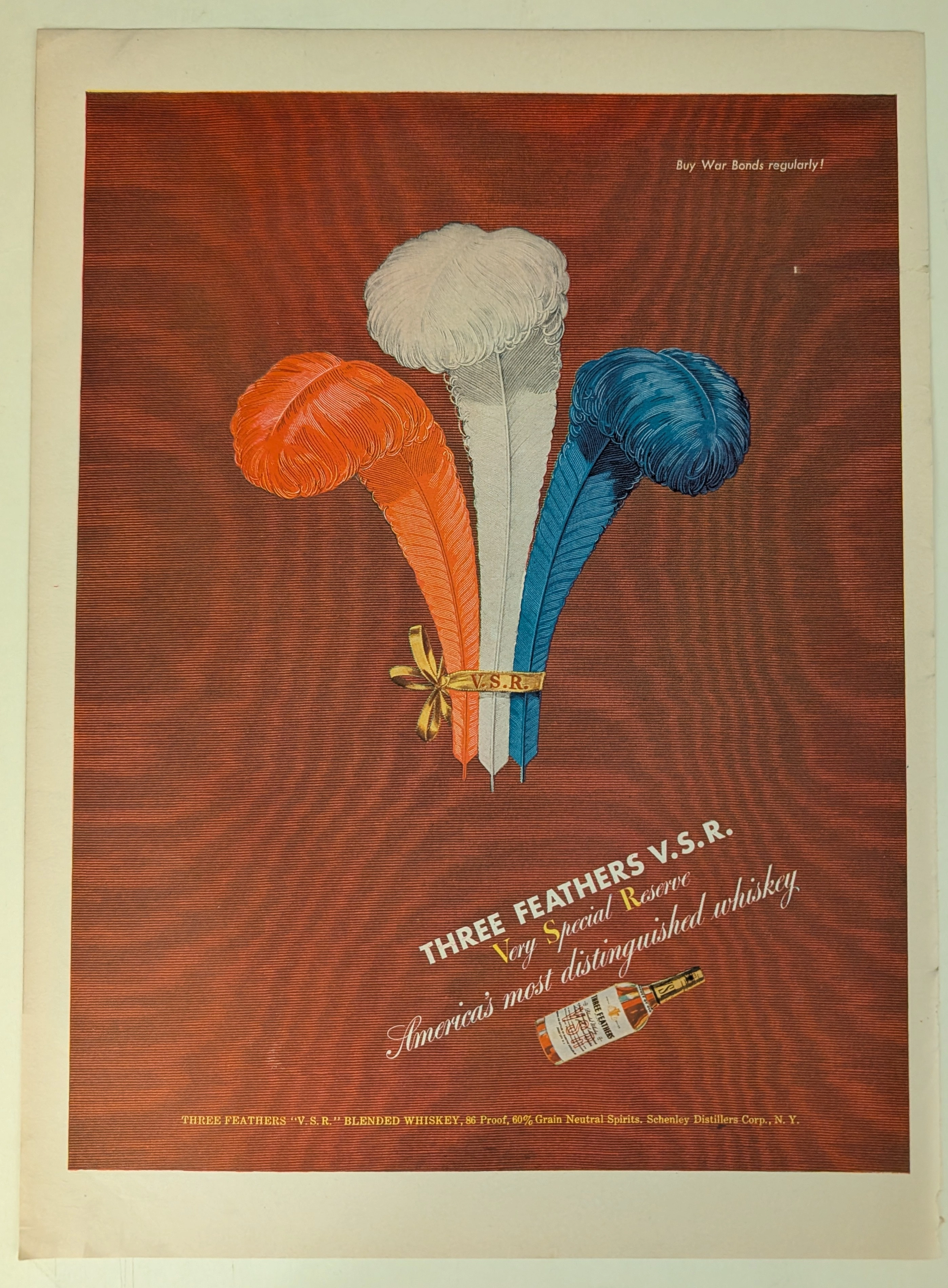
THE TIME TRAVELER'S DOSSIER: BLOOD CAPITALISM AND THE WEAPONIZATION OF WHISKEY
This impeccably preserved Historical Relic is a Primary Art Document from the brutal crucible of World War II, featuring a sweeping advertisement for THREE FEATHERS V.S.R. Blended Whiskey. It chronicles the ultimate mid-century psychological strategy of "Patriotic Capitalism." The artifact is forensically and definitively dated to the WWII era by the explicit, government-aligned directive in the upper right corner: "Buy War Bonds regularly!". Visually, the brand masterfully hijacked American nationalism by rendering its iconic three feathers in a vibrant Red, White, and Blue patriotic color scheme. Surviving the aggressive scrap paper drives of the 1940s, the acidic analog paper exhibits a profound integration of the deep crimson ink into its degrading fibers, perfectly encapsulating the analog aesthetic of wabi-sabi. This slow chemical death elevates this rescued wartime artifact to an irreplaceable Primary Art Document of Rarity Class A.
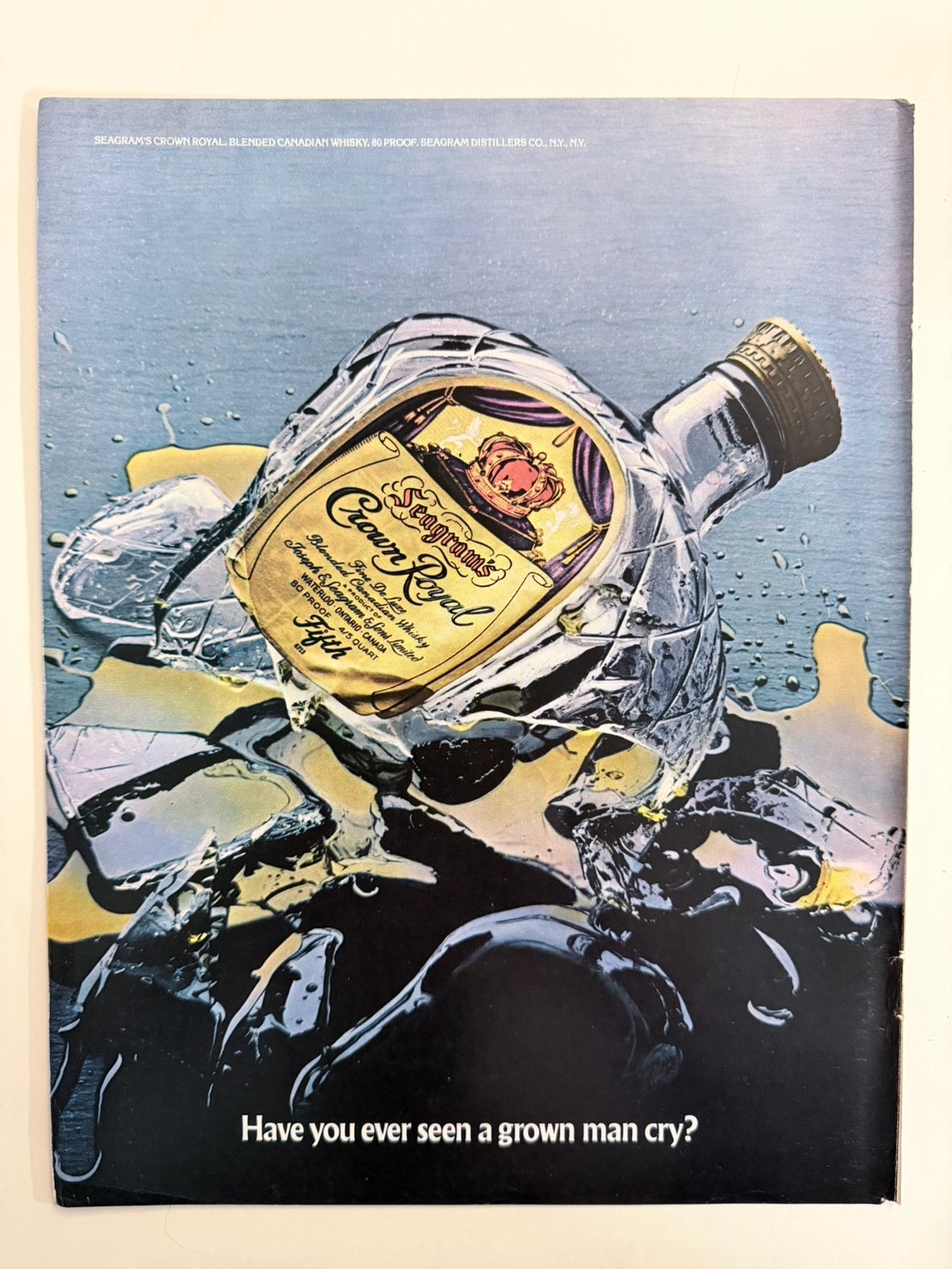
Vintage 70s Crown Royal Ad: Vanishing Analog Art | The Record
An in-depth look at the priceless 1970s Crown Royal "Have you ever seen a grown man cry?" advertisement. A masterpiece of authentic analog photography on degrading vintage paper, driving up the value of this original print as global supply inevitably shrinks.
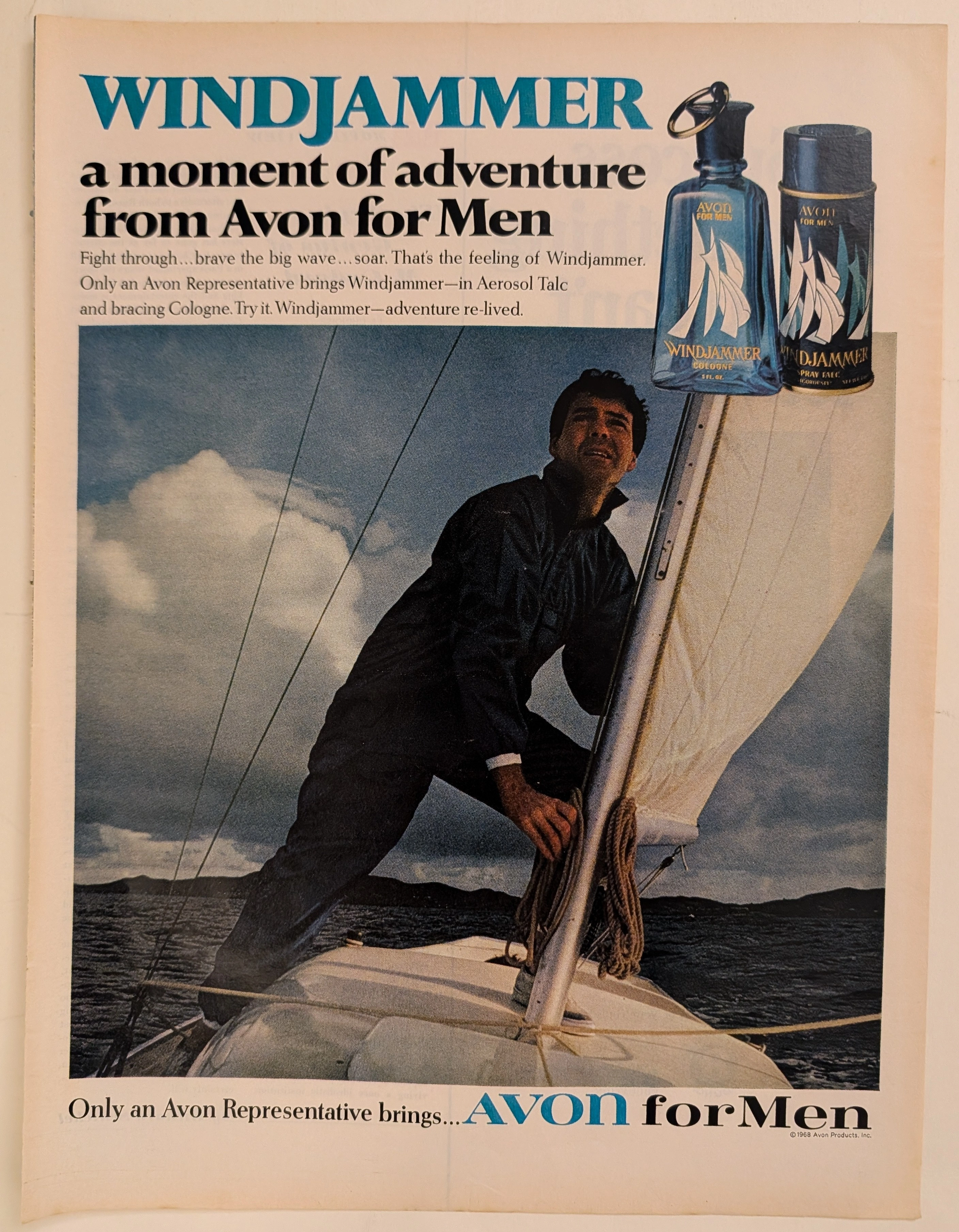
Avon · Other
The Time Traveller's Dossier: The Suburb's Sea – Avon for Men, the Windjammer Mythos, and the Commodification of Mid-Century Masculinity
The evolution of mid-twentieth-century American domestic commerce was fundamentally reshaped by the aggressive expansion of the direct-sales model into the male grooming sector. The historical artifact elegantly and securely positioned upon the analytical table of The Record Institute today is a visually arresting, full-page print advertisement for Avon for Men: Windjammer, definitively dated by its copyright macro to the turbulent year of 1968. This document completely transcends the standard, utilitarian boundaries of fragrance marketing. It operates as a highly sophisticated, multi-layered cultural mirror, reflecting a precise era in consumer psychology where the American male—increasingly confined to the sterile environments of corporate offices and manicured suburbs—yearned for visceral, physical validation. By utilizing the universally potent, romanticized motif of the solitary sailor battling the elements, Avon ingeniously packaged the concept of raw, nautical adventure into a socially acceptable, easily purchasable glass bottle. This world-class, comprehensive dossier conducts a meticulous, unyielding, and exceptionally exhaustive examination of the artifact, operating under the absolute most rigorous parameters of historical, sociological, and material science evaluation. Dedicating the overwhelming majority of our analytical focus to its immense historical gravity, we will decode the brilliant marketing psychology embedded within the "Windjammer" maritime narrative, analyze the profound sociopolitical genius of the "Avon Lady" distribution network selling masculinity to wives, and dissect the semiotics of the product's mid-century packaging design. Furthermore, as we venture deeply into the chemical and physical foundations of this analog printed ephemera, we will reveal the precise mechanical fingerprints of the CMYK halftone rosettes captured in the macro imagery. Finally, we will assess its archival rarity, exploring how the graceful, natural oxidation of the paper substrate cultivates a serene wabi-sabi aesthetic—a natural, irreversible phenomenon that serves as the primary engine driving up its market value exponentially within the elite global spheres of Vintage Commercial Ephemera and Lifestyle Archives.