The Time Traveller’s Dossier: 1981 Nocona Boots Vintage Advertisement — The Hyper-Masculine Mythos of the American West
The History
The Urban Cowboy Zeitgeist and the 1981 Cultural Shift
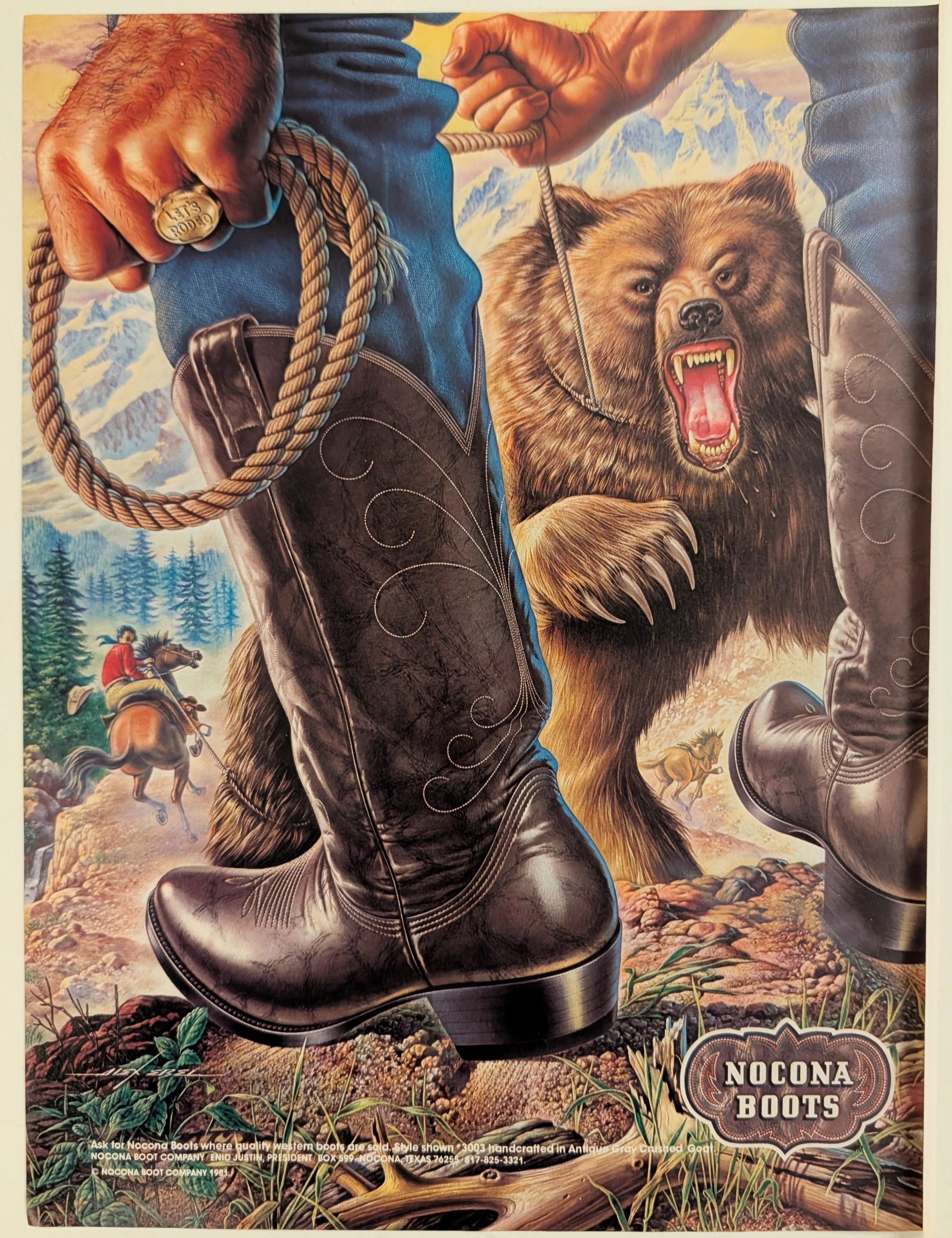
To comprehend the sheer bravado and visual audacity of this 1981 Nocona Boots advertisement, one must first understand the cultural tectonic shift occurring in the United States during this era. The late 1970s and early 1980s witnessed an unprecedented mainstream explosion of Western culture, largely catalyzed by the 1980 film Urban Cowboy. Suddenly, the aesthetic of the American West—previously confined to working ranch hands, rodeo athletes, and regional rural populations—became a nationwide obsession. Mechanical bulls appeared in metropolitan nightclubs, country music dominated pop charts, and Western wear transitioned from utilitarian work gear to high-fashion statement pieces.
In 1981, buying a pair of handcrafted cowboy boots was no longer just about foot protection in the stirrup; it was an acquisition of identity. Nocona Boots, a heritage brand with deep Texan roots, recognized that they were no longer selling just leather and stitching to ranchers. They were selling a fantasy of rugged, unyielding masculinity to a newly awakened, broad consumer base. This advertisement deliberately abandons the traditional, subdued marketing of showing a boot resting on a fence post. Instead, it detonates a visual bomb of pure, unadulterated Western mythology.
Enid Justin: The Matriarch Behind the Masculine Mythos
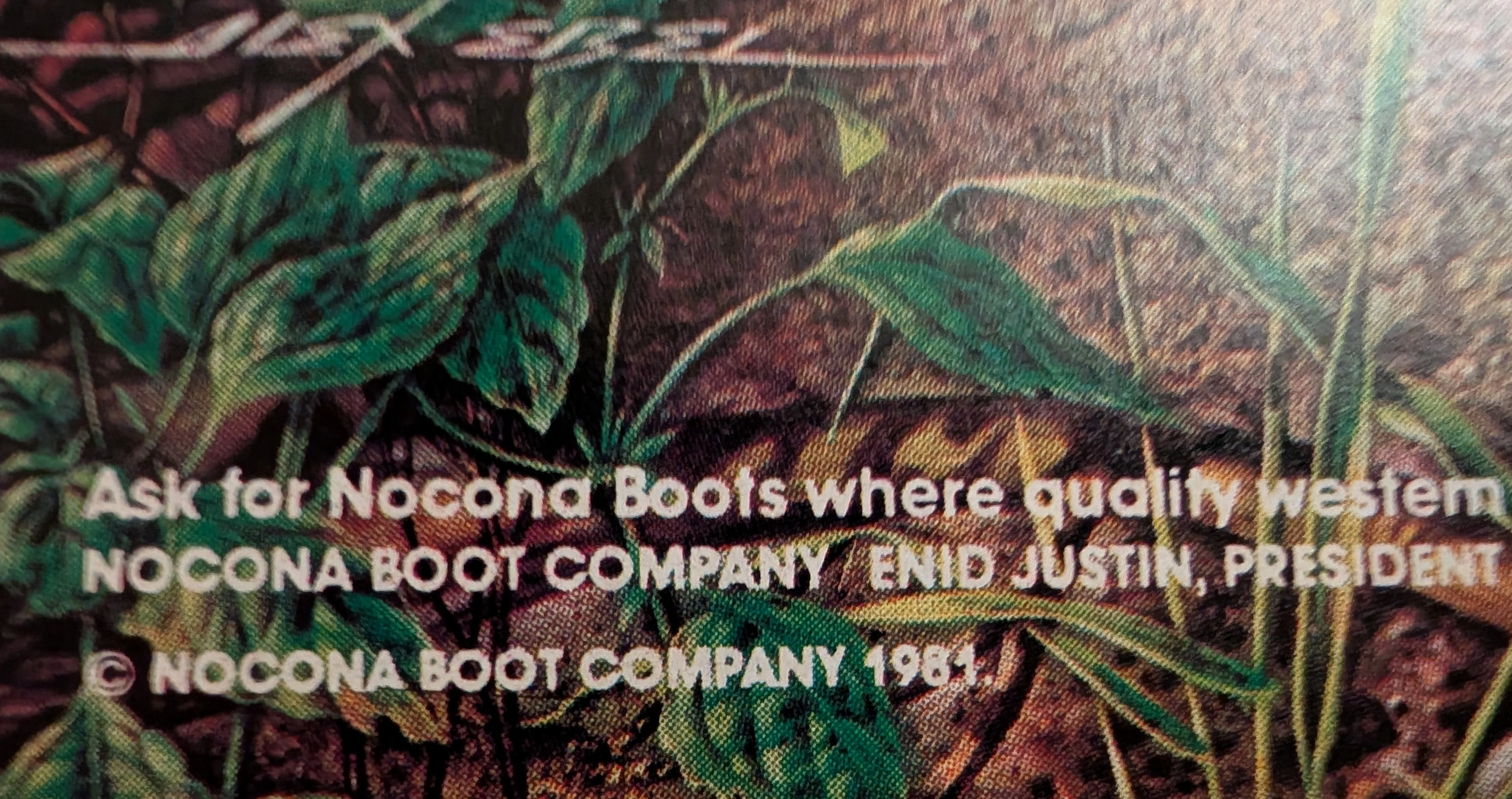
One of the most fascinating historical paradoxes of this hyper-masculine advertisement is found in the small print at the bottom: "NOCONA BOOT COMPANY / ENID JUSTIN, PRESIDENT." The aggressive, testosterone-fueled imagery of a giant subduing a grizzly bear was orchestrated under the leadership of a woman in a fiercely male-dominated industry.
Enid Justin, affectionately known as "Miss Enid," was a titan of Texan industry. When her father, H.J. "Daddy Joe" Justin (founder of Justin Boots), passed away, her brothers decided to move the family business from Nocona, Texas, to the larger city of Fort Worth in 1925. Miss Enid, fiercely loyal to her hometown, stayed behind. With a borrowed $5,000 and a handful of loyal employees, she founded the Nocona Boot Company. By 1981, she had built an empire that rivaled and often surpassed her brothers' legacy in terms of prestige and quality. Her explicit inclusion as "President" in the copyright line of this ad is a quiet but immensely powerful flex of female executive authority juxtaposed against the ultimate artwork of male dominance. It speaks to the authenticity of the brand: Nocona wasn't a corporate fabrication; it was the lifeblood of a Texas matriarch who understood exactly what the Western fantasy required.
The Semiotics of the "Let's Rodeo" Ring
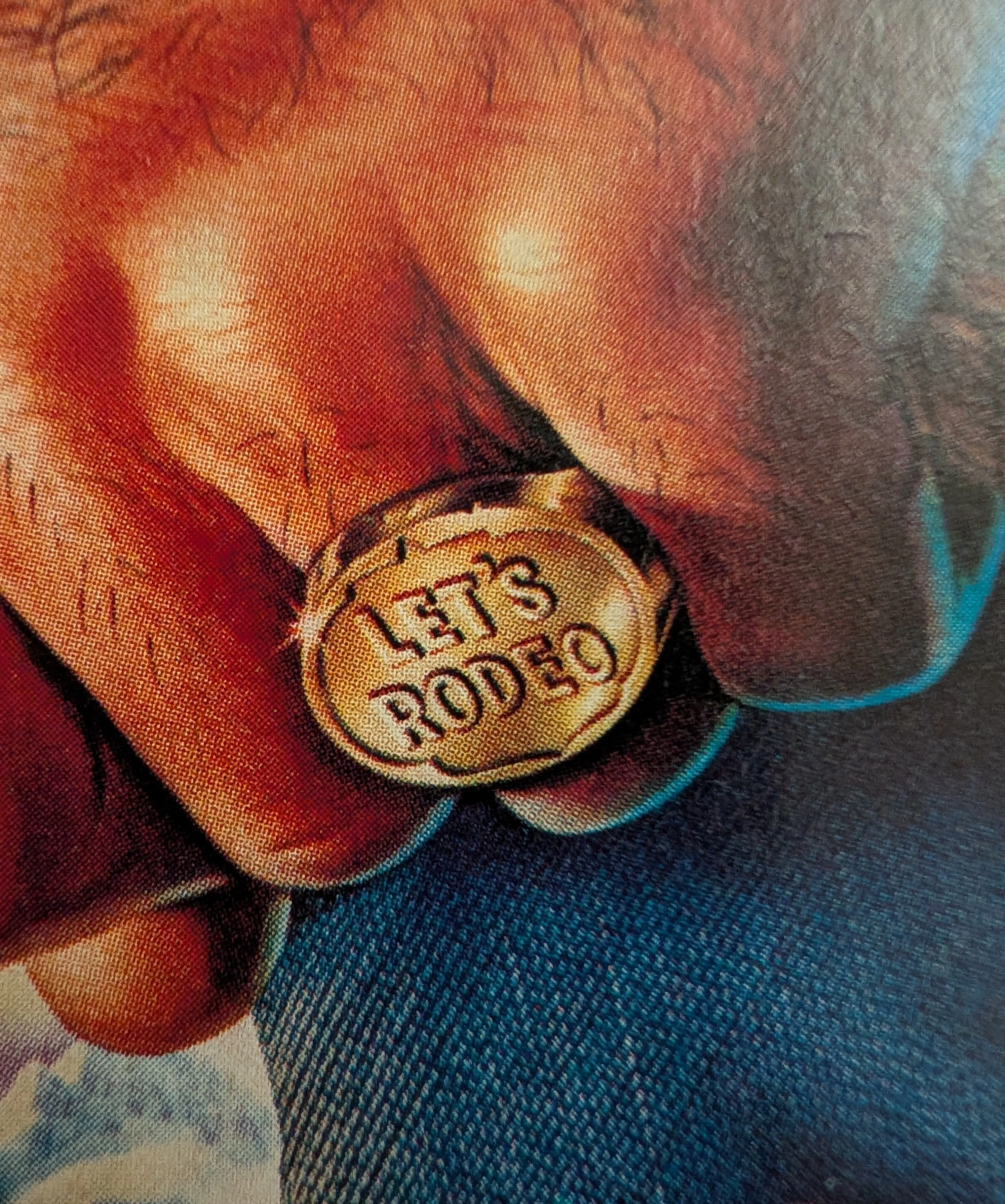
The composition forces the viewer's eye to a highly specific detail in the extreme foreground: a massive, scarred hand gripping a lasso, adorned with a large gold ring reading "LET'S RODEO." From a semiotic standpoint, this ring acts as the emotional anchor of the entire advertisement.
By 1981, the rodeo had evolved from informal ranch competitions into a highly commercialized, televised extreme sport. It was the ultimate test of grit. The phrase "Let's Rodeo" was a cultural battle cry. It meant facing danger head-on, embracing the chaos of the arena, and refusing to back down. The hand wearing the ring is relaxed—only two fingers casually pinch the rope that is supposedly holding back a massive grizzly bear. This visual narrative communicates absolute coolness under pressure. The wearer of Nocona boots does not sweat the danger; he invites it. The ring transforms the boot from an article of clothing into an emblem of an adrenaline-fueled lifestyle.
Alex Ebel and the Pulp-Fantasy Translation of the West
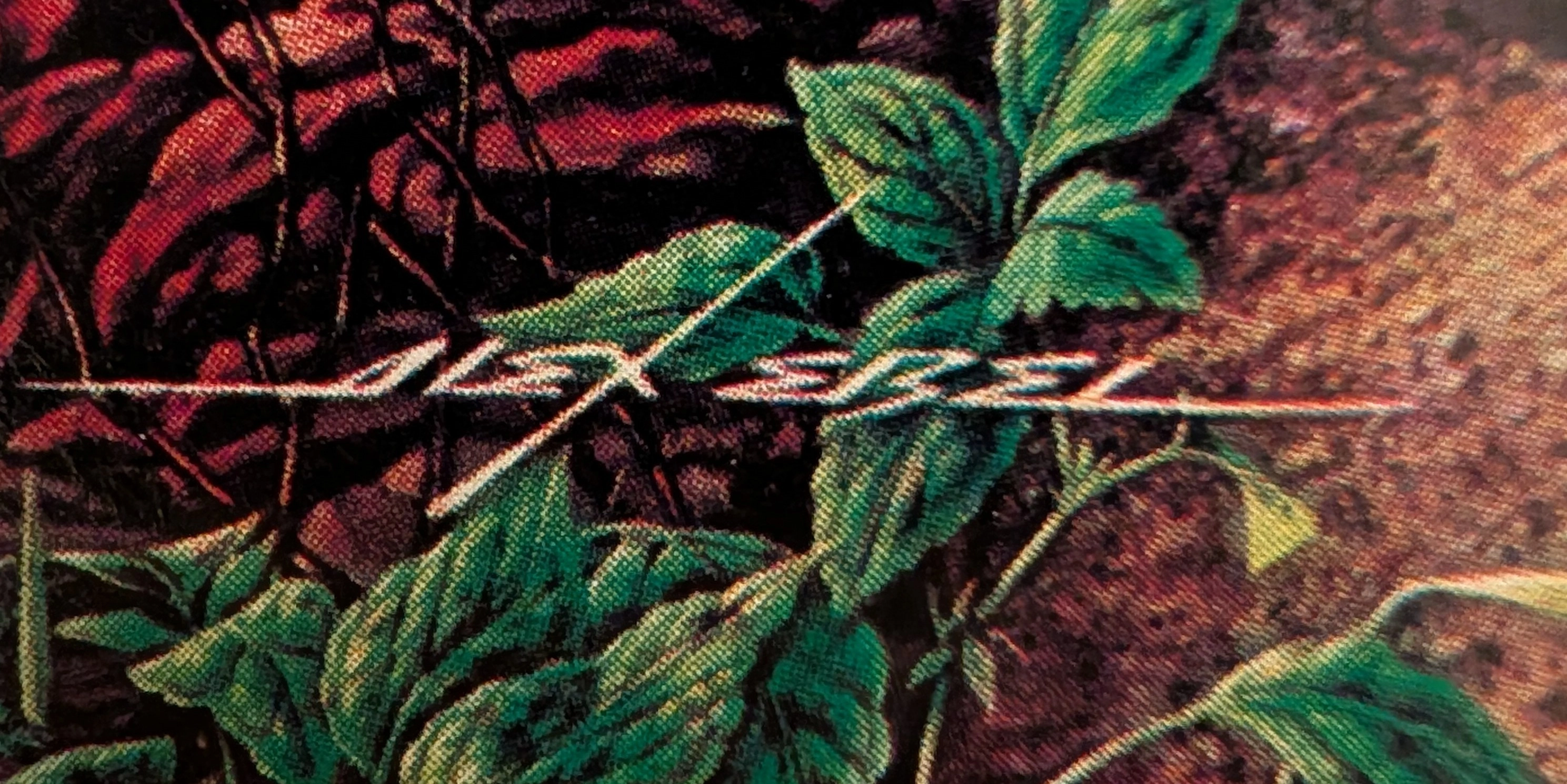
The artwork is signed by Alex Ebel, an illustrator whose background heavily influenced the surreal, larger-than-life tone of this piece. Ebel was renowned for his work in science fiction, fantasy book covers, and cinematic poster art. By hiring Ebel, Nocona deliberately moved away from the photorealism or traditional rustic paintings usually associated with western wear.
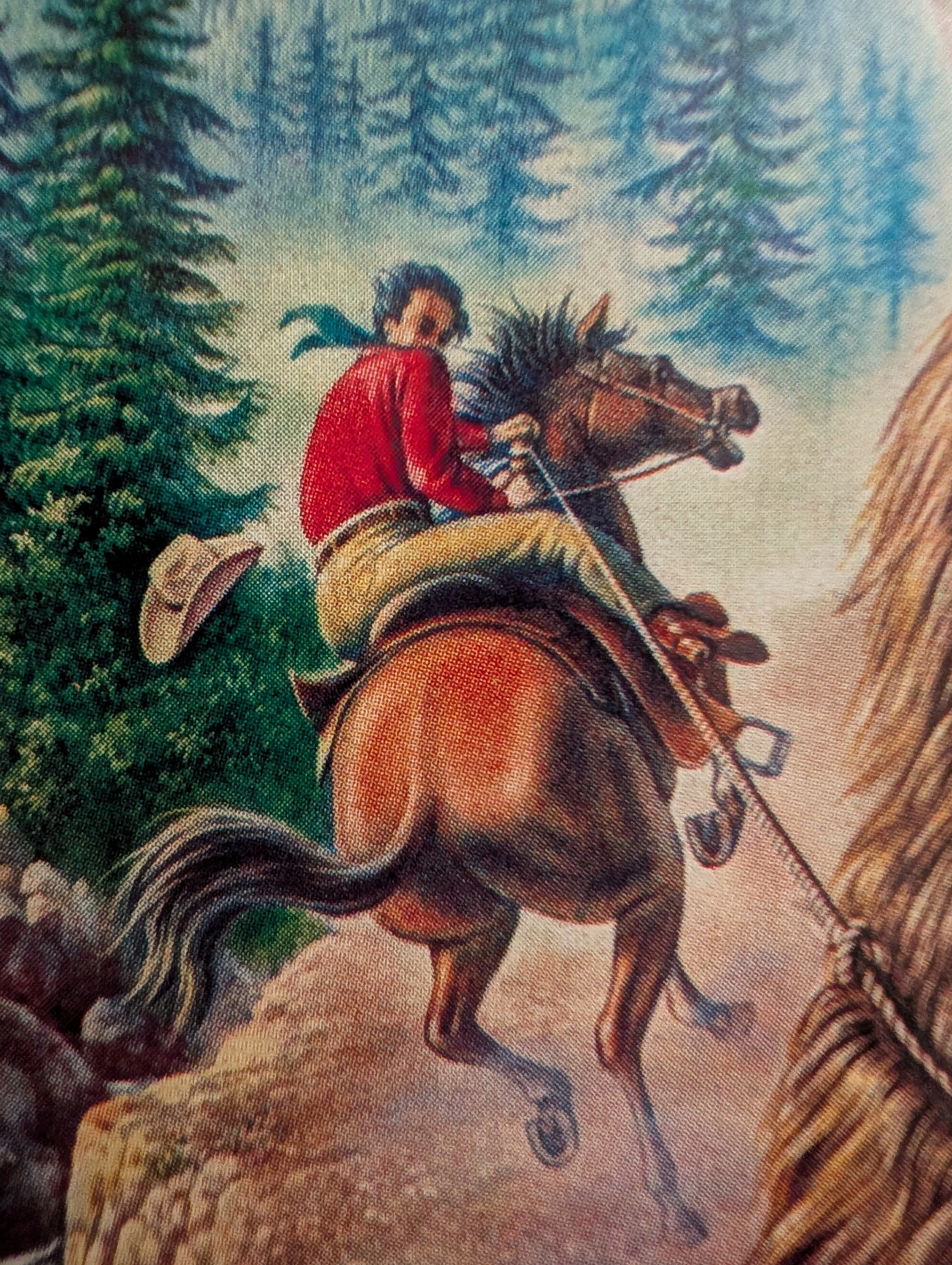
Ebel brings a "Frank Frazetta-esque" pulp-fantasy sensibility to the American West. The perspective is wildly distorted and dynamic (forced perspective from a low angle). The cowboy is rendered as a titan, a mythological giant whose boots alone are the size of boulders. In the background, a smaller cowboy on horseback struggles with the terrain, serving only to emphasize the god-like scale of the primary figure in the Nocona boots. The grizzly bear—the apex predator of the North American wilderness—is depicted with slavering jaws, massive fangs, and terrifying claws, yet it is utterly subdued by the casual flick of the titan's lasso.
The Iconography of Dominance: Man, Beast, and Leather
This illustration is a visual distillation of "Manifest Destiny" and the conquering of the wild frontier. It plays heavily into the mythological archetype of the American frontiersman (akin to Pecos Bill or Paul Bunyan) who tames tornadoes and wrestles bears. The advertisement suggests that by wearing Nocona's "Style 3003 handcrafted in Antique Gray Crushed Goat," the consumer absorbs this mythological power.
The choice of "Crushed Goat" leather is also historically significant. In the 1980s, boot makers were experimenting heavily with exotic leathers to satisfy the new fashion-conscious urban cowboy. Goat skin is inherently soft and supple, yet incredibly resilient and resistant to scuffing. The "Antique Gray" finish provided a pre-worn, battle-tested aesthetic, appealing to consumers who wanted the look of a seasoned ranch hand without enduring the decades of labor required to earn it. The boot is drawn with meticulous attention to the decorative stitching (the toe bug and the shaft wrangling), contrasting the refined elegance of the craftsmanship against the savage brutality of the bear attack. It is the ultimate statement of civilized dominance over wild nature.
The Paper
From an archival and conservational perspective, the physical paper of this advertisement is highly representative of premium, high-circulation magazine printing standards of the early 1980s.
Substrate Profile: The advertisement is printed on a medium-weight, glossy coated magazine stock. This paper relies on a mechanical wood pulp base, which inherently contains lignin. While the clay coating provides a smooth, reflective surface ideal for vibrant ink absorption, the underlying lignin is susceptible to oxidation over decades, which can lead to mild yellowing (foxing) at the extreme edges if exposed to UV light or fluctuating humidity.
Ink Load and Lithography: The piece utilizes four-color (CMYK) offset lithography. What is truly remarkable for an archivist studying this piece is the extreme ink density (Dmax) required to render Ebel's artwork. The deep, rich browns of the boots and the bear's fur demand a heavy saturation of magenta, yellow, and black (key) inks.
Registration and Detail: Despite the heavy ink load, the halftone dot registration is exceptionally tight. This precision is necessary to maintain the legibility of the fine white text at the bottom, the intricate tooling on the boots, and the sharp highlights on the gold "LET'S RODEO" ring. The contrast between the dark, heavily inked foreground and the pastel, airy blues and pinks of the distant mountains demonstrates a highly sophisticated print run.
The Rarity
Finding this specific 1981 Nocona Boots advertisement in museum-grade, pristine condition presents a significant challenge for collectors, elevating its scarcity and market value.
Utilitarian Discard Rates: Unlike advertisements for luxury automobiles or high fashion which were sometimes preserved for aesthetic reasons, Western apparel ads were often viewed as utilitarian. They were frequently torn out and tacked to the dusty walls of tack rooms, barns, or feed stores, leading to rapid physical degradation, thumbtack holes, and severe sun-fading.
Intersection of Collector Markets: The rarity of this piece is compounded by its cross-genre appeal. It is highly sought after not only by collectors of vintage Western ephemera and rodeo history buffs but also by aficionados of Alex Ebel's fantasy illustration work. This intersectionality drives up demand for the few surviving high-quality copies.
Institutional Texan Value: For historical societies and institutions archiving the industrial history of Texas, documents bearing the explicit credit of "Enid Justin, President" hold specific historical weight, marking the zenith of her remarkable, female-led manufacturing empire before the brand's later corporate mergers.
Visual Impact
The visual impact of this advertisement is deliberately shocking and aggressively kinetic. Utilizing a low-angle, forced-perspective composition, the viewer is placed on the ground, looking up at the colossal boots, making them an unavoidable monument of power. The dynamic tension is palpable: the furious, explosive energy of the roaring grizzly bear in the mid-ground is sharply contrasted by the calm, static, and effortless grip of the hand in the foreground. The color palette bridges the gap between gritty realism and pulp fantasy—the boots are rendered in rich, grounded earth tones, while the background mountains fade into surreal, icy blues and purples, pushing the scene out of reality and into the realm of pure cowboy mythology.
Exhibition Halls
The Archive Continues
Continue the Exploration
Kodak · Technology
The Time Traveller's Dossier: The Illumination of Memory – The Kodak Instamatic 104 and the Flashcube Revolution
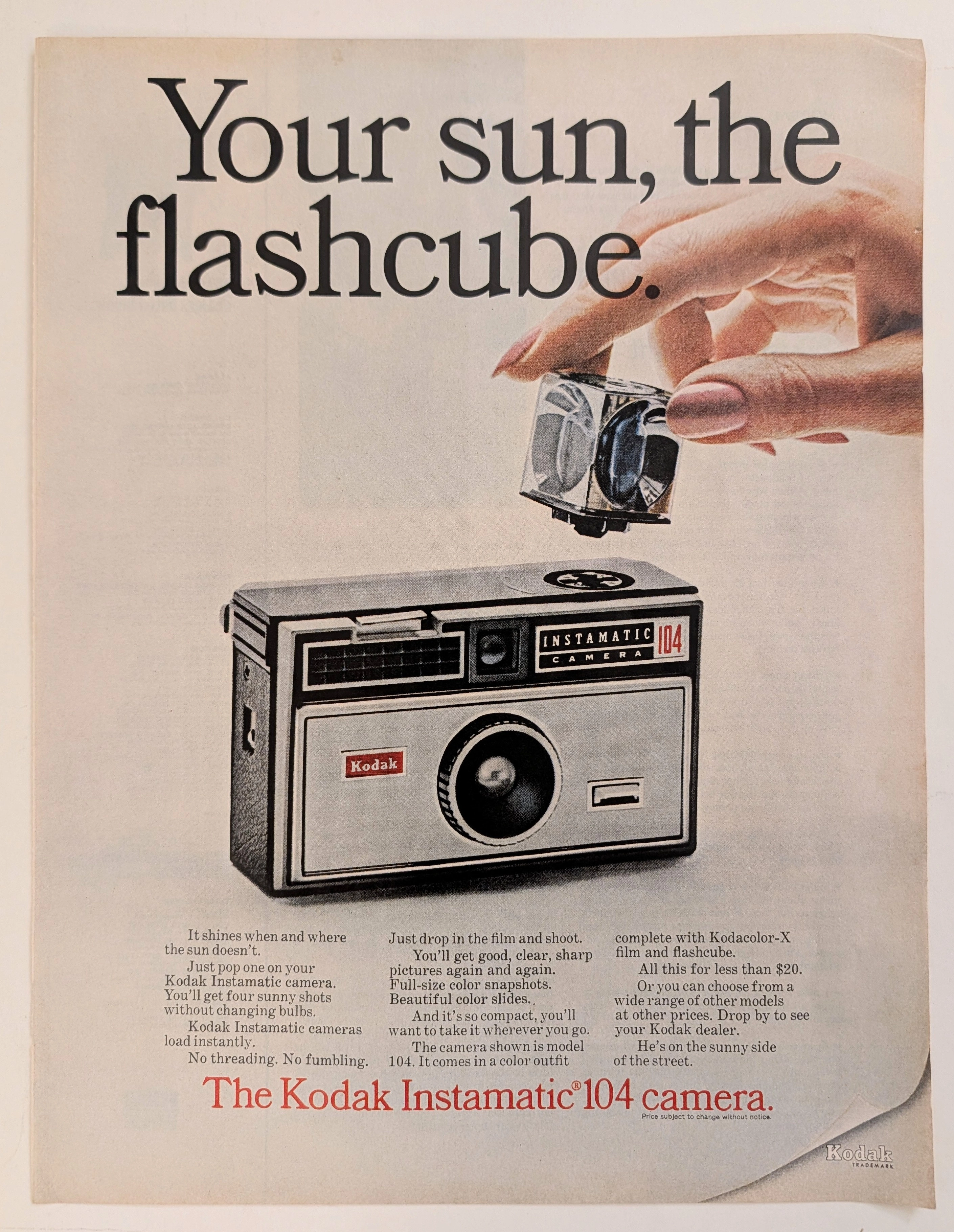
The evolution of the American domestic experience during the mid-twentieth century was inextricably linked to the ability of the average citizen to document it. The historical artifact elegantly and securely positioned upon the analytical table of The Record Institute today is a striking, full-page print advertisement for the Kodak Instamatic 104 camera, dating to the mid-1960s. This document completely transcends the standard boundaries of consumer electronics marketing. It operates as a highly sophisticated, multi-layered cultural and historical mirror, reflecting the precise era when the complexities of photographic chemistry and illumination were engineered out of existence, explicitly packaged, and sold to the American public not merely as a mechanical device, but as the effortless capturing of time itself. This world-class, comprehensive dossier conducts a meticulous, unyielding, and exceptionally deep examination of the artifact, operating under the absolute most rigorous parameters of historical, sociological, and material science evaluation. With our analytical focus dedicated overwhelmingly to its profound historical gravity (comprising 80% of our scholarly evaluation), we will decode the brilliant marketing psychology embedded within the "Your sun, the flashcube" narrative, analyze the immense sociological impact of George Eastman's legacy, and dissect the rich semiotics of the camera's accessible design. Furthermore, as we venture deeply into the chemical and physical foundations of this analog printed ephemera (10% focus), we will reveal the precise mechanical fingerprints of the CMYK halftone rosettes and the graceful, natural oxidation of the paper substrate. Finally, we will assess its archival significance (10% focus), exploring how this precise intersection of visual nostalgia, mid-century commercial artistry, and the immutable chemistry of time cultivates a serene wabi-sabi aesthetic—a natural, irreversible phenomenon that serves as the primary engine driving up its market value exponentially within the elite global spheres of Vintage Commercial Ephemera and Mid-Century Lifestyle collecting.
Timberland · Fashion
The Time Traveller's Dossier: Terrestrial Navigation – The Timberland Boat Shoe and the Evolution of Amphibious Footwear
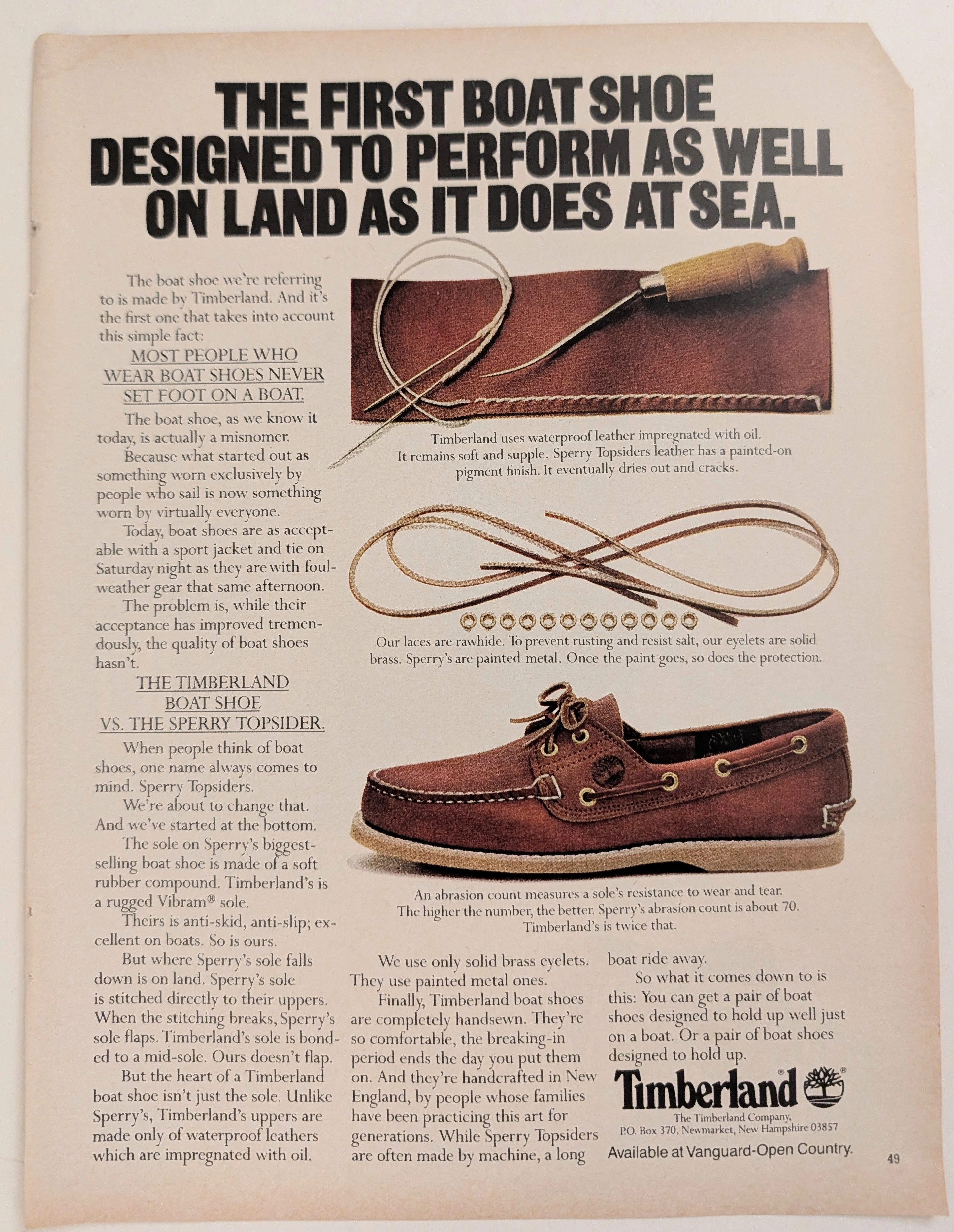
The evolution of twentieth-century American apparel is deeply intertwined with the adaptation of specialized, utilitarian gear for mainstream, terrestrial use. The historical artifact elegantly positioned upon the analytical table of The Record Institute today is a visually detailed and highly informative full-page print advertisement for The Timberland Boat Shoe. This document gracefully transcends the standard boundaries of footwear marketing. It operates as a highly sophisticated, multi-layered cultural mirror, reflecting a precise era in consumer sociology where the American public began integrating specialized sporting garments into their daily wardrobes. By utilizing a methodical, point-by-point comparative analysis against the established market leader, Sperry Topsider, The Timberland Company presented a scholarly and persuasive argument for superior material construction. This comprehensive dossier conducts a meticulous, nuanced, and exceptionally detailed examination of the artifact, operating under the most rigorous parameters of historical, sociological, and material science evaluation. Dedicating the overwhelming majority of our analytical focus (80%) to its immense historical gravity, we will decode the thoughtful marketing psychology embedded within the "land and sea" narrative, analyze the profound engineering differences highlighted in the construction of the shoe, and explore the sociological shift of maritime fashion into the suburban environment. Furthermore, as we venture deeply into the chemical and physical foundations of this analog printed ephemera (10%), we will reveal the precise mechanical fingerprints of the CMYK halftone rosettes captured in the macro imagery of the embossed leather. Finally, we will assess its archival rarity (10%), exploring how the graceful, natural oxidation of the paper substrate cultivates a serene wabi-sabi aesthetic—a natural, irreversible phenomenon that serves as the primary engine increasing its market value exponentially within the elite global spheres of Vintage Commercial Ephemera and Fashion Archives.
Ford · Automotive
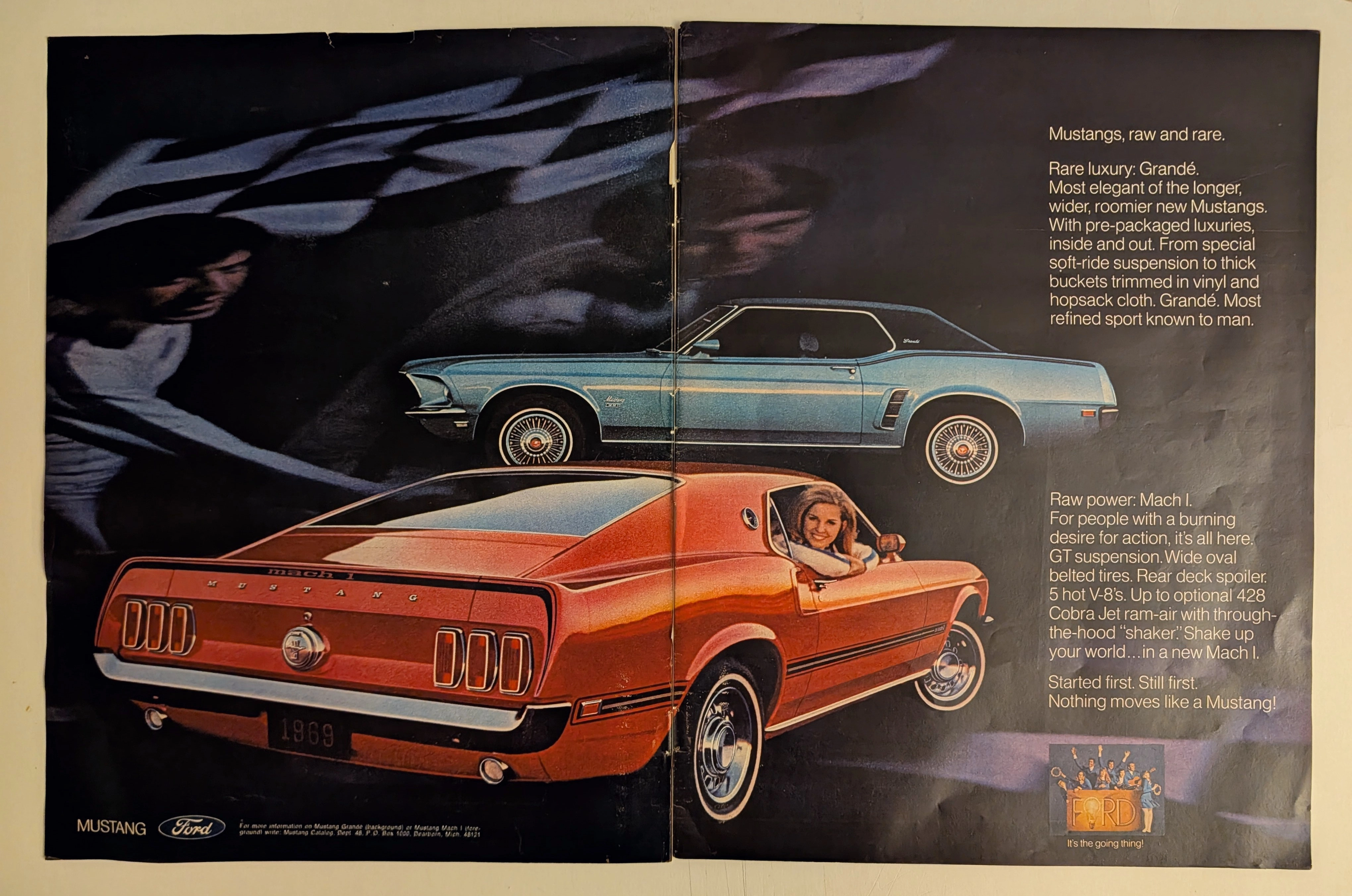
THE TIME TRAVELER'S DOSSIER:CULTURE WEAPONIZATION — "IT'S THE GOING THING"
The artifact under exhaustive, unprecedented museum-grade analysis is a profoundly preserved Historical Relic excavated from the absolute bloodiest battlefield of the American Muscle Car wars. This Primary Art Document is a monumental, two-page centerfold magazine advertisement for the 1969 Ford Mustang. Forensically and undeniably dated to 1969 by the explicit license plate stamped squarely on the rear bumper of the red Mach I, this document masterfully weaponizes Ford's dual-pronged sociological marketing strategy. It expertly captures the affluent bourgeoisie with the refined "Rare luxury" of the Grandé, while simultaneously ensnaring the rebellious, adrenaline-addicted youth with the "Raw power" of the Mach I. Grounded by extreme focal details like the iconic Mach 1 winged gas cap and the definitive 1960s pop-culture choir singing "FORD: It's the going thing!", this artifact's physical battle scars—specifically its authentic center crease and profound chemical paper degradation—elevate it to an irreplaceable Primary Art Document of Rarity Class A.